












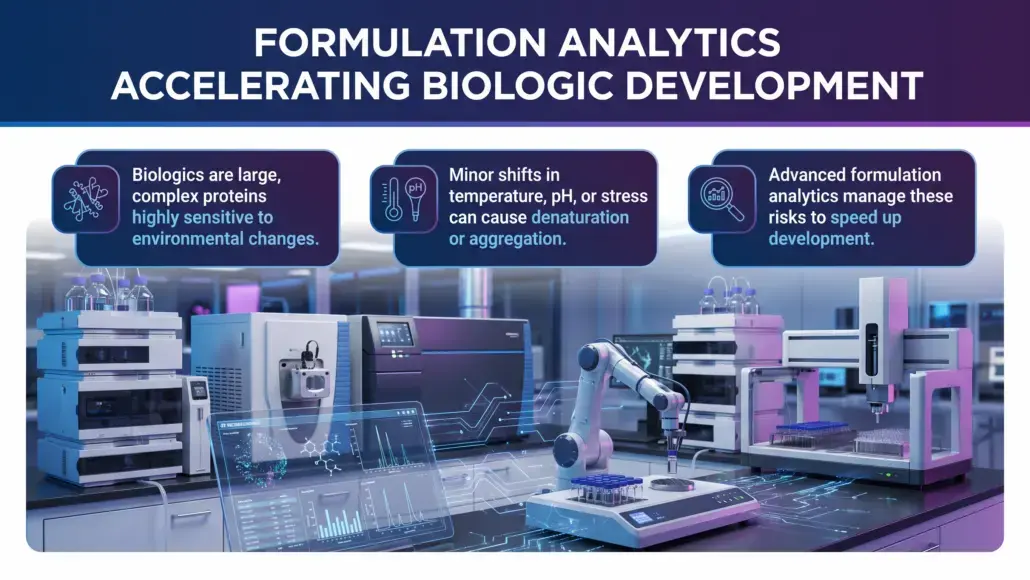
The development of biological drugs is an intricate process that requires a meticulous understanding of the physical and chemical properties of large, complex proteins. Unlike small molecules, biologics are highly sensitive to their environment, and even minor changes in temperature, pH, or mechanical stress can lead to denaturation or aggregation. To manage these risks, the industry has turned to formulation analytics accelerating biologic development, a discipline that combines advanced instrumentation with data-driven insights to optimize drug products. By identifying the most stable and effective formulations early in the development cycle, pharmaceutical companies can reduce the risk of clinical failure and expedite the path to regulatory approval. This analytical framework is essential for ensuring the safety, efficacy, and quality of modern biopharmaceuticals.
High-Throughput Screening and Predictive Stability Studies
One of the most significant advancements in formulation analytics accelerating biologic development is the implementation of high-throughput screening (HTS) platforms. These systems allow scientists to evaluate hundreds of different formulation conditions simultaneously, including variations in buffer type, pH, ionic strength, and excipient concentration. By using small volumes of protein, HTS enables the rapid identification of “hot spots” where the biologic is most susceptible to degradation. This early-stage data is invaluable for narrowing down the number of candidates that proceed to more intensive stability testing, saving significant time and resources.
Predictive stability studies complement HTS by using accelerated aging conditions to forecast the long-term behavior of a formulation. By exposing the biologic to elevated temperatures or agitation for short periods, researchers can gain insights into the degradation pathways that might occur over years of storage at refrigerated temperatures. Sophisticated mathematical models are then used to correlate these results with real-time stability data. The integration of these predictive tools allows formulation scientists to make informed decisions about the shelf life and storage requirements of a product long before the formal stability studies are completed. This proactive approach is a key component of the Quality by Design (QbD) philosophy, which emphasizes building quality into the product from the very beginning.
Advanced Characterization of Protein Aggregation and Sub-Visible Particles
Protein aggregation is a major concern in biologic development, as it can lead to reduced efficacy and increased immunogenicity. Aggregates can range in size from small dimers to large sub-visible and visible particles. Traditional techniques like Size Exclusion Chromatography (SEC) are excellent for detecting small soluble aggregates, but they may miss larger particles or those that dissociate under the pressure of the column. To provide a more comprehensive view, formulation analytics accelerating biologic development utilizes a suite of orthogonal techniques. This includes Dynamic Light Scattering (DLS) for measuring the size distribution of particles in the nanometer range and Nanoparticle Tracking Analysis (NTA) for visualizing and counting individual particles.
For larger particles, Flow Imaging Microscopy (FIM) has become a standard tool. Unlike light obscuration, which only measures the size and number of particles, FIM provides actual images of the particles, allowing scientists to distinguish between protein aggregates, silicone oil droplets, and air bubbles. This level of detail is critical for identifying the source of contamination and understanding the mechanical stresses that lead to particle formation. Furthermore, techniques like Circular Dichroism (CD) and Differential Scanning Calorimetry (DSC) are used to assess the secondary and tertiary structure of the protein. By monitoring the thermal melting point of the biologic in different formulations, researchers can identify the conditions that provide the greatest conformational stability.
Mass Spectrometry and Higher-Order Structure Analysis
As biologics become increasingly complex, with the rise of multi-specific antibodies and fusion proteins, the need for deep molecular characterization has never been greater. Mass spectrometry (MS) is a cornerstone of formulation analytics accelerating biologic development, providing detailed information about the primary structure, post-translational modifications, and chemical degradation products. Techniques such as Peptide Mapping and Intact Mass Analysis allow for the precise identification of oxidation, deamidation, and glycation events that can occur during storage. By quantifying these modifications, scientists can determine their impact on the biological activity of the drug.
Beyond the primary sequence, MS is also being used to probe the higher-order structure (HOS) of proteins. Hydrogen-Deuterium Exchange Mass Spectrometry (HDX-MS) is a powerful method for mapping the solvent accessibility and dynamics of a protein. By measuring the rate at which amide hydrogens exchange with deuterium in a heavy-water buffer, researchers can identify regions of the protein that are flexible or prone to unfolding. This information is vital for understanding how excipients interact with the protein surface and for comparing the structure of a biologic across different manufacturing scales or formulation changes. The ability to demonstrate structural similarity is a requirement for the approval of biosimilars, making HOS analysis a critical part of the regulatory landscape.
Regulatory Expectations and the Role of Process Analytical Technology
The regulatory environment for biologics is highly demanding, with agencies requiring extensive data to support the safety and consistency of the drug product. Formulation analytics accelerating biologic development provides the evidence needed to satisfy these requirements. Regulatory submissions must include a detailed characterization of the biologic, a justification for the choice of excipients, and a comprehensive stability profile. Agencies are increasingly looking for evidence of a mechanistic understanding of the product, rather than just empirical data. This has led to a greater emphasis on Process Analytical Technology (PAT), which involves the real-time monitoring and control of the manufacturing process.
PAT tools, such as in-line Raman spectroscopy or Near-Infrared (NIR) spectroscopy, allow for the continuous assessment of critical quality attributes during the filling and finishing stages. For instance, NIR can be used to monitor the moisture content of lyophilized products without destroying the vial. By integrating these analytical tools into the production line, manufacturers can identify deviations as they occur and make adjustments to ensure that every batch meets the required specifications. This real-time quality control reduces the risk of batch loss and ensures a steady supply of medicine to patients. As the industry moves toward continuous manufacturing for biologics, the role of advanced analytics will only become more prominent, serving as the bridge between development and commercial success.