













Close
CDMO Safety Testing 2026
Novotech

Magnetic Particles Steer the Vesicles for Drug Delivery

Note* - All images used are for editorial and illustrative purposes only and may not originate from the original news provider or associated company.

Subscribe

- Never miss a story with notifications

- Gain full access to our premium content

- Browse free from any location or device.

Media Packs

Expand Your Reach With Our Customized Solutions Empowering Your Campaigns To Maximize Your Reach & Drive Real Results!

โ€“ Access the Media Pack Now

โ€“ Book a Conference Call

โ€“ Leave Message for Us to Get Back

Related stories

Quantum Machine Learning in Pharma Research Growth

The convergence of artificial intelligence and quantum processing is opening new avenues for rapid discovery and innovation within the life sciences. By utilizing advanced mathematical models that operate across multi-dimensional datasets, researchers can now identify complex biological patterns and predict molecular behaviors with a speed that surpasses traditional computational methods. This transformation is accelerating the development of novel therapies and providing deeper insights into disease mechanisms, fundamentally altering the trajectory of pharmaceutical research and development.

Quantum Sensors Enabling Advanced Drug Diagnostics

The landscape of medical diagnostics is being reshaped by the introduction of sensing technologies that operate with atomic-level sensitivity. By providing high-fidelity measurements and real-time data, these tools allow for the detection of subtle biological changes and chemical markers that were previously invisible to conventional equipment. This advancement is enhancing the precision of drug testing and clinical monitoring, leading to earlier disease detection and more effective therapeutic interventions across the global healthcare spectrum.

Quantum Computing Optimizing Pharma Supply Chains

The global distribution of pharmaceutical products is facing unprecedented challenges that demand a new level of logistical precision and resilience. By utilizing advanced analytical models, companies can now navigate complex international networks with greater efficiency, ensuring that temperature-sensitive medicines and life-saving therapies reach their destinations without delay. This evolution toward a more intelligent and responsive supply chain is critical for maintaining public health and responding effectively to emerging medical needs on a global scale.
- Advertisement -

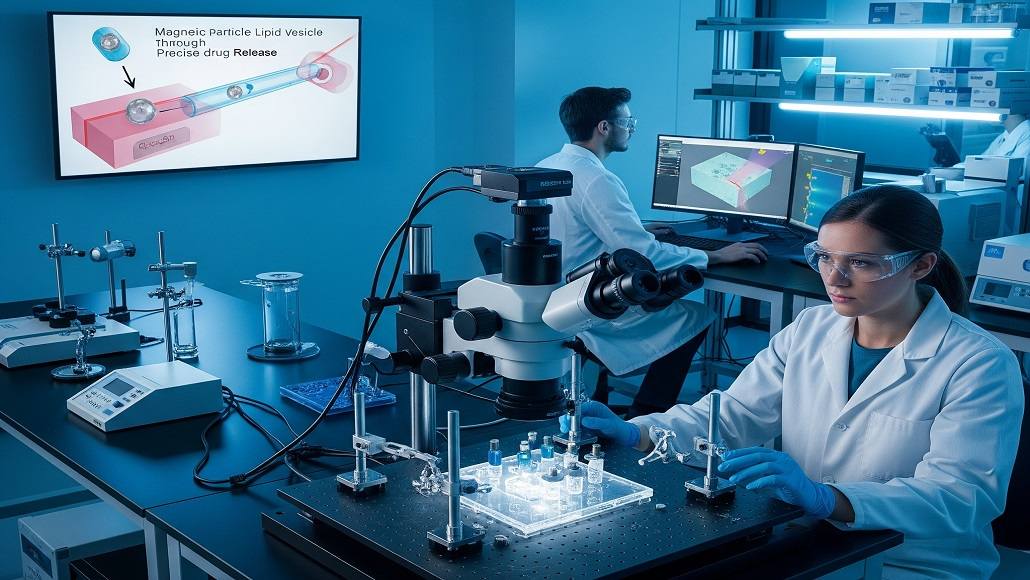
Researchers have gone on to demonstrate that microscopic drug delivery containers can get magnetically steered to their objectives, thereby advancing the development when it comes to precision medicine for the treatment of diseases like cancer. A multi-university team, which was led by Jie Feng, who happens to be a professor of mechanical science and engineering at Grainger College of Engineering at the University of Illinois, happened to demonstrate that magnetic particles steer the vesicles by way of fluids.

This work, which has been published in the Royal Society of Chemistry journal named Nanoscale, happens to build on earlier results that showed that lipid vesicles can get engineered in order to release drugs when illuminated with the laser light. The resulting system, which combines both the results, happens to be a comprehensive prototype in terms of precision and also targeted drug delivery.

Feng went on to note that the present medical technologies like MRI can be repurposed in order to steer drug delivery vehicles with their magnetic fields, specifically since these fields get designed in order to penetrate within the human body. This can indeed be achieved by way of encapsulating a superparamagnetic particle in the drug delivery vehicle so that it interacts with the magnetic field, which is externally controlled.

It is well to be noted that the first step when it comes to creating magnetically steerable lipid vesicles was developing a dependable method so as to encapsulate magnetic particles within the vesicles. One of the graduate students at Graingerย Engineering in Fengโ€™s laboratory, Vineet Malik, who also happens to be the studyโ€™s lead author, went on to use the method of inverted emulsion wherein the magnetic particles get added to a solution of dissolved lipids, thereby leading to lipid droplets getting formed around the particles.

As per Malik, it was indeed not obvious what the best way to encapsulate lipid particles was going to be, so there was a large literature search, and there was also some trial and error as well. He added that they had to determine what the best magnetic particle size would be, and then they had to figure out that the inverted emulsion methodology gives out the highest yields for encapsulated particles.

After this, the researchers went onย to demonstrate that magnetic fields could very well direct the lipid vesicles. Malik developed a 3-D printable platform so as to mount the magnets securely on a microscope and then to place the vesicles in a solution between the magnets. By way of observing the resulting motion, the researchers went on to observe how the speed was distinct with the ratio of magnetic particle size to the vesicle size. They also confirmed that the vesicles only released their cargo when illuminated along with laser light post moving to the end of the microfluidic channel.

While all these experiments went on to show that lipid vesiclesย moved as anticipated in magnetic fields, it was indeed required to also gauge how the magnetic particles steer the vesicles from within so as to understand the behavior of the entire device.

Apparently, the researchers collaborated with investigators at Santa Clara University to computationally study the internal dynamics of the vesicle in order to anticipate the motion speed. By way of using the latest Boltzmann method, they went on to observeย how the magnetic particle drags the entire vesicleย when moving throughย a magnetic field.

Malik remarked that it enabled them to expand their experiment since it is otherwise pretty steep in order to observe or anticipate the response of such a kind of vesicle system. He further said that it gives them the predictive power that will enhance the design guidelines and also enable them to understand the physical mechanisms that are governing the motion.

Fengโ€™s Laboratory, which is armed with experimental demonstrations when it comes to light-induced drug release as well as magnetic steering, now looks forward to beginning the in vitro studies, which demonstrate that a lipid vesicle can get magnetically steered to certain specific locations by way of fluids like human blood.

Feng saidย that their combined results happen to lay theย foundation of a very comprehensive precision drug delivery system, and they are set to explore the potential uses when it comes to the treatment. He also added that they are working towards the next step by way of using a real drug and performing an in vitro study in a microfluidic system, which simulates the biological environment’s features.


Latest stories

Related stories

Quantum Machine Learning in Pharma Research Growth

The convergence of artificial intelligence and quantum processing is opening new avenues for rapid discovery and innovation within the life sciences. By utilizing advanced mathematical models that operate across multi-dimensional datasets, researchers can now identify complex biological patterns and predict molecular behaviors with a speed that surpasses traditional computational methods. This transformation is accelerating the development of novel therapies and providing deeper insights into disease mechanisms, fundamentally altering the trajectory of pharmaceutical research and development.

Quantum Sensors Enabling Advanced Drug Diagnostics

The landscape of medical diagnostics is being reshaped by the introduction of sensing technologies that operate with atomic-level sensitivity. By providing high-fidelity measurements and real-time data, these tools allow for the detection of subtle biological changes and chemical markers that were previously invisible to conventional equipment. This advancement is enhancing the precision of drug testing and clinical monitoring, leading to earlier disease detection and more effective therapeutic interventions across the global healthcare spectrum.

Quantum Computing Optimizing Pharma Supply Chains

The global distribution of pharmaceutical products is facing unprecedented challenges that demand a new level of logistical precision and resilience. By utilizing advanced analytical models, companies can now navigate complex international networks with greater efficiency, ensuring that temperature-sensitive medicines and life-saving therapies reach their destinations without delay. This evolution toward a more intelligent and responsive supply chain is critical for maintaining public health and responding effectively to emerging medical needs on a global scale.

Quantum security strengthening pharma data protection

Protecting sensitive patient information and proprietary research data is becoming a critical priority as the pharmaceutical industry navigates an increasingly complex digital landscape. By integrating advanced cryptographic methods and secure communication protocols, researchers can ensure the integrity of their clinical findings and the privacy of those involved in medical trials. This shift toward a more resilient digital infrastructure is essential for maintaining public trust and fostering global collaboration in the pursuit of life-saving therapeutic breakthroughs.

Subscribe

- Never miss a story with notifications

- Gain full access to our premium content

- Browse free from any location or device.

Media Packs

Expand Your Reach With Our Customized Solutions Empowering Your Campaigns To Maximize Your Reach & Drive Real Results!

โ€“ Access theMedia Pack Now

โ€“ Book a Conference Call

โ€“ Leave Message for Us to Get Back

Translate ยป