













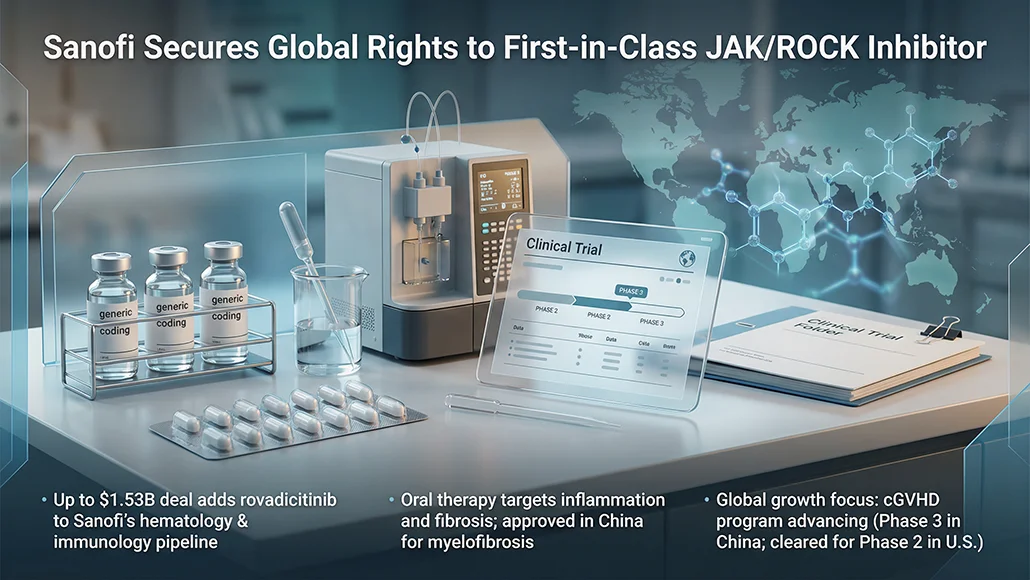
Sanofi has committed up to $1.53 billion to obtain global rights to a novel therapy from Sino Biopharmaceutical, adding a first-in-class JAK/ROCK inhibitor to its hematology and immunology pipeline. The French pharmaceutical group will make an upfront payment of $135 million to Chia Tai Tianqing Pharmaceutical (CTTQ), a subsidiary of Sino Biopharm, to secure exclusive global rights to rovadicitinib, according to a securities filing (PDF). Beyond the initial payment, Sanofi has pledged up to $1.395 billion in potential development, regulatory and sales milestones, as well as up to double-digit tiered royalties based on the net sales of rovadicitinib. The oral therapy represents the first inhibitor designed to target both JAK and ROCK pathways, enabling anti-inflammation and anti-fibrosis effects. In February, rovadicitinib received its first approval from Chinese authorities for the treatment of patients with certain forms of myelofibrosis, a rare blood cancer.
Although the drug’s first authorization focuses on myelofibrosis, Sino Biopharm indicated that its broader global potential lies in chronic graft-versus-host disease. A phase 3 study in cGVHD is already underway in China, while the FDA has cleared the therapy to enter phase 2 trials in the U.S. “Through this partnership, Sanofi a global leader in vaccines, immunology, and rare diseases will leverage its global clinical and commercial infrastructure to unlock rovaciditinib’s international potential and maximize its long-term value,” Sino Biopharm said in a March 4 release (local time) provided to Fierce Pharma. The agreement also expands Sanofi’s specialty care portfolio and mirrors its recent acquisition of Blueprint Medicines, a 2025 deal valued at up to $9.5 billion that added Ayvakit, a commercial product for the rare blood disorder of systemic mastocytosis (SM), along with a next-generation SM candidate and an early-stage KIT inhibitor with potential in immunology indications.
Mechanistically, rovadicitinib works by inhibiting the JAK1/2-STAT3/5 signaling pathway, which reduces inflammatory cytokines produced by myeloid cells and helps relieve abnormal spleen enlargement and systemic inflammatory symptoms. At the same time, blocking ROCK1/2 lowers overactivated helper T cells while enhancing regulatory T cell function, strengthening its anti-inflammatory activity, according to Sino Biopharm. In a clinical trial conducted in China, the therapy demonstrated stronger spleen responses than hydroxyurea among patients with intermediate-2 or high-risk myelofibrosis. At Week 24, 58% of patients treated with rovadicitinib achieved at least a 35% reduction in spleen volume compared with baseline, versus 23% in the hydroxyurea group. Regarding symptom relief, 61% of patients receiving rovadicitini achieved at least a 50% reduction in total symptom score at Week 24, compared with 46% in the comparator arm.
Additional data highlighting the drug’s potential in cGVHD were released a year ago from a Phase 1b/2a study. Among 44 patients treated with two different doses of rovadicitini, the best overall response rate reached 86.4%. The 12-month failure-free survival rate was 85.2%, which Sino Biopharm noted is “significantly superior to approved therapies.” Investigators also reported favorable safety findings, describing the therapy as “well tolerated” with no dose-limiting toxicity, and confirming that no drug-related adverse events led to discontinuation. For Sino Biopharm, the agreement represents its first major innovative drug out-licensing deal with a Big Pharma partner in recent years. More than a decade ago, CTTQ collaborated with Johnson & Johnson on a treatment for hepatitis B. More recently, Sino Biopharm subsidiaries have transferred rights to Western biotech partners, including a January agreement in which Chia Tai Feng Hai Pharmaceutical granted ex-China rights to an autoimmune candidate targeting miR-124 to Formation Bio.