









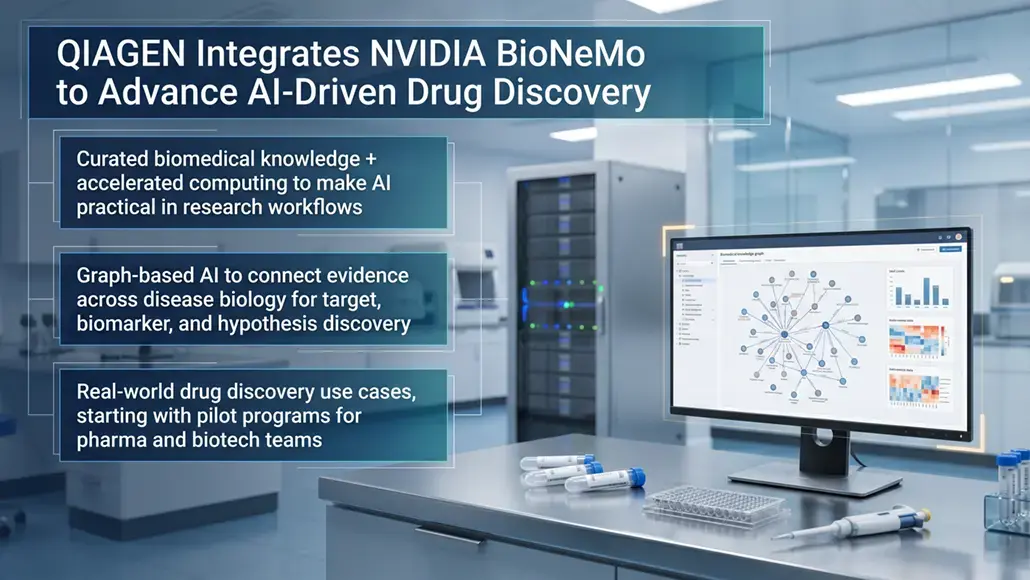
QIAGEN’s Digital Insights bioinformatics division is set to integrate NVIDIA’s accelerated computing infrastructure and the BioNeMo platform to strengthen AI-driven drug discovery capabilities for pharmaceutical and biotechnology researchers. The collaboration aims to make AI more actionable in research settings by combining advanced bioinformatics tools with curated biomedical knowledge bases.
The partnership is designed to help research teams develop a deeper understanding of disease biology, pinpoint promising therapeutic targets, and uncover biomarkers that can support the development of new medicines.
At the core of the collaboration is the application of graph-based AI, which uses retrieval and reasoning methods over biomedical knowledge graphs. This approach enables researchers to explore evidence across complex biological systems and supports the creation of agentic, multi-step workflows throughout the AI-driven drug discovery process.
Nitin Sood, Senior Vice President and Head of Product Portfolio and Innovation at QIAGEN, stated: “QIAGEN Digital Insights has spent more than 25 years building the biomedical knowledge foundation that researchers rely on to interpret complex biology. Through this collaboration with NVIDIA, we can accelerate the impact of that knowledge by combining it with advanced AI to help customers improve critical steps in drug discovery, from target identification to biomarker research and hypothesis generation.”
The collaboration is oriented around concrete, real-world applications across the drug discovery pipeline. These include target identification and validation, drug repurposing, biomarker discovery, pathway analysis, and hypothesis generation using multi-omics data.
By bringing together curated biomedical knowledge, graph-based AI, and NVIDIA’s accelerated computing capabilities, QIAGEN seeks to equip research teams with the means to convert complex biological data into well-informed discovery decisions. The integration of pharmaceutical AI at this scale reflects the growing demand for intelligent, knowledge-driven tools in life sciences research.
Initial pilot programmes will be made available to select partners in the pharmaceutical and biotechnology sectors. A broader rollout is planned following the validation phase, with the initiative positioned to extend the benefits of bioinformatics-powered, AI-driven drug discovery to a wider research community.
The QIAGEN and NVIDIA collaboration underscores how biomedical knowledge graphs and advanced AI frameworks are becoming central to modern drug discovery workflows, offering research-driven organisations new pathways to address some of the most complex challenges in life sciences.