










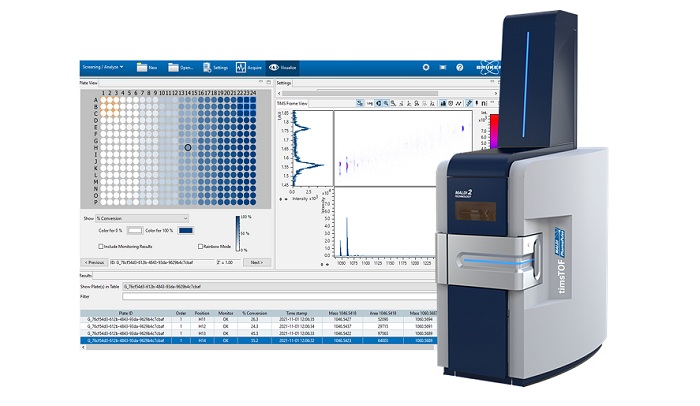
At the 71st ASMS meeting, Bruker Corporation announced transformative sensitivity on the 4D-Proteomics timsTOF platform with the launch of the new timsTOF Ultra mass spectrometer. It incorporates a new Captive Spray Ionization (CSI) Ultra ion source with larger capillary and optimized vortex gas flow, a novel 4th-generation TIMS (trapped ion mobility separation) XR cell and 14bit digitizer. The timsTOF Ultra can identify over 55K peptides that map into 5000 protein groups at the single-cell level of 0.125 ng protein loading, at 1% FDR, and over 4800 protein groups quantified at CVs of <20%. This breakthrough sensitivity and quantitation performance below the 1 ng protein load level sets a new benchmark. Unparalleled sensitivity, with the proven robustness of the timsTOF platform, and with PASEF duty cycle now up to 300 Hz for MS/MS, offers significant further performance improvements for ultra-low sample amounts, including unbiased single-cell proteomics and single-cell lipidomics, unbiased spatial proteomics, immunopeptidomics, phosphoproteomics, PTM analysis, and protein-protein interaction (PPI) studies.
Dr. Fabian Coscia, Group Leader for Spatial Proteomics at the Max Delbruck Center, Berlin, Germany, said: “The single-cell sensitivity dia-PASEF workflow on the timsTOF Ultra has brought our low-input tissue proteomics research to a new level. Using a 20-min nanoflow LC gradient combined with Bruker’s optimized dia-PASEF (3×8 window) method, we can now reproducibly quantify 1,500 – 2,000 proteins from laser micro-dissected mouse liver FFPE tissue of only 1,500 µm2, regions corresponding to approximately 1-2 hepatocytes.”
These timsTOF Ultra advances have been achieved without compromising the excellent robustness for high-throughput proteomics, e.g., at 50 samples per day (SPD), or even up to 398 SPD, nor the highest identification confidence of <1% peptide and <1% protein FDRs (false discovery rates), avoiding the cross-reactivity seen with targeted immune-recognition methods.
Professor Dr. Karl Mechtler, Proteomics Head at the Innovation Hub of the Research Institute for Molecular Pathology (IMP), Gregor Mendel Institute (GMI), and the Institute of Molecular Biotechnology of the Austrian Academy of Sciences (IMBA), added: “To truly understand cellular mechanisms and diseases, it’s crucial to differentiate between the various cell types. While single-cell analysis has been game-changing, we face obstacles in maximizing its potential for throughput and proteins groups that can be analyzed. It would make biological sense to detect 6000 or more proteins in a single-cell experiment. The timsTOF Ultra has overcome these barriers, allowing us to explore the proteome of individual cells at speed and unparalleled sensitivity. Thanks to the timsTOF Ultra, single-cell analysis has reached new heights, and I’m excited to see where this breakthrough will lead us next.”
Bruker also introduces VistaScan software for synchronizing TIMS ramp with the quadrupole scan to further benefit from ion mobility information at scale. This sophisticated dynamic linked-ramp supports the novel midia-PASEF mode, introduced by Stefan Tenzer
Dr. Stefan Tenzer, Professor for Quantitative Proteomics and Head of MS Core Facility, Johannes Gutenberg University Mainz, commented: “Our laboratory focuses on methods for quantitative proteomics that require highest sensitivity and highest information extraction. Together with Bruker, we have developed the novel maximum information dia (midia) PASEF scanning acquisition mode which offers sensitivity of data-independent acquisition (dia), while transforming data into data-dependent acquisition (dda)-like spectra. The midia-PASEF potential for immunopeptidomics and phosphoproteomics is particularly exciting.”
Bruker has exclusively licensed midia-PASEF from Johannes Gutenberg University Mainz and plans to release midia-PASEF as a product in 2023. The timsTOF Ultra is equipped with the required VistaScan acquisition capabilities.
In addition, the timsTOF Ultra features a further improved dda-PASEF acquisition mode, increasing the speed to 300 Hz for up to 18,000 collision cross-section (CCS)-enabled MS/MS spectra per minute to enable in-depth 4D-Proteomics and 4D-Lipidomics / 4D-Metabolomics with very short LC gradients of just minutes.