













The supplement industry has experienced exponential growth over the past decade, with consumers becoming increasingly discerning about the quality and purity of the products they consume. As nutritional supplements have evolved from niche products to mainstream health essentials, questions about manufacturing standards have come to the forefront. One of the most frequently debated topics is the distinction between pharma grade and food grade supplement powders, and whether these classifications represent genuinely different production processes or merely marketing terminology.
Understanding the difference between these grades is crucial for consumers, healthcare professionals, and manufacturers alike. The distinction affects not only the final quality of the product but also its safety, efficacy, and price point. This article explores the fundamental differences in how pharma grade and food grade supplement powders are produced, the regulatory frameworks governing each, and what these distinctions mean for end users.
Defining the Grades: What Do These Terms Actually Mean?
Before delving into production differences, it’s essential to establish what “pharma grade” and “food grade” actually signify. Food grade ingredients are those deemed safe for human consumption and produced according to food safety standards. These standards vary by country but generally ensure that products are free from harmful contaminants and are safe when used as intended.
Pharma grade, conversely, refers to ingredients manufactured according to pharmaceutical standards, which are considerably more stringent. In many jurisdictions, truly pharma grade substances must meet pharmacopoeia standards comprehensive references that establish quality benchmarks for pharmaceutical ingredients. These include the United States Pharmacopeia (USP), European Pharmacopoeia (Ph. Eur.), and British Pharmacopoeia (BP).
However, it’s worth noting that the term “pharma grade” isn’t always legally regulated in the supplement industry, which has led to some manufacturers using it as a marketing term rather than a verified certification. This ambiguity makes understanding actual production differences even more important.
Raw Material Sourcing and Purity Standards
The most significant difference between pharma grade and food grade supplement powders like Life Powders begins at the source raw material selection and purity requirements.
Pharma grade powders typically require raw materials with purity levels of 99% or higher, with strict limits on specific impurities and contaminants. The sourcing process for these materials involves rigorous vendor qualification, where suppliers must demonstrate compliance with Good Manufacturing Practices (GMP) specific to pharmaceuticals. Each batch of raw material undergoes extensive testing using validated analytical methods before acceptance.
Food grade supplements, whilst still required to be safe, may permit lower purity thresholds. The acceptable level of impurities is generally higher, and whilst reputable manufacturers still test their raw materials, the depth and frequency of testing may not match pharmaceutical standards. This doesn’t necessarily render food grade supplements unsafe or ineffective, but it does mean there’s greater variability in the final product composition.
The documentation requirements also differ substantially. Pharma grade raw materials come with detailed Certificates of Analysis (CoA) that specify exact composition, potential contaminants, and test results for multiple quality parameters. Food grade materials may have simpler documentation that confirms basic safety and composition without the exhaustive detail required for pharmaceutical applications.
Manufacturing Environment and Facility Standards
The production environment represents another critical area of distinction between pharma grade and food grade supplement manufacturing.
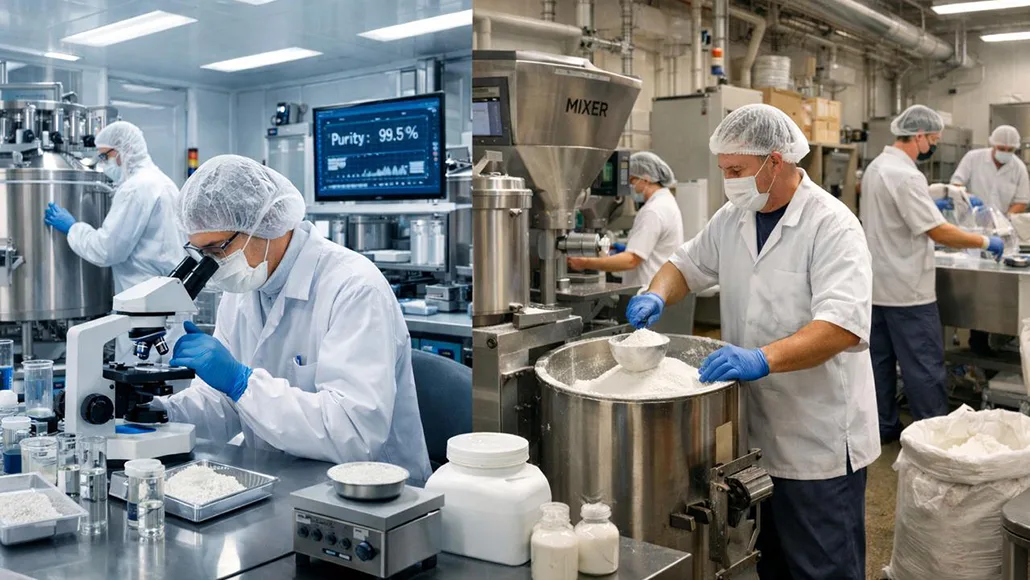
Pharmaceutical-grade facilities operate under stringent environmental controls. These include controlled air quality with HEPA filtration systems, positive air pressure rooms to prevent contaminant entry, and classified clean rooms where air particle counts are strictly monitored and limited. Temperature and humidity are precisely controlled and continuously monitored, with deviations triggering immediate investigation and potential batch rejection.
Personnel working in pharma grade facilities follow rigorous hygiene protocols, including gowning procedures, restricted access areas, and extensive training in contamination prevention. The facilities themselves undergo regular validation to ensure all systems function as intended, and equipment is subject to qualification protocols before use.
Food grade facilities like Engineered Muscle, whilst maintaining good hygiene standards, typically operate with less stringent environmental controls. Standard food manufacturing practices focus primarily on preventing microbial contamination and ensuring basic cleanliness, but the level of environmental monitoring and control doesn’t match pharmaceutical standards. This isn’t inherently problematic for food-grade supplements, as the risk profile differs from pharmaceutical products, but it does represent a genuine production difference.
Quality Control and Testing Protocols
Perhaps nowhere is the difference between pharma grade and food grade production more apparent than in quality control measures.
Pharmaceutical-grade supplement production involves in-process testing throughout manufacturing. Samples are taken at multiple stages, and production doesn’t proceed until each stage passes predetermined quality criteria. Final products undergo extensive analytical testing including identity verification, potency assays, dissolution testing, and comprehensive screens for contaminants such as heavy metals, pesticides, microbial contaminants, and residual solvents.
These tests utilise validated analytical methods, meaning the testing procedures themselves have been proven to reliably and accurately measure what they claim to measure. Method validation is a time-consuming and expensive process, but it ensures test results are trustworthy.
Food grade supplement testing, whilst increasingly comprehensive among reputable manufacturers, may not include the same breadth of testing or use fully validated methods. Some manufacturers test only finished products rather than implementing in-process controls, and the range of contaminants screened may be more limited. Again, this doesn’t mean food grade supplements are unsafe, but the level of quality assurance is different.
Documentation and Traceability
Pharma grade production operates under the principle that if something isn’t documented, it didn’t happen. This philosophy drives extensive record-keeping requirements that create complete traceability from raw materials through to finished products.
Batch records in pharmaceutical facilities document every step of production, including who performed each operation, when it occurred, what equipment was used, and all in-process test results. These records are reviewed by quality assurance personnel before batch release, and deviations from standard procedures must be investigated and documented.
Environmental monitoring records, equipment maintenance logs, cleaning validation, and stability studies all form part of the comprehensive documentation package that accompanies pharma grade production.
Food grade production typically involves less extensive documentation. Whilst basic batch records are maintained, the level of detail and the oversight procedures may be less rigorous. Traceability exists but may not extend to the same granular level as pharmaceutical production.
Stability Testing and Shelf-Life Determination
The approach to determining product shelf-life differs substantially between pharma grade and food grade production.
Pharmaceutical standards require formal stability studies conducted under controlled conditions. Products are stored at various temperatures and humidity levels, and samples are tested at predetermined intervals to assess degradation. Only after stability data demonstrates that the product maintains its specification throughout the proposed shelf-life can that shelf-life be claimed.
Food grade supplements may determine shelf-life through less formal means, potentially using industry standards, literature data, or abbreviated testing. Whilst responsible manufacturers conduct some stability assessment, it may not reach the rigour of pharmaceutical stability protocols.
Cost Implications and Market Positioning
These production differences inevitably affect costs. Pharma grade production requires more expensive facilities, more extensive testing, more detailed documentation, and highly trained personnel. These costs are reflected in higher prices for pharma grade supplements.
Food grade production, with less stringent requirements, can be more economical whilst still producing safe, effective products. For many consumers and applications, food grade supplements represent excellent value and entirely adequate quality.
Conclusion
The distinction between pharma grade and food grade supplement powders is not merely marketing rhetoric genuine differences exist in production processes, quality control, and final product characteristics. Pharma grade production implements pharmaceutical manufacturing standards including higher purity requirements, stricter environmental controls, more comprehensive testing, and extensive documentation. Food grade production, whilst still subject to safety regulations, operates under less stringent requirements.
However, it’s crucial to recognise that food grade doesn’t mean inferior or unsafe. Many food grade supplements are excellent products manufactured by responsible companies. The choice between pharma grade and food grade should consider the intended use, individual needs, and budget constraints. For therapeutic applications or individuals with specific health concerns, pharma grade products may offer additional assurance. For general nutritional supplementation, quality food grade products often serve perfectly well.
Ultimately, consumers should look beyond simple grade classifications and examine actual manufacturer practices, third-party testing, and transparency. Reputable companies, whether producing pharma grade or food grade supplements, will willingly share information about their manufacturing standards, testing protocols, and quality commitments.