














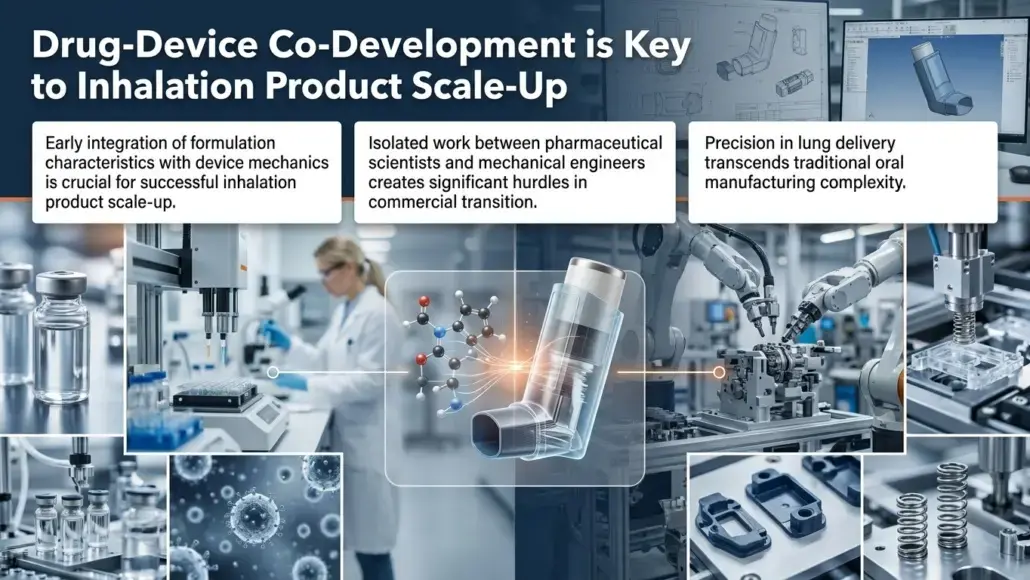
The complexity of delivering active pharmaceutical ingredients to the lungs requires a level of precision that transcends traditional oral dosage manufacturing. Achieving successful inhalation product scale-up depends on the early integration of formulation characteristics with device mechanics. When pharmaceutical scientists work in isolation from mechanical engineers, the transition from pilot batches to commercial volume often encounters significant hurdles. The physical properties of the formulation, such as viscosity, surface tension, and particle size distribution, must be perfectly calibrated to the specific internal geometry of the delivery system. This alignment ensures that the aerosol plume remains consistent even as production speeds increase and batch sizes expand. Engineers focus on the fluid dynamics within the device, while chemists analyze the stability and solubility of the drug. By establishing a shared set of performance parameters, the team can identify potential failure points before they manifest in large-scale production. For instance, a formulation that performs adequately in a manual filling process might exhibit instability or clogging when subjected to the high-pressure filling systems used in commercial manufacturing. Addressing these variables through a unified development framework reduces the risk of costly delays and ensures that the final product meets the stringent requirements of regulatory agencies. The adoption of Quality by Design principles further strengthens the co-development process. This methodology involves defining the desired product performance and identifying the critical quality attributes that influence the final therapeutic outcome. In the context of inhalation therapies, this means understanding how variations in raw materials or manufacturing conditions impact the delivered dose. By mapping the design space for both the drug and the device, manufacturers can create a more resilient production process that accommodates minor fluctuations without compromising patient safety. This level of foresight is essential for navigating the transition from clinical trials to the global market.
Technical Hurdles in Aerodynamic Performance Validation
As production volumes increase, maintaining the aerodynamic profile of the inhaled drug becomes increasingly difficult. The fine particle fraction, which represents the portion of the dose capable of reaching the deep lung, is highly sensitive to changes in manufacturing environment. During the expansion of production lines, factors such as ambient humidity, temperature, and even the vibration of the assembly line can alter the performance of the device. Consequently, pharmaceutical companies must invest in sophisticated testing protocols that replicate real-world usage scenarios while monitoring for deviations in plume geometry and droplet size. Validation of these performance metrics requires a combination of laboratory testing and computer modeling. Computational fluid dynamics can simulate how the aerosol travels through the device and into the human respiratory tract, providing valuable insights into how formulation changes might affect deposition patterns. These models allow developers to test thousands of iterations virtually, significantly speeding up the development timeline. However, virtual models must be supported by empirical data derived from standardized testing equipment, such as Next Generation Impactors or Andersen Cascade Impactors. These tools measure the mass distribution of the drug across different particle size ranges, providing a definitive assessment of the product quality. The challenge of validation is compounded when scaling up for international markets. Different regions may have varying regulatory expectations regarding the frequency and type of testing required for batch release. A robust co-development strategy accounts for these differences by building a comprehensive data package that addresses global standards. This includes long-term stability studies that assess how the drug-device combination performs over its shelf life in diverse climates. By ensuring that the device hardware remains compatible with the chemical properties of the drug throughout the product lifecycle, manufacturers can maintain a consistent supply of high-quality respiratory treatments.
Optimizing Manufacturing Infrastructure for Inhalation Systems
The physical infrastructure required for inhalation product scale-up is significantly different from that used for tablets or capsules. Cleanroom environments must be strictly controlled to prevent contamination and manage the specific requirements of aerosolized medications. This often involves specialized filling equipment designed to handle high-potency drugs with minimal waste. The precision required for meter-valve assembly or dry powder filling necessitates advanced automation and real-world monitoring systems. These technologies provide immediate feedback on the consistency of the fill weight and the integrity of the device seal, allowing for real-time adjustments to the production line. Investment in automated assembly lines not only improves efficiency but also reduces the potential for human error. In the production of pressurized metered-dose inhalers, for example, the crimping of the valve onto the canister is a critical step that dictates the leak rate and the shelf life of the product. Automated systems can apply uniform pressure and verify the quality of every crimp, ensuring that no substandard units reach the market. Similarly, for dry powder systems, the precision of the blister filling or capsule loading process is paramount. Any variation in the amount of powder can lead to inconsistent dosing, which directly impacts the therapeutic efficacy of the medication. Efficient manufacturing also requires a close relationship with component suppliers. The materials used in the construction of the device, such as plastics, elastomers, and metals, must be of the highest medical grade and compatible with the drug formulation. Any leaching or adsorption between the drug and the device materials could degrade the active ingredient or introduce impurities. By involving suppliers in the inhalation product scale-up process, pharmaceutical companies can ensure a steady supply of high-quality components that meet their specific technical requirements. This collaborative approach minimizes supply chain risks and supports the long-term sustainability of the manufacturing process.
Regulatory Considerations and Compliance Pathways
Navigating the regulatory environment is perhaps the most complex aspect of bringing a new inhalation product to market. Regulatory bodies like the Food and Drug Administration and the European Medicines Agency view inhalation therapies as combination products, requiring simultaneous evaluation of both the drug and the device. This dual scrutiny means that any change in the device design or the manufacturing process during inhalation product scale-up must be supported by comprehensive data demonstrating bioequivalence and safety. The use of the 505(b)(2) pathway in the United States or similar hybrid applications in Europe can streamline this process by referencing existing data for known drugs, but the burden of proof regarding the device performance remains high. Documentation is a vital component of regulatory compliance. Manufacturers must maintain detailed records of every step in the development and manufacturing process, from initial design concepts to final batch testing. This technical file serves as evidence that the company has followed current Good Manufacturing Practices and has established a robust quality management system. During inspections, regulatory authorities will closely examine these records to ensure that the inhalation product scale-up has been conducted in a controlled and validated manner. Any gaps in the documentation can lead to significant delays or even the rejection of the marketing application. Furthermore, the evolving regulatory focus on environmental sustainability is adding new layers of complexity to the manufacturing process. The transition away from high-global-warming-potential propellants in metered-dose inhalers requires significant changes to both the formulation and the device hardware. Manufacturers must demonstrate that the new, more sustainable propellants deliver the drug with the same efficacy as the traditional options. This transition involves a complete re-evaluation of the inhalation product scale-up strategy, highlighting the ongoing need for drug-device co-development. By staying ahead of these regulatory trends, pharmaceutical companies can ensure that their products remain compliant and accessible to patients worldwide.
Improving Patient Outcomes through Integrated Design
The ultimate goal of any pharmaceutical development project is to improve patient health, and inhalation products are no exception. A device that is difficult to use or inconsistent in its delivery will inevitably lead to poor treatment adherence and suboptimal outcomes. Integrated design focuses on the ergonomics and usability of the inhaler, ensuring that patients of all ages and physical abilities can receive their medication effectively. This includes features such as low-resistance airflows for dry powder inhalers or easy-to-read dose counters for metered-dose systems. By simplifying the user experience, manufacturers can increase the likelihood that the drug is delivered correctly to the lungs. Patient feedback should be incorporated into the development process as early as possible. Human factors studies can identify common user errors and allow engineers to refine the device design to mitigate these risks. For example, if patients struggle to coordinate their breath with the actuation of a metered-dose inhaler, the team might consider a breath-actuated mechanism or a spacer device. These modifications, while seemingly small, can have a profound impact on the real-world efficacy of the therapy. When these patient-centric features are successfully integrated during inhalation product scale-up, the result is a product that is both commercially viable and clinically superior. Furthermore, maintaining stability for Dry Powder Inhaler Devices requires a deep understanding of how environmental factors like humidity influence the physical properties of the medication. The integration of advanced moisture-resistant packaging and desiccant systems within the device can protect the formulation from degradation, ensuring that each dose remains potent throughout the treatment period. This holistic view of the product, encompassing the drug, the device, and the patient, is what defines modern pharmaceutical excellence. As the industry continues to advance, the synergy between these elements will remain the cornerstone of successful inhalation therapy development.