














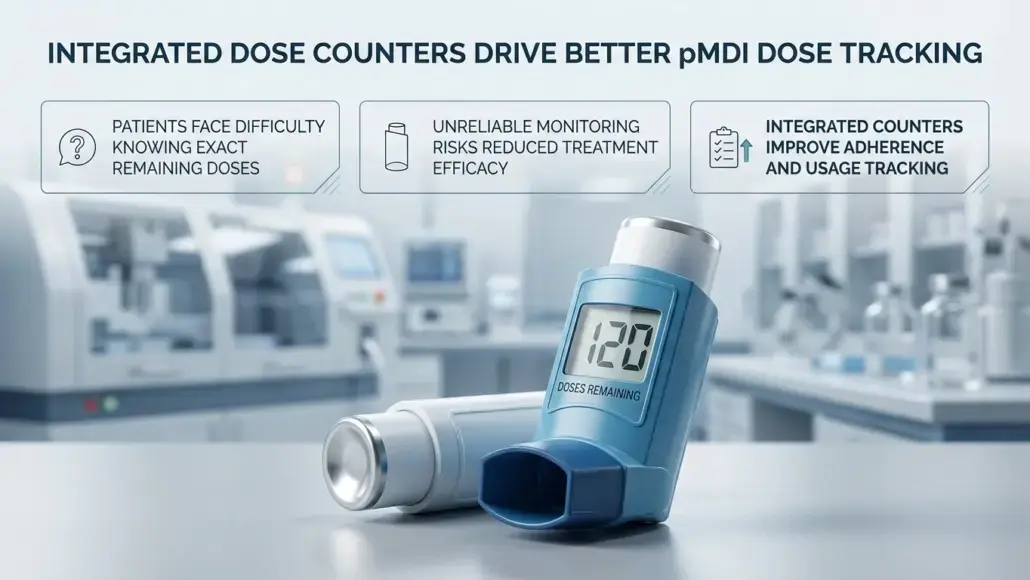
The pharmaceutical industry has long recognized that the efficacy of respiratory treatments is heavily dependent on patient adherence. One of the most significant challenges in the use of pressurized metered-dose inhalers is the inability of users to determine the exact number of doses remaining in the canister. Without a reliable mechanism for monitoring usage, patients may continue to use an inhaler that is nearly empty, receiving only propellant without the therapeutic active ingredient. The introduction of integrated dose counters provides a technical solution to this problem, ensuring that every actuation is recorded and displayed clearly. This advancement in pMDI dose tracking is a critical safety feature that prevents the dangerous situation of a patient attempting to manage an acute asthma attack with an empty device.
Mechanical dose counters operate through a series of internal gears that advance a numerical display each time the canister is depressed. These systems must be engineered with extreme precision to avoid double-counting or failing to record an actuation. The design must account for the specific force required to activate the inhaler while ensuring that the counting mechanism does not interfere with the aerosol delivery. Pharmaceutical manufacturers spend years refining these mechanical systems to meet the rigorous standards set by international regulatory bodies. By providing a clear and intuitive visual cue, these devices empower patients to manage their condition with greater confidence and accuracy.
The transition from visual estimation to precise measurement represents a significant shift in respiratory care. In the past, patients often resorted to unreliable methods, such as floating the canister in water, to estimate the remaining volume. These practices were not only inaccurate but could also potentially damage the valve or introduce contaminants. With the integration of counting technology directly into the device housing, these archaic methods are replaced by a standardized, reliable metric. This improvement in pMDI dose tracking not only benefits individual patients but also provides clinicians with more accurate data to assess treatment efficacy and make informed decisions about dosage adjustments.
Engineering Reliability in Mechanical and Electronic Systems
Developing a counter that functions consistently throughout the multi-year shelf life of an inhaler requires a deep understanding of material science and mechanical engineering. The components of the counter are subjected to repetitive stress and must operate smoothly in a variety of environmental conditions, from high humidity to extreme temperatures. Manufacturers often utilize high-performance polymers that offer low friction and high durability, ensuring that the gears do not bind or wear down over time. Furthermore, the assembly process must be tightly controlled to ensure that the counter is correctly aligned with the valve and the actuator, preventing mechanical failures that could compromise the safety of the device.
Electronic dose counters offer even greater potential for data collection and connectivity. These systems use sensors to detect the movement of the canister or the flow of the aerosol, transmitting the information to a digital display or a mobile application. While more complex than mechanical systems, electronic counters can provide additional features, such as reminders for scheduled doses and alerts for improper inhaler technique. This level of sophistication is particularly valuable for patients with chronic conditions like chronic obstructive pulmonary disease, where consistent medication use is vital for preventing exacerbations. However, the inclusion of electronics introduces new challenges related to battery life, electromagnetic compatibility, and data privacy.
The reliability of these systems is verified through extensive testing protocols that simulate real-world usage. Engineers perform thousands of actuations on test units to monitor for any deviation in the counter accuracy. These studies also include drop tests and vibration tests to ensure that the device remains functional after accidental impacts. By establishing a high bar for mechanical and electronic performance, the pharmaceutical sector ensures that the dose measurement system remains a dependable tool for patients. The goal is to create a device that is so reliable that the user never has to question the accuracy of the remaining dose count.
Regulatory Standards and Global Compliance Frameworks
Regulatory agencies, including the Food and Drug Administration, have increasingly emphasized the importance of dose counters for all new pressurized metered-dose inhaler products. Guidance documents outline the specific requirements for the visibility and legibility of the numerical display, as well as the need for a warning system when the inhaler is approaching its final doses. Compliance with these standards is not optional; it is a prerequisite for market approval in most major healthcare jurisdictions. Manufacturers must provide detailed evidence that their pMDI dose tracking system is both accurate and user-friendly, often involving human factors studies to validate the design with representative patient groups.
Global harmonization of these standards is an ongoing process that aims to simplify the regulatory landscape for international manufacturers. The ISO 20072 standard provides a framework for the design and testing of aerosol delivery systems, including the requirements for dose indicators. By adhering to these international benchmarks, pharmaceutical companies can streamline the development process and ensure that their products are accepted in multiple markets without the need for redundant testing. This efficiency is essential for maintaining the affordability of respiratory treatments while meeting the highest safety standards.
The documentation required for regulatory submission is extensive, covering every aspect of the counter design, manufacture, and validation. This includes risk assessments that identify potential failure modes and the measures taken to mitigate them. For example, if a mechanical gear were to fail, how would the device alert the user? Addressing these questions through a proactive quality management system is essential for securing regulatory approval. As the technology continues to evolve, the pharmaceutical industry must stay engaged with regulators to ensure that the rules keep pace with innovation in pMDI dose tracking.
Enhancing Adherence and Clinical Outcomes
The impact of integrated counters on patient adherence cannot be overstated. Clinical studies have consistently shown that patients who use inhalers with dose counters are more likely to take their medication as prescribed and are less likely to experience severe respiratory events. The psychological benefit of knowing exactly how much medicine remains reduces anxiety and improves the overall quality of life for individuals with chronic respiratory diseases. This is particularly important for pediatric and geriatric populations, who may struggle more with managing their medication schedules. By simplifying the process of tracking doses, these devices remove a significant barrier to effective treatment.
Clinicians also benefit from the improved data provided by these systems. During routine check-ups, the dose counter provides a clear record of how frequently the patient has been using their medication. This objective data is far more reliable than patient recall, which is often inaccurate. If the counter shows that a patient is using their rescue inhaler more frequently than expected, the physician can investigate the underlying cause, such as worsening symptoms or environmental triggers. This proactive approach to care allows for more timely interventions and can prevent hospitalizations. The integration of pMDI dose tracking into routine clinical practice represents a major step forward in the management of respiratory conditions.
Furthermore, which is essential during Drug-Device Co-Development phases, the integration of these tracking mechanisms must be considered from the initial design stage. The physical space required for the counter mechanism can impact the overall size and weight of the inhaler, which in turn affects the ergonomics and portability of the device. By treating the counter as an integral part of the system rather than an add-on, manufacturers can create a more cohesive and user-friendly product. This holistic approach to device design is what ultimately leads to better patient experiences and improved clinical results across the pharmaceutical sector.
Future Innovations in Integrated Tracking Technology
Looking ahead, the future of dose tracking lies in the integration of smart technology and the internet of medical things. Future generations of inhalers may feature Bluetooth connectivity that automatically syncs usage data with a healthcare provider’s portal. This would allow for real-time monitoring of patient populations, enabling early identification of individuals at risk of an exacerbation. These smart inhalers could also provide personalized feedback to patients on their inhalation technique, helping them to maximize the benefit of each dose. While these advancements are still in the early stages of adoption, they represent the next frontier in respiratory care.
Sustainability is also becoming a key focus for device manufacturers. The materials used in dose counters must be evaluated for their environmental impact, and there is a growing interest in developing recyclable or reusable components. For example, a reusable electronic counter module could be detached from an empty inhaler and snapped onto a new one, reducing electronic waste. This requires a rethink of the entire device architecture and a close collaboration between material scientists and environmental engineers. By balancing the need for technical innovation with the imperative of environmental responsibility, the industry can create a more sustainable future for pMDI dose tracking.
The ongoing commitment to innovation in this field is driven by the clear clinical need for better respiratory management tools. As chronic respiratory diseases continue to rise globally, the importance of reliable and user-friendly delivery systems will only grow. The pharmaceutical sector will continue to invest in the research and development of new technologies that make it easier for patients to take their medicine and for doctors to monitor their progress. By keeping the patient at the center of the design process, the industry can ensure that every actuation counts towards a healthier future.