













Close
CDMO Safety Testing 2026
Novotech

Sustainable Lab Automation : Altering Diagnostics By 2030

Note* - All images used are for editorial and illustrative purposes only and may not originate from the original news provider or associated company.

Subscribe

- Never miss a story with notifications

- Gain full access to our premium content

- Browse free from any location or device.

Media Packs

Expand Your Reach With Our Customized Solutions Empowering Your Campaigns To Maximize Your Reach & Drive Real Results!

โ€“ Access the Media Pack Now

โ€“ Book a Conference Call

โ€“ Leave Message for Us to Get Back

Related stories

Quantum Machine Learning in Pharma Research Growth

The convergence of artificial intelligence and quantum processing is opening new avenues for rapid discovery and innovation within the life sciences. By utilizing advanced mathematical models that operate across multi-dimensional datasets, researchers can now identify complex biological patterns and predict molecular behaviors with a speed that surpasses traditional computational methods. This transformation is accelerating the development of novel therapies and providing deeper insights into disease mechanisms, fundamentally altering the trajectory of pharmaceutical research and development.

Quantum Sensors Enabling Advanced Drug Diagnostics

The landscape of medical diagnostics is being reshaped by the introduction of sensing technologies that operate with atomic-level sensitivity. By providing high-fidelity measurements and real-time data, these tools allow for the detection of subtle biological changes and chemical markers that were previously invisible to conventional equipment. This advancement is enhancing the precision of drug testing and clinical monitoring, leading to earlier disease detection and more effective therapeutic interventions across the global healthcare spectrum.

Quantum Computing Optimizing Pharma Supply Chains

The global distribution of pharmaceutical products is facing unprecedented challenges that demand a new level of logistical precision and resilience. By utilizing advanced analytical models, companies can now navigate complex international networks with greater efficiency, ensuring that temperature-sensitive medicines and life-saving therapies reach their destinations without delay. This evolution toward a more intelligent and responsive supply chain is critical for maintaining public health and responding effectively to emerging medical needs on a global scale.
- Advertisement -

The Sustainable Development Goals (SDGs) included in the UN 2030 Agenda also address the environmental, social, and economic aspects of development. In this sense, the diagnostic and healthcare industries proceed to convert the SDG Global Data agenda into development plans and policies by implementing automation, integration, digital transformation and process innovation in the laboratory. They also carry out carbon footprint reduction.

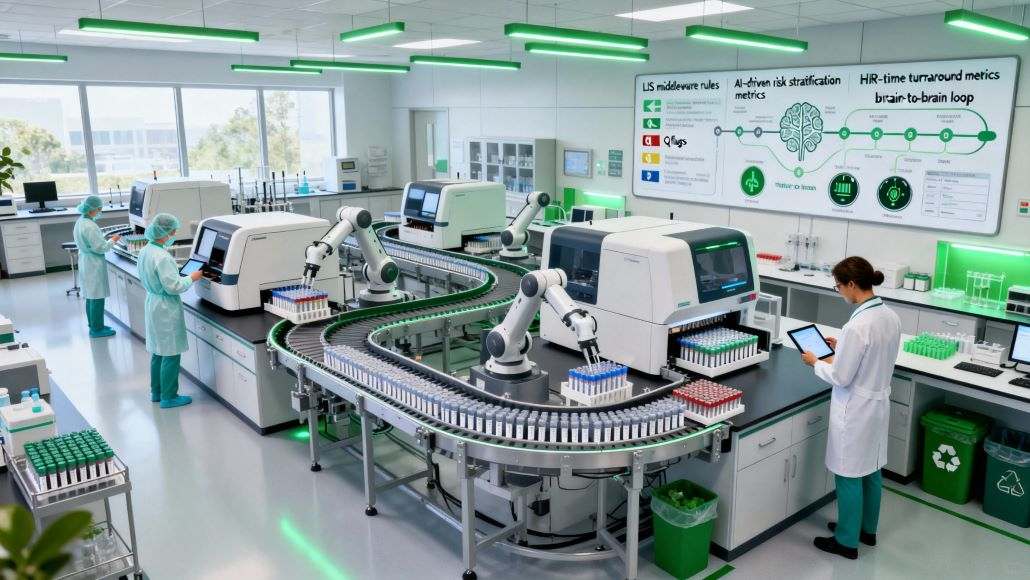
It is noteworthy that Total Lab Automation (TLA) integrates excellent healthcare via activity-based costing, automation, LEAN design, and a decrease in carbon footprint through the green lab idea. TLA also occurs to combine sustainable diagnostic innovation in lab medicine. Rapid shifts in the diagnostic industry, together with concurrent developments in lab automation and digital transformation technology in the diagnostic platforms, have sparked the emergence of methods for AI and robotic components in the regular lab process flow. It is important to note that the lab procedures have been reduced to ensure the provision of accurate and quick test results, suitable partnerships with a brain-to-brain loop, and overall improvements in patient care and safety.

The implementation of middleware, aided clinical decision-making, and the adoption of paperless workflows are crucial factors in the lab’s transformation. These factors specifically impact clinical validation, procedure efficiency, data handling and analysis, and more. AI allows the risk stratification score of clinical and laboratory data to be calculated using an expert system and evidence-based recommendations. As cost reduction requirements continue to rise, this technology’s applicability becomes more accessible.

Notably, the Lundenburg Loop ideaโ€”often called the brain-to-brain loop for laboratory testingโ€”comes from the minds of primary care doctors who also happen to be involved in the process of choosing the lab tests and ends with the ordering physician receiving the test results in the end.

Pre-examinations, pre-examinations, tests, and post-examination procedures are essentially all that are involved in the process. To achieve process excellence within the lab workflow, the whole lab automation process is combined with the digitalization of the entire testing process.

The demand for developing a framework for sustainable technology policies and supply chain policies is quite high, as is the need to prioritize innovation and allocate resources to accelerate the growth of the IVD industry. They must also use digitalization to close the gap between supply and demand. The problems with COVID-19 indicate that concentrating on opportunities also implies pursuing opportunities while simultaneously closing the gap between supply and demand. It should be mentioned that the involvements continue to call for varying degrees of financial commitment, both in terms of immediate and long-term incremental improvements to the diagnostic care portfolio.

It is true that hospitals may continue to gain from the tech and digital transformation process in terms of both clinical and operational aspects. Complete lab automation and digitalization may improve stakeholder collaboration, improve lab and administration communication, and help hospitals and laboratories provide better results. The secret to successful and efficient illness management as well as public health management is timely communication of diagnostic test findings to doctors and other stakeholders.


Latest stories

Related stories

Quantum Machine Learning in Pharma Research Growth

The convergence of artificial intelligence and quantum processing is opening new avenues for rapid discovery and innovation within the life sciences. By utilizing advanced mathematical models that operate across multi-dimensional datasets, researchers can now identify complex biological patterns and predict molecular behaviors with a speed that surpasses traditional computational methods. This transformation is accelerating the development of novel therapies and providing deeper insights into disease mechanisms, fundamentally altering the trajectory of pharmaceutical research and development.

Quantum Sensors Enabling Advanced Drug Diagnostics

The landscape of medical diagnostics is being reshaped by the introduction of sensing technologies that operate with atomic-level sensitivity. By providing high-fidelity measurements and real-time data, these tools allow for the detection of subtle biological changes and chemical markers that were previously invisible to conventional equipment. This advancement is enhancing the precision of drug testing and clinical monitoring, leading to earlier disease detection and more effective therapeutic interventions across the global healthcare spectrum.

Quantum Computing Optimizing Pharma Supply Chains

The global distribution of pharmaceutical products is facing unprecedented challenges that demand a new level of logistical precision and resilience. By utilizing advanced analytical models, companies can now navigate complex international networks with greater efficiency, ensuring that temperature-sensitive medicines and life-saving therapies reach their destinations without delay. This evolution toward a more intelligent and responsive supply chain is critical for maintaining public health and responding effectively to emerging medical needs on a global scale.

Quantum security strengthening pharma data protection

Protecting sensitive patient information and proprietary research data is becoming a critical priority as the pharmaceutical industry navigates an increasingly complex digital landscape. By integrating advanced cryptographic methods and secure communication protocols, researchers can ensure the integrity of their clinical findings and the privacy of those involved in medical trials. This shift toward a more resilient digital infrastructure is essential for maintaining public trust and fostering global collaboration in the pursuit of life-saving therapeutic breakthroughs.

Subscribe

- Never miss a story with notifications

- Gain full access to our premium content

- Browse free from any location or device.

Media Packs

Expand Your Reach With Our Customized Solutions Empowering Your Campaigns To Maximize Your Reach & Drive Real Results!

โ€“ Access theMedia Pack Now

โ€“ Book a Conference Call

โ€“ Leave Message for Us to Get Back

Translate ยป