












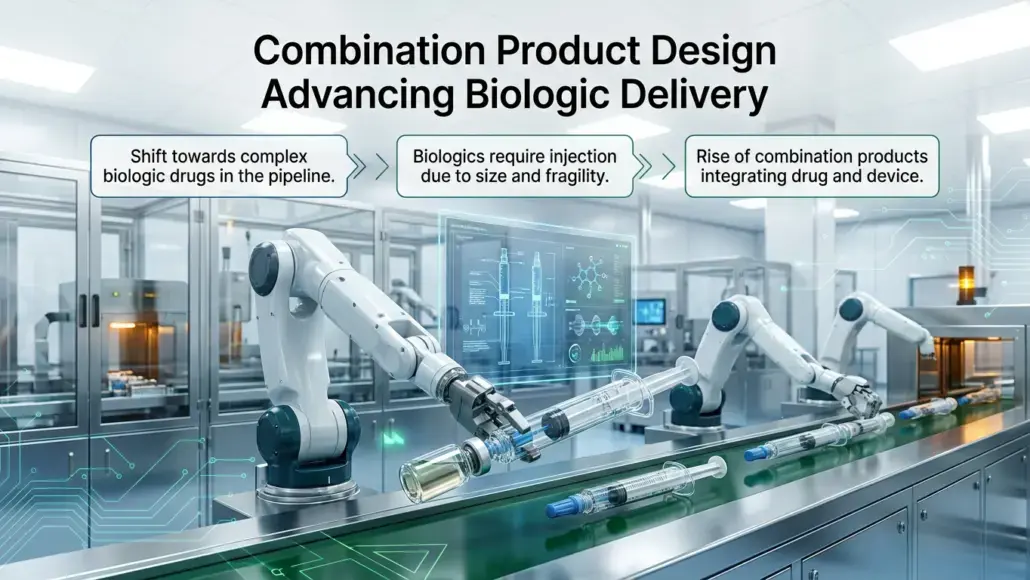
The pharmaceutical sector has witnessed a significant shift toward the development of biologics, which now constitute a substantial portion of the global drug pipeline. Unlike small molecules, biologics are typically large, complex proteins that require parenteral administration due to their susceptibility to degradation in the gastrointestinal tract and their inability to cross biological membranes easily. This requirement has led to the rise of combination products, which integrate a biological drug with a delivery device such as an autoinjector, a prefilled syringe, or a wearable pump. The focus on combination product design advancing biologic delivery is essential for improving patient adherence, ensuring accurate dosing, and enabling the administration of high-concentration formulations in a home-care setting.
Technical Challenges in Formulating High-Concentration Biologics
One of the primary drivers for innovation in combination product design advancing biologic delivery is the trend toward subcutaneous administration. Patients and healthcare providers increasingly prefer subcutaneous injections over intravenous infusions because they are less invasive and can often be self-administered. However, delivering a therapeutic dose of a monoclonal antibody or other large protein in a small volume (typically less than 2 mL) requires highly concentrated formulations. These high concentrations often result in significant increases in viscosity, which presents major challenges for both the formulation scientist and the device engineer.
High viscosity can lead to issues such as needle clogging, excessive injection forces, and prolonged injection times. To address these problems, formulation scientists utilize excipients such as amino acids, salts, and surfactants to modulate protein-protein interactions and reduce viscosity. Simultaneously, device engineers must design delivery systems capable of exerting sufficient force to expel the viscous liquid through fine-gauge needles without compromising the integrity of the device or causing discomfort to the patient. This requires a deep understanding of the rheological properties of the biologic and the mechanical limits of the delivery hardware. The integration of these two disciplines is the hallmark of successful combination product design, ensuring that the physical properties of the drug are compatible with the mechanical capabilities of the device.
Human Factors and User-Centric Engineering in Device Development
The success of a combination product depends not only on its technical performance but also on the ease with which a patient can use it. Human factors engineering is a critical component of combination product design advancing biologic delivery, focusing on the interaction between the user and the device. In a home-care environment, devices must be intuitive, safe, and reliable. This involves conducting rigorous usability studies to identify potential use errors, such as incorrect needle insertion, premature removal of the device, or failure to follow the required steps for preparation.
Designers utilize these insights to incorporate features that enhance the user experience. For instance, autoinjectors often include audible clicks, visual windows, and tactile feedback to signal when an injection has started and finished. Ergonomic considerations, such as the shape and size of the device, are also vital for patients with limited manual dexterity, such as those suffering from rheumatoid arthritis. By prioritizing user-centric design, pharmaceutical companies can improve treatment adherence and reduce the likelihood of dosing errors. This approach also extends to the packaging and labeling of the product, ensuring that instructions are clear and easy to follow. The ultimate goal is to empower patients to manage their chronic conditions with confidence, reducing the burden on the healthcare system and improving long-term clinical outcomes.
Material Compatibility and Primary Packaging Considerations
The choice of materials for the primary packaging and the delivery device is a fundamental aspect of combination product design advancing biologic delivery. Biologics are sensitive to their environment and can interact with the surfaces of syringes, stoppers, and needles. These interactions can lead to protein adsorption, aggregation, or the leaching of impurities into the drug product, potentially compromising its safety and efficacy. Therefore, selecting the right materials is essential for maintaining the stability of the biologic throughout its shelf life.
Glass has traditionally been the material of choice for prefilled syringes due to its excellent barrier properties and long history of use. However, issues such as glass breakage, tungsten residues from the needle-forming process, and the presence of silicone oil (used as a lubricant) have led to the exploration of alternative materials. Cyclic olefin polymers (COP) and cyclic olefin copolymers (COC) are becoming increasingly popular because they offer high break resistance, low extractables, and superior dimensional stability. These polymers also allow for more complex designs, such as integrated plungers and non-uniform shapes, which can be advantageous for specific delivery applications. Furthermore, the development of silicone-free systems and advanced coating technologies is helping to minimize protein aggregation and ensure consistent glide forces. Every material decision must be backed by extensive compatibility testing to ensure that the device does not adversely affect the biological drug.
Regulatory Pathways and Quality Management Systems
Navigating the regulatory environment for combination products is a complex task that requires coordination across multiple functional areas. In the United States, combination products are regulated by the FDA under 21 CFR Part 4, which outlines the requirements for both drug and device quality systems. Achieving compliance involves demonstrating that the product meets the safety and efficacy standards for the biological component while also satisfying the design control requirements for the device. This dual requirement necessitates a comprehensive quality management system that can handle the unique challenges of integrated drug-device development.
Risk management is at the heart of the regulatory process for combination product design advancing biologic delivery. Manufacturers must conduct thorough risk assessments, such as Failure Mode and Effects Analysis (FMEA), to identify and mitigate potential hazards throughout the product lifecycle. This includes risks related to manufacturing variability, environmental factors, and user behavior. Additionally, the regulatory submission must include detailed data on the physical and chemical stability of the drug within the device, as well as the results of clinical studies that demonstrate the performance of the combination. As global regulations continue to evolve, particularly with the implementation of the Medical Device Regulation (MDR) in Europe, pharmaceutical companies must stay abreast of changing requirements to ensure timely market access. The ability to effectively manage these regulatory hurdles is a key differentiator for companies seeking to lead in the biologic delivery market.