











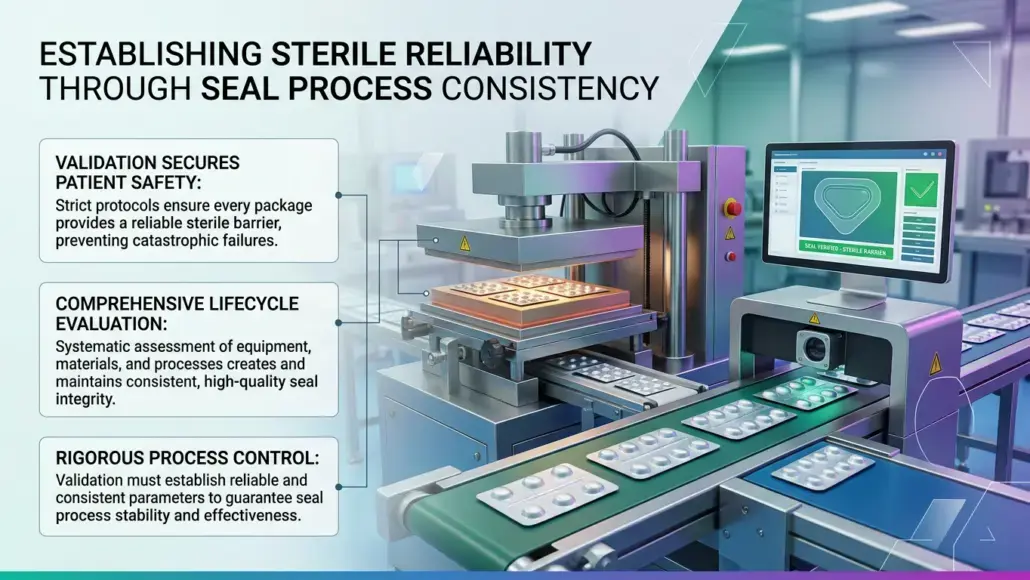
The production of pharmaceutical packaging is a highly regulated process where the failure of a single seal can have catastrophic consequences for patient safety. To ensure that every package provides a reliable sterile barrier, manufacturers must implement rigorous validation protocols that establish and maintain seal process consistency. Validation is not a one-time event but a comprehensive lifecycle approach that involves the systematic evaluation of equipment, materials, and processes to ensure they consistently produce results within specified tolerances. By standardizing these variables, pharmaceutical companies can minimize the risk of intermittent defects and ensure that their products are protected throughout their entire shelf life.
The Foundation of Validation: IQ, OQ, and PQ Protocols
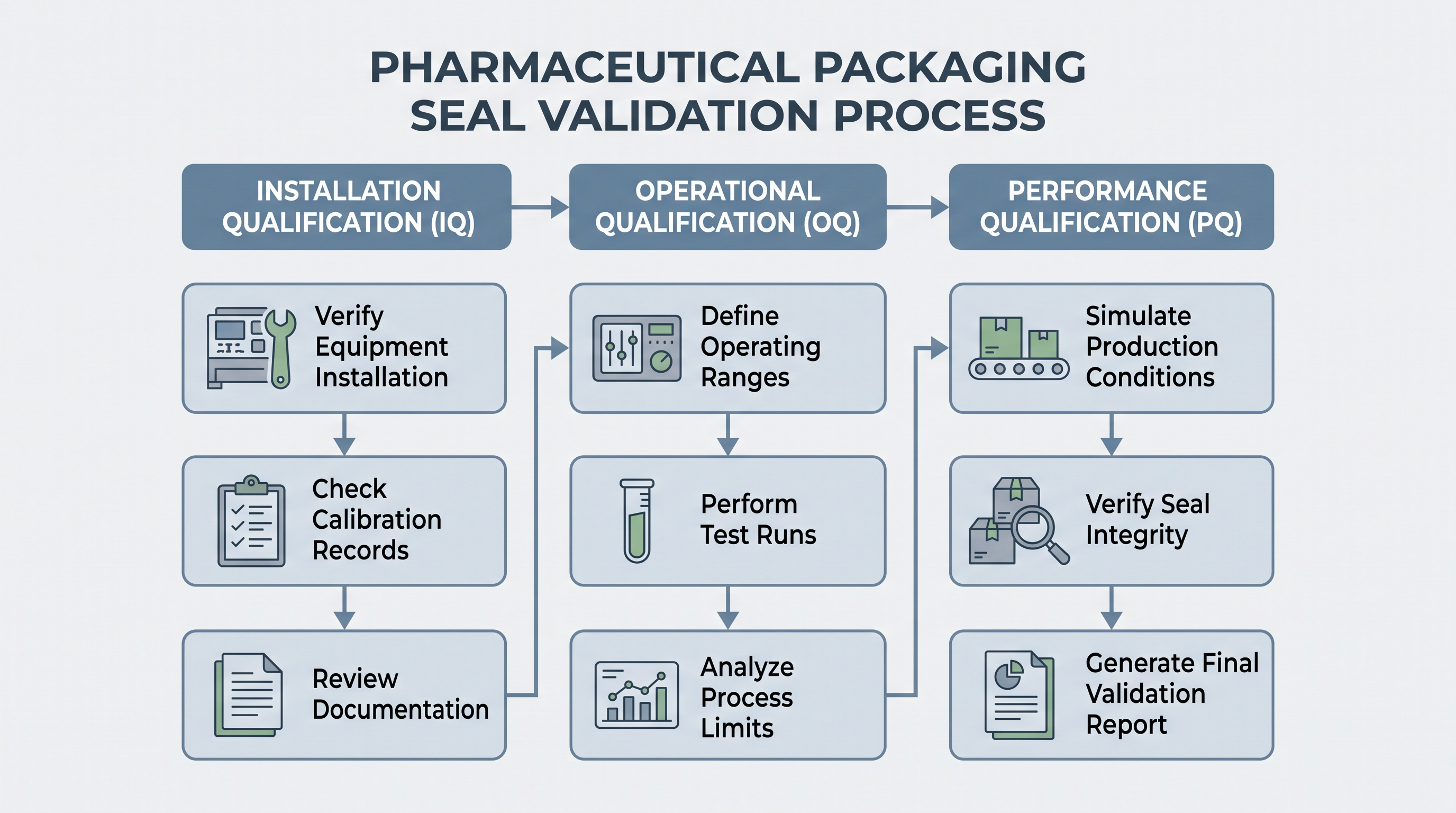
The validation of a pharmaceutical packaging line follows a structured framework consisting of Installation Qualification (IQ), Operational Qualification (OQ), and Performance Qualification (PQ). Each stage is designed to verify specific aspects of the sealing operation, providing a documented trail of evidence that the process is under control. IQ involves verifying that the equipment is installed correctly according to the manufacturer’s specifications and that all sensors and controls are calibrated. This stage is critical for ensuring that the physical foundation of the sealing process is sound and that the machine is capable of operating within the required environment.
Once the equipment is installed, the OQ phase begins, which focuses on identifying the “operating window” for the sealing process. This involves testing the equipment at the extremes of its specified parameters—such as the highest and lowest temperatures and pressures—to ensure that it can still produce acceptable seals under worst-case conditions. By defining these boundaries, manufacturers can establish the critical process parameters (CPPs) that must be monitored during routine production. This stage is where the initial data for seal process consistency is generated, providing the baseline for future performance monitoring and troubleshooting.
The final stage, PQ, involves running the process under normal production conditions using actual product and packaging materials. This stage demonstrates that the process is capable of consistently producing high-quality seals over an extended period and across different shifts and batches. The data collected during PQ provides the statistical evidence needed to support the claim that the process is validated. By completing this rigorous three-stage process, pharmaceutical companies can be confident that their packaging operations are capable of meeting the highest standards of safety and quality, fulfilling their regulatory obligations.
Identifying and Controlling Critical Process Parameters
Achieving seal process consistency requires a deep understanding of the variables that influence the quality of the bond. In heat sealing, the three most critical parameters are temperature, pressure, and dwell time. Each of these must be precisely controlled and monitored to ensure that the polymer sealant reaches its optimal state for interdiffusion without degrading the other layers of the laminate. If the temperature fluctuates by even a few degrees, the seal strength can vary significantly, leading to potential failures. Therefore, the use of high-precision sensors and closed-loop control systems is a fundamental requirement for modern pharmaceutical packaging equipment.
- Temperature Control: Heat must be applied uniformly across the entire sealing surface to avoid “cold spots” that could lead to micro-leaks.
- Pressure Monitoring: Constant and even pressure ensures that the sealant material flows into any irregularities on the container rim, creating a continuous bond.
- Dwell Time Accuracy: The duration of contact must be long enough for heat transfer but short enough to maintain production efficiency.
- Cooling Phase Management: Controlling the rate of cooling after the seal is formed helps to stabilize the polymer structure and lock in the mechanical strength of the bond.
In addition to these primary parameters, other factors such as the cleanliness of the seal bars and the tension of the lidding material can also impact the results. Regular maintenance and calibration of the equipment are essential for maintaining seal process consistency over the long term. By implementing a proactive maintenance schedule, manufacturers can identify and address potential issues before they result in a deviation from the validated state. This focus on prevention is a key component of a high-quality packaging operation and is essential for minimizing waste and ensuring product safety.
The integration of advanced monitoring tools, such as infrared thermography and laser surface inspection, allows for real-time feedback on the state of the sealing process. These tools can detect subtle changes in temperature or pressure that might not be apparent to the operator, allowing for immediate corrective action. By reducing the reliance on manual adjustments, these automated systems improve the reliability of the operation and ensure a higher level of seal process consistency. The data generated by these systems also provides a valuable resource for continuous improvement and for demonstrating compliance during regulatory audits.
Statistical Process Control and Seal Integrity Testing
Validation is only the beginning of the journey toward seal process consistency. To maintain the validated state, manufacturers must use Statistical Process Control (SPC) to monitor the process in real-time. SPC involves the use of control charts and other statistical tools to track the performance of the sealing parameters and identify any trends that could lead to a process deviation. By analyzing this data, quality engineers can determine if the process is “in control” and take action if the data points begin to drift toward the control limits. This proactive approach allows for the identification of root causes and the implementation of permanent solutions, rather than just treating the symptoms of a problem.
Seal integrity testing is another vital component of the quality assurance process. This involves both destructive and non-destructive methods to verify that the seals meet the required specifications for strength and barrier performance. Destructive tests, such as burst testing and peel force testing, provide a quantitative measure of the seal’s mechanical properties. While these tests result in the loss of a sample, they are essential for verifying the effectiveness of the sealing process and for ensuring that the seals can withstand the rigors of distribution. These tests are also used to validate the product fit within custom packaging dimensions, ensuring that the package structure provides the necessary support for the product.
Non-destructive testing (NDT) methods, such as vacuum decay and high-voltage leak detection (HVLD), allow for 100% inspection of the production line without damaging the product. These technologies can detect microscopic leaks that would be missed by visual inspection, providing a much higher level of confidence in the integrity of the sterile barrier. By combining SPC with a robust testing program, pharmaceutical companies can achieve a state of continuous validation, where the process is constantly being monitored and refined to ensure the highest possible level of seal process consistency.
Risk-Based Approaches to Lifecycle Management
The modern approach to pharmaceutical validation is increasingly focused on risk management. This involves identifying the most critical steps in the packaging process and focusing the validation efforts where they will have the greatest impact on product quality. A Failure Mode and Effects Analysis (FMEA) is a common tool used to identify potential failure points and to prioritize the necessary controls. By taking a risk-based approach, manufacturers can optimize their validation activities, ensuring that resources are used efficiently while still maintaining the highest level of safety.
Lifecycle management also involves the ongoing evaluation of the process as materials or equipment change over time. If a manufacturer switches to a new supplier for lidding material or upgrades a component on the sealing machine, a re-validation study may be required to ensure that the seal process consistency is maintained. This “change control” process is a fundamental requirement of Good Manufacturing Practices (GMP) and is essential for ensuring that the process remains in a validated state. By maintaining a detailed record of all changes and their impact on the process, companies can demonstrate to regulators that they are in full control of their operations.
Furthermore, the data collected during the validation and monitoring processes provides a rich source of information for process optimization. By analyzing the relationship between the CPPs and the final seal quality, engineers can identify opportunities to improve throughput, reduce waste, or enhance the performance of the package. This culture of continuous improvement is a hallmark of world-class pharmaceutical manufacturing and is essential for staying competitive in a rapidly evolving marketplace. By viewing validation as a dynamic and ongoing process, companies can achieve a level of excellence that goes far beyond simple compliance.
Future Directions in Digital Validation and Automation
The future of pharmaceutical packaging validation is being shaped by the rise of Industry 4.0 and digital technology. The integration of the Internet of Things (IoT) and big data analytics is allowing for a new level of connectivity and insight into the packaging process. Sensors on every part of the line can provide a constant stream of data, which can be analyzed in real-time to identify patterns and predict potential failures. This “predictive maintenance” approach can reduce downtime and improve seal process consistency by identifying issues before they even occur.
Digital validation protocols are also becoming more common, allowing for the electronic capture and management of all validation documentation. This not only improves the efficiency of the validation process but also ensures a higher level of accuracy and data integrity. Electronic records are easier to audit and provide a more comprehensive view of the process history, making it easier to demonstrate compliance to regulatory agencies. As these digital tools become more sophisticated, the traditional paper-based validation process will likely become a thing of the past.
The increasing use of robotics and automation in pharmaceutical packaging is also improving the reliability and consistency of the sealing operation. Robots can perform repetitive tasks with a level of precision and speed that is impossible for human operators, reducing the risk of errors and variability. By automating the most critical parts of the process, manufacturers can achieve a higher level of seal process consistency and ensure that every package meets the required specifications. As these technologies continue to advance, the focus of validation will shift from manual inspection to the verification of automated systems and the management of digital data, ushering in a new era of safety and efficiency in pharmaceutical packaging.