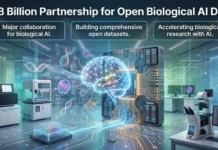



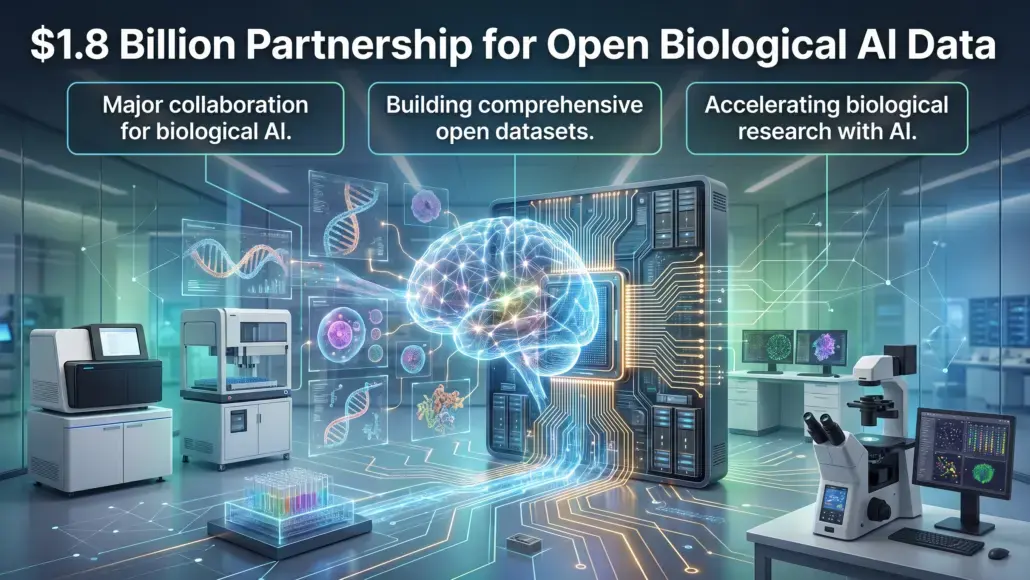
The United States government, alongside technology enterprises Meta Platforms and Alphabet, is officially joining forces with the nonprofit organization Biohub. This collaborative effort aims to construct comprehensive open datasets designed to train advanced AI models for biological research, elevating the total investment in this initiative to $1.8 billion.
Financial Contributions and Strategic Partnerships
In a unified approach to modernize the scientific landscape, Meta Platforms, Google DeepMind, and drug discovery startup Isomorphic Labs are collectively investing $300 million into the project. Parallel to this private funding, the Department of Energy is committing over $500 million across a five-year period to support laboratory measurement, modeling, and computation.
Furthermore, the National Institutes of Health will coordinate repositories and open datasets that were established using more than $500 million in previous federal grants. Biohub will undertake the standardization of these resources specifically for training AI models. These substantial financial pledges build upon a prior $500 million investment made in April by Biohub, which operates as a philanthropic venture established by Meta CEO Mark Zuckerberg and his wife, Dr. Priscilla Chan.
The Virtual Biology Initiative Focus
These targeted investments will directly fund the Virtual Biology Initiative. This specific project is designed to observe and measure how cells respond to environmental changes across a vastly expanded range of conditions than scientists have previously studied. By analyzing this wealth of information, researchers intend to construct accurate predictive models capable of compressing drug development timelines, which conventionally require multiple years to yield viable results.
Redefining the Scientific Methodology
Dr. Priscilla Chan emphasized the necessity of evolving the foundational approach to these studies to support expansive biological research.
“Biology has been just sort of a clever discovery-based science until this point,” Chan said in an interview. “We have always held this as a community asset, not just for one group, so that it can build upon itself over time.”
Data Accessibility and Commercial Timelines
While the core objective of the Virtual Biology Initiative is to eventually release all findings to the public, corporate contributors will receive preliminary access. According to Alex Rives, the head of science at Biohub, the entities funding these open datasets will benefit from a strategic head start.
“With commercial funders we have embargo periods where there’s a period of time where the groups can work on the data, and then it becomes available as a public scientific resource,” Rives said.
He noted that this specific arrangement is the primary mechanism Biohub utilizes to attract private capital into what it fundamentally describes as an open science endeavor. Conversely, Rives clarified that the government-funded work operating concurrently will not be subject to any such embargo restrictions. Moving forward, Biohub intends to approach pharmaceutical companies and philanthropic organizations.
Transitioning from Millions to Trillions of Cells
Current cellular repositories generally contain hundreds of millions of cells. However, Rives indicated that building an optimal framework will demand billions, and ultimately trillions, of data points. Biohub’s primary goal is to bridge this significant information gap.
“We need to capture the language of biology, we need to capture the language of the cell. And that doesn’t exist today,” he said.
To achieve this immense scale, the required information will be sourced through specialized techniques such as spatial transcriptomics, which precisely maps molecular activity within intact tissue. Additionally, the project will utilize analytical screens that record how cells respond to environmental shifts. A substantial portion of this information has never before been generated in a coordinated manner to support expedited drug development.
Accelerated Timelines for Scientific Progress
Rives detailed that compiling this volume of information would traditionally span several decades. However, the collaborative partners intend to compress this extensive workload into a concise five-year window, with the initial dataset projected for completion in approximately one year. Consequently, he expects the successful deployment of accurate predictive models within five years.
Other prominent artificial intelligence laboratories are concurrently pursuing parallel initiatives. Anthropic has recently doubled down on its biological efforts by incorporating a wet lab facility, while the OpenAI Foundation has started a grant program exceeding $125 million to specifically fund medical and cellular data collections for machine learning studies.