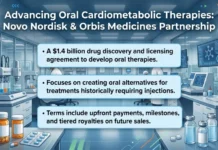










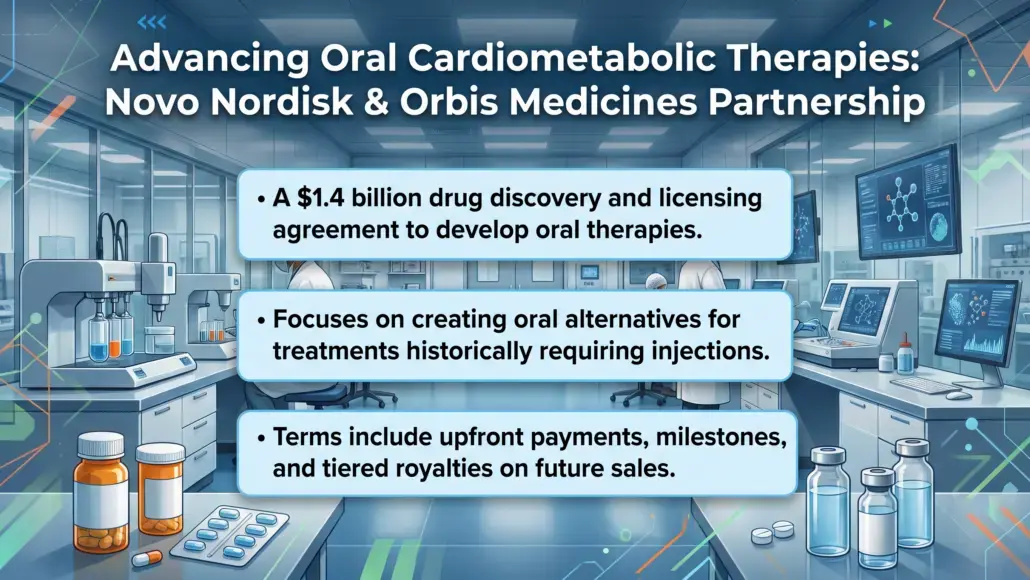
Danish pharmaceutical company Novo Nordisk and biotechnology developer Orbis Medicines have entered into a drug discovery and licensing agreement valued at up to $1.4 billion to develop oral therapies for cardiometabolic diseases. The program aims to advance oral alternatives for therapeutic indications that have historically required administration by injection.
Under the agreed terms, Orbis Medicines will receive upfront and milestone payments, along with tiered royalties on future commercial sales. Novo Nordisk will also make a strategic investment in the privately held biotechnology company. Both Novo Nordisk and Orbis Medicines declined to disclose the investment size or provide a specific breakdown of the potential $1.4 billion transaction.
AI-Driven Discovery Platform and Molecule Design
The multi-target research collaboration will utilize the proprietary, AI-enabled nGen platform developed by Orbis Medicines. The platform is designed to discover macrocycles, a structural class of molecules capable of converting therapies traditionally administered via injection into oral treatment options.
The ring-shaped macrocycles have the biochemical ability to address difficult disease targets that remain hard to reach for standard small-molecule compounds. By leveraging this technological platform, the companies intend to expand the availability of oral therapies for patients managing cardiometabolic diseases.
Preclinical Bioavailability Data and Corporate Insights
In preclinical studies, Orbis Medicines documented that its synthetic macrocycles achieved oral bioavailability rates of up to 18 percent, which measures the proportion of an active compound that enters systemic circulation following oral ingestion.
Orbis CEO Morten Graugaard highlighted the therapeutic possibilities of the alliance in an interview, stating: “Together with Novo, we have an opportunity to unlock a new generation of oral medicines for cardiometabolic diseases and demonstrate the transformative potential of AI-enabled macrocycle drug discovery,” Graugaard said.
Progress in the Oral Peptide Landscape
The partnership builds upon existing industry momentum focused on delivering complex peptide drugs in pill format. Novo Nordisk previously introduced the world’s first oral GLP-1 medicines for type 2 diabetes and weight management, which utilize SNAC absorption technology to assist peptide uptake in the gastrointestinal tract.
Macrocyclic compounds have also achieved recent regulatory milestones across the biopharmaceutical landscape. Johnson & Johnson received U.S. approval in March for Icotyde, an oral macrocyclic peptide for plaque psoriasis. Additionally, Merck secured regulatory approval in July for Lipfendra, an oral macrocyclic peptide engineered to lower cholesterol.