













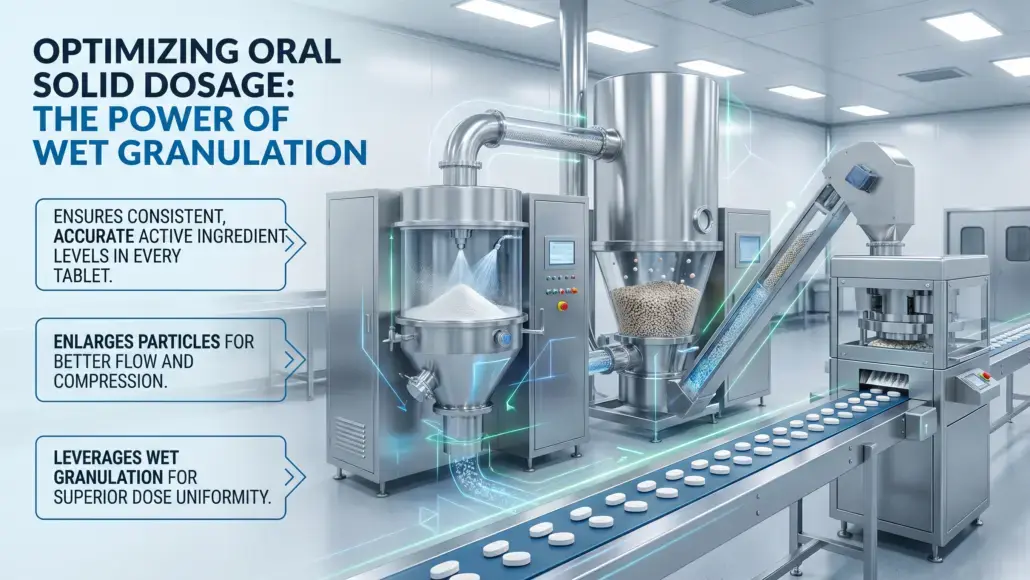
In the production of oral solid dosage forms, achieving a high degree of content uniformity is essential for ensuring that every tablet contains the correct amount of the active pharmaceutical ingredient. One of the most critical unit operations for achieving this goal is granulation, a process that enlarges particle size to improve flowability and compressibility. Among the various methods available, the application of wet granulation strategies improving oral solid dose uniformity remains a cornerstone of pharmaceutical manufacturing, particularly for formulations where the drug substance is present in low concentrations or has poor physical properties. By using a liquid binder to facilitate the agglomeration of powders, manufacturers can ensure that the API is evenly distributed throughout the granulation, thereby reducing the risk of segregation during the subsequent compression or filling steps.
The technical depth of wet granulation involves a careful balancing of material properties and process parameters. The selection of the binder, the rate of liquid addition, and the intensity of the mixing all play a significant role in determining the final characteristics of the granules. If the granulation is too wet, it can lead to the formation of dense, hard lumps that are difficult to dry and mill; if it is too dry, the granules may be fragile and prone to breaking, leading to poor flow and inconsistent tablet weights. The utilization of wet granulation strategies improving oral solid dose uniformity thus requires a deep understanding of the physics of particle bonding and the kinetics of liquid bridge formation, making it one of the most sophisticated processes in the pharmaceutical industry.
High-Shear vs. Fluid-Bed Granulation Techniques
Two of the most common methods for performing wet granulation are high-shear granulation and fluid-bed granulation, each offering distinct advantages depending on the nature of the formulation. High-shear granulation involves the use of a high-speed impeller and chopper to mix the powders and distribute the binder liquid. This method is particularly effective for creating dense, spherical granules with a narrow size distribution, which are ideal for high-speed tableting. The rapid mixing action ensures that the binder is quickly and evenly dispersed, even in formulations with high levels of fine particles. This level of control is essential for maintaining the integrity of the dosage form and ensuring that each unit meets the required specifications for content uniformity.
Fluid-bed granulation, on the other hand, involves the suspension of powders in a heated air stream while the binder is sprayed onto the particles from above. This process combines mixing, granulation, and drying into a single unit operation, which can improve efficiency and reduce the risk of cross-contamination. The granules produced in a fluid bed are typically more porous and less dense than those from a high-shear mixer, which can be advantageous for immediate-release formulations where a rapid disintegration time is desired. The choice between these techniques depends on the specific requirements of the drug substance and the desired performance of the final dosage form. The strategic application of these techniques allows manufacturers to select the best possible approach for each individual product.
The Role of Binder Distribution and Content Uniformity
The primary goal of any granulation process is to ensure that the active pharmaceutical ingredient is locked into a stable matrix that prevents it from separating from the excipients. In wet granulation, the binder liquid acts as the bridge that holds the particles together. If the binder is not distributed evenly, it can lead to areas of high and low drug concentration within the batch, resulting in poor content uniformity. This is particularly critical for high-potency drugs where even a small deviation in dose can have significant clinical consequences. Modern manufacturers use advanced spraying systems and specialized mixing blades to ensure that the binder is delivered in a controlled manner, reaching all parts of the powder bed at the same time.
Additionally, the monitoring of the granulation end-point is essential for maintaining consistency between batches. Engineers often use torque sensors or power consumption measurements to track the progress of the granulation in real-time. As the granules grow and become denser, the resistance to the mixing blades increases, providing a clear indication of when the process is complete. By establishing strict control limits for these parameters, companies can ensure that their wet granulation strategies are stable and repeatable. This level of process oversight is a key component of the Quality by Design approach, where quality is built into the product from the very beginning rather than being tested at the end.
The physics of liquid bridge formation is a central theme in the engineering of these systems. As the binder liquid is introduced, it creates pendular and funicular bridges between the particles, which are held together by capillary forces and viscous dissipation. The strength of these bridges depends on the surface tension of the liquid and the wettability of the solid surfaces. Formulators often add surfactants to the binder solution to lower the contact angle and ensure that the liquid penetrates deep into the powder bed. This careful manipulation of surface chemistry is a vital part of the broader wet granulation strategies improving oral solid dose uniformity, as it ensures that the API is firmly anchored within the granule structure.
Additionally, the viscosity of the binder solution itself must be carefully optimized. A solution that is too viscous will not atomize properly, leading to large droplets that cause localized over-wetting and poor content uniformity. Conversely, a binder that is too thin may not provide sufficient adhesive force to hold the granules together during the drying and milling phases. The use of rheological testing to characterize the binder properties is a standard part of the development process, providing the data necessary to refine the formulation and ensure consistent results across different scales of production. This level of technical detail is what allows pharmaceutical manufacturers to produce high-quality dosage forms that meet all therapeutic and regulatory requirements.
Drying and Milling: Critical Post-Granulation Steps
After formation, granules are dried to remove moisture and milled for size distribution. Drying must prevent API degradation, especially for heat-sensitive molecules. Fluid-bed drying is preferred for efficiency and uniform heat transfer. Residual moisture content is a critical attribute, impacting flowability and physical stability. If granules are too moist, they stick to punches; if too dry, tablets may cap. Milling reduces dried agglomerates to a uniform size. Mill type and screen selection depend on flow requirements. A narrow size distribution ensures consistent die filling and uniform weights. Integrating these steps into a continuous line improves efficiency and reduces human error. Refinement of these protocols focuses on optimizing these steps for quality.
In high-shear systems, the impeller tip speed is a critical process parameter that influences the final granule size and density. A higher tip speed increases the energy input into the powder bed, leading to more frequent collisions between particles and a more compact granule structure. However, excessive shear can also lead to the degradation of sensitive APIs or the over-densification of the granules, which can negatively impact the disintegration and dissolution of the finished tablet. Engineers must thus conduct extensive scale-up studies to ensure that the shear forces remain consistent as the process moves from the laboratory to full-scale production. This requires the use of dimensionless numbers, such as the Froude number, to maintain geometric and kinematic similarity between different sizes of equipment.
The management of the air flow rate and the dew point of the inlet air in fluid-bed systems is also a vital consideration. If the air is too humid, the granules may not dry efficiently, leading to sticking and poor flow. If the air is too dry, it can lead to the premature evaporation of the binder solvent, resulting in weak granules that break apart easily. The use of advanced climate control systems and real-time moisture sensors allows manufacturers to maintain the optimal environment for granulation and drying, ensuring that every batch meets the required quality standards. The strategic application of wet granulation strategies improving oral solid dose uniformity thus involves a comprehensive approach to process control that covers every stage of the manufacturing cycle.
Future Directions in Continuous Granulation and Automation
The pharmaceutical industry is increasingly moving toward continuous manufacturing, where raw materials are fed into a single production line and finished tablets are produced without interruption. Continuous wet granulation is a central part of this trend, utilizing twin-screw extruders or continuous fluid-bed systems to produce granules in real-time. This approach offers significant advantages in terms of process control, as the smaller batch sizes allow for more precise monitoring and immediate corrective actions. The use of process analytical technology, such as near-infrared or Raman spectroscopy, enables the continuous verification of the granule composition and moisture content, providing a high level of assurance that every unit meets the required standards.
Automation also plays a growing role in the optimization of granulation processes. Smart sensors and machine learning algorithms can now analyze process data to identify patterns and predict potential quality issues before they occur. This proactive approach to quality management reduces waste, improves yields, and ensures that the manufacturing process remains under control at all times. The investment in these advanced technologies reflects the industry’s commitment to continuous improvement and its focus on delivering safe and effective medications. The role of these advanced techniques will continue to evolve, providing a reliable platform for oral solid dosage forms. By embracing innovation, the pharmaceutical sector can meet the growing demand for high-quality medications. The focus on process optimization is a testament to the industry’s commitment to excellence. Through scientific rigor and data-driven decision-making, the industry will push the boundaries of dosage design, ensuring that challenging molecules are successfully formulated for the benefit of patients.