















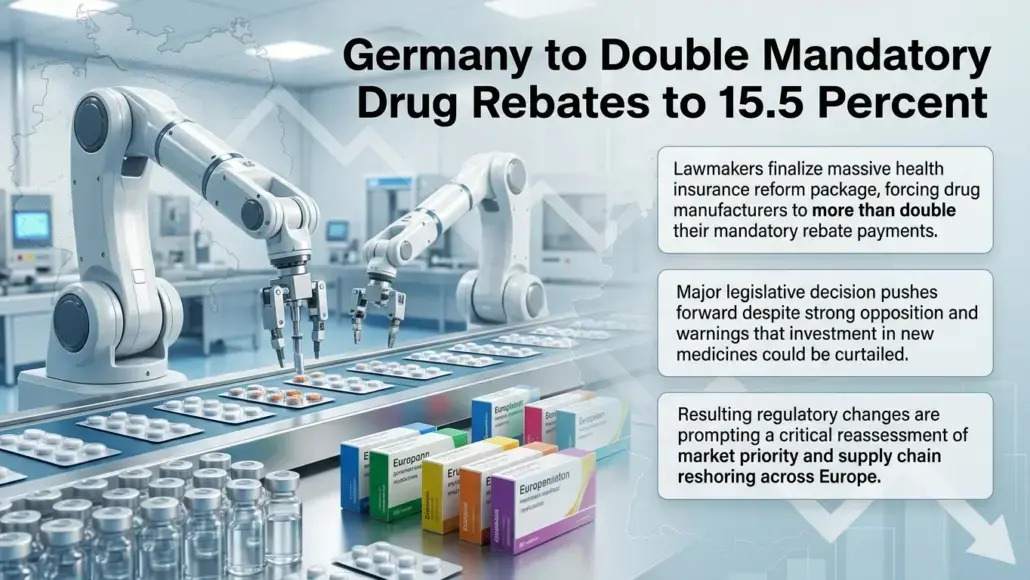
As European nations seek to stabilize their national health systems, the resulting regulatory changes are prompting a reassessment of market priority and supply chain reshoring. In a significant escalation of this trend, German lawmakers have finalized a sweeping health insurance reform package that more than doubles the mandatory drug rebates that manufacturers must pay on patented medicines. This legislative decision, which arrives despite intense industry opposition and warnings of curtailed investment, marks a pivotal moment for the European pharmaceutical market and its relationship with global innovators.
The Legislative Framework and Financial Imperatives
The newly approved health insurance reform, scheduled for implementation on Jan. 1, 2027, establishes a new baseline for pharmaceutical commerce within Germany. Under the finalized law, the fixed manufacturer rebate on branded drugs will rise from the current 7% to a mandatory 15.5%. This adjustment is accompanied by specific restrictions on patented vaccines, which will face both higher rebate requirements and a mandated price freeze spanning the years 2027 to 2030. The final version of the legislation follows a period of intense negotiation, during which a proposed variable, expenditure-linked rebate mechanism was dropped in favor of the fixed increase after significant pressure from industry stakeholders.
German Health Minister Nina Warken defended the reform as a necessary measure to secure the “basis for stable finances” within the national statutory health insurance system. The system has grappled with years of rising contribution rates and faces a projected deficit of 15.3 billion euros in 2027. The reform is designed to provide immediate relief, with government projections suggesting a 16.3 billion euro benefit to the statutory system next year, potentially reaching as much as 38.1 billion euros by 2030. However, the pharmaceutical sector has characterized the move as a significant threat to the country’s status as a center for medical advancement. Merck described the law as a “hard blow to Germany’s pharmaceutical sector,” stating that it “endangers patient care, harms the development of new medicines, and weakens Germany’s position as an innovation hub.”
Industry Resistance and the Global Pressure Campaign
The push for higher mandatory drug rebates triggered a coordinated resistance campaign from global pharmaceutical leaders, many of whom modeled their strategy on a recent successful pressure campaign in the United Kingdom. In the UK, industry-led efforts successfully linked medicine spending to the avoidance of US tariffs, a precedent that German-based and international firms hoped to replicate. Throughout the spring, manufacturers issued stern warnings regarding the potential consequences of the reform on domestic investment and the availability of new treatments.
Specific corporate actions underscored the severity of the industry’s position. Eli Lilly reportedly halved a planned 2.3 billion euro investment, while Germany-based Boehringer Ingelheim canceled 900 million euros in expansion plans. Pfizer formally communicated with the German chancellor, warning that its existing and future investments in the country were at risk. AstraZeneca further cautioned that the regulatory changes might result in the company bypassing Germany for the launch of new medicines. While these efforts secured a partial concession—the removal of the variable rebate mechanism—the core increase in the fixed rebate remains a central grievance for the sector. This friction is not limited to Germany, as evidenced by clinical assessment disputes in France and growing caution regarding reimbursement filings in the Netherlands, suggesting a broader regional shift in pharmaceutical industry relations.
Transatlantic Disparity and Supply Chain Implications
The immediate effect of the German reform is a direct margin reduction in one of the world’s largest pharmaceutical markets, but the larger implications are transatlantic in nature. By aggressively cutting the prices paid for patented drugs, Germany is expanding the pricing gap between itself and the United States. This widening disparity sits at the center of the most-favored-nation policy push, which seeks to tie US domestic prices to lower international benchmarks. The reform effectively provides more data for those advocating for lower US prices, while simultaneously making the US market appear more attractive for manufacturing capacity expansion.
Furthermore, the reform compounds existing trade tensions, particularly the US Section 301 investigation into Germany’s drug pricing opened in June. The investigation argues that German cost-containment measures—such as these mandatory drug rebates—amount to a persistent underpayment for innovative medicines. This probe could lead to the imposition of tariffs on German pharmaceutical exports, including both active pharmaceutical ingredients and finished-dosage products. As drug prices, tariffs, and manufacturing decisions become increasingly intertwined, the industry is witnessing a “reshoring” wave. For manufacturers, the combination of aggressive European price cuts and potential trade penalties creates a compelling argument for prioritizing the US for new production facilities, thereby reshaping pharmaceutical supply chains for the coming decade.


