






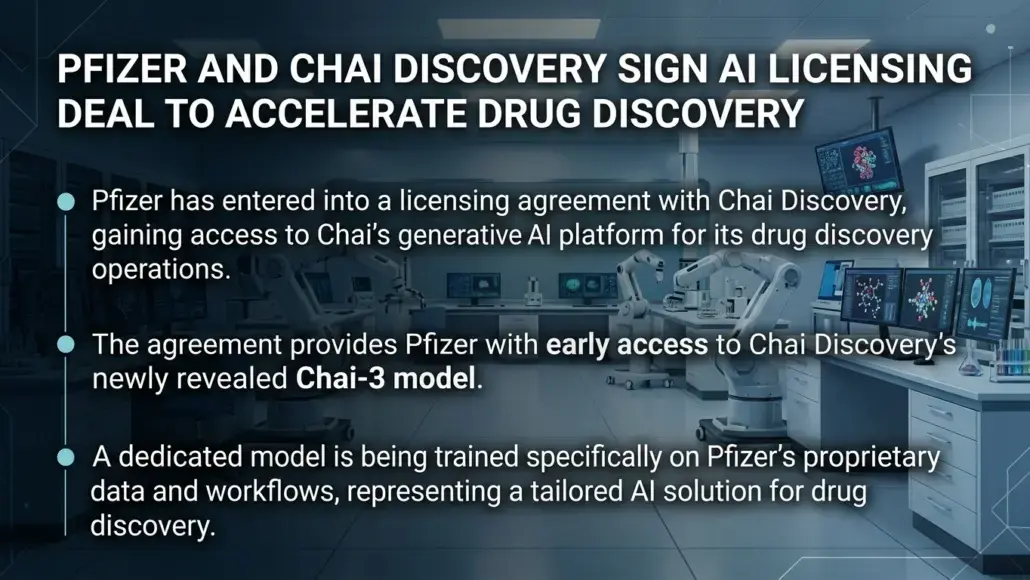
Pfizer has entered into a licensing agreement with Chai Discovery, granting the pharmaceutical giant access to Chai’s generative AI platform for integration into its drug discovery operations. The deal provides Pfizer with early access to the newly revealed Chai-3 model, as well as a dedicated model trained specifically on Pfizer’s proprietary data and workflows — representing a deliberate strategic move toward AI drug discovery acceleration.
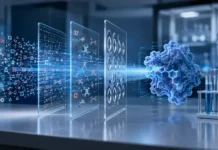
Chai Discovery builds generative AI solutions designed to predict and reprogram molecular interactions, enabling scientists to design biomolecules with defined functional properties. The company’s platforms are engineered to streamline the traditionally time-intensive early stages of drug development by facilitating the design of biomolecules from scratch, targeting complex biological processes, and shortening discovery cycles from several months to just a few weeks.
Chai Discovery co-founder Joshua Meier stated: “Our work with Pfizer is about putting Chai’s software directly into the hands of one of the world’s leading drug discovery organisations. By combining Chai’s frontier AI platform with Pfizer’s scientific depth, data and discovery capabilities, we see an opportunity to expand and accelerate what is possible in biologics discovery and help Pfizer pursue targets that traditional methods have struggled to reach.”
Under the terms of the agreement, Pfizer will be among the first pharmaceutical companies to access the Chai-3 model. The model is reported to deliver meaningful advances in AI-led antibody design, including a doubled success rate relative to its predecessor, the production of therapeutically viable antibodies, and improved capability in targeting difficult-to-drug molecules.
Chai-3 builds on the foundation established by the earlier Chai-2 model, which introduced zero-shot antibody design and improved experimental hit rates. The Chai-2 platform had already demonstrated its value by enabling the design of drug-like molecules and compressing discovery timelines considerably.
The Pfizer–Chai Discovery partnership reflects a broader, ongoing trend of pharmaceutical companies turning to advanced AI models to bridge the gap between early-stage research and practical, real-world drug discovery workflows. The collaboration positions Pfizer to leverage AI drug discovery capabilities in biologics discovery at a depth that traditional methodologies have not been able to achieve.
Separately, last month Pfizer and Innovent Biologics finalized a global licensing and collaboration agreement valued at up to $10.5 billion, focused on the research and development of a portfolio of 12 early-stage cancer medications.