












A blister pack may seem like a simple enough concept until you’re trying to prove that it will open cleanly every time. Peel testing turns each peel into data so you can protect dose integrity, support and child resistance and avoid line surprises.
What Peel Testing Measures
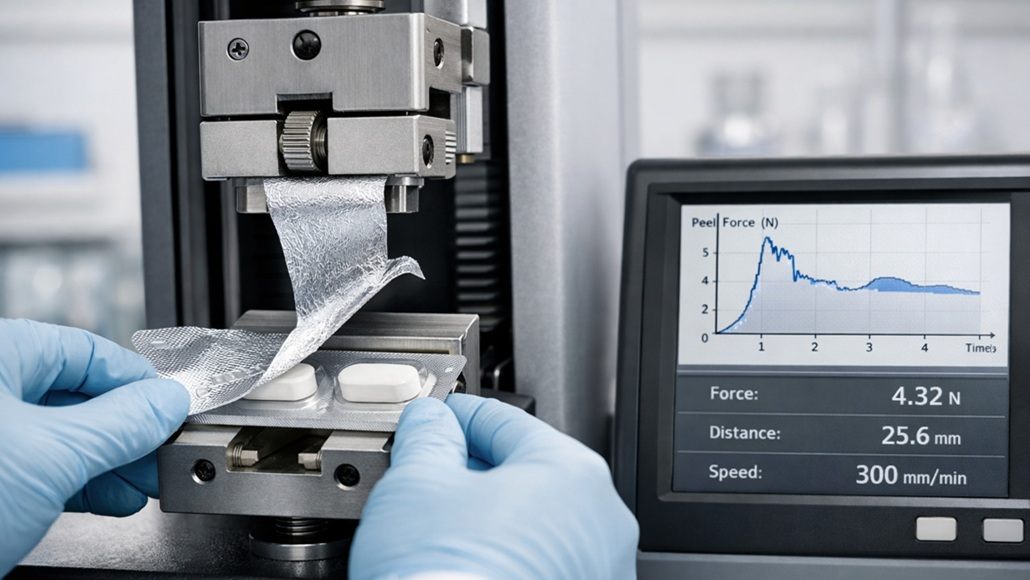
Peel testing measures the force required to separate the lidding from the formed web along a defined path, with results commonly expressed as N/m or lb/in to quantify the strength. In pharma blister work, that data answers whether the pack will open with a steady push, fight the user and tear into shards, or pop open too easily.
A peel curve tells you how the seal behaves. You might see a sharp peak, then a stable plateau or jagged spikes that hint at uneven heat-seal contact. You can also learn what failed between the adhesive, cohesion or delamination of the foil layers. Each one points to a different root cause, which can save time and budget later.
For the day-to-day lab, this usually runs on a universal testing frame, paired with peel grips and fixtures that maintain repeatable geometry.
A blister pack is a layered system, and the test is sensitive. Small setup choices can shift the force level and failure mode. That changes your release decisions and investigations. Here are the parameters that matter most.
1. Test Method and Standard Selection
Start with the peel mode and document closely. A 90° peel can make sense when you need a consistent bend radius and a controlled peel front. A 180° peel is often used when the geometry allows a full foldback and you want a strong, steady signal. Blister formats can complicate both. Cavity spacing and flange width can force a custom approach, which is fine as long as it is documented and repeatable.
Anchor your method to a recognized framework when possible. Many pharma teams reference ASTM or ISO approaches for peel-style testing, then refine the details in internal standard operating procedures (SOPs). The key is consistency across sites and time.
When you are selecting equipment and accessories, match them to your method. Thwing-Albert Instrument Company offers guidance, peel-and-seal testing and peel fixtures that help standardize angle and specimen handling. Those fixtures can also reduce variability.
2. Peel Angle and Path Control
Angle control keeps your data honest. A few degrees off can change the bend mechanics at the peel front. That can raise or lower the force depending on the laminate or sealant.
Control the peel path, too. Make sure the peel front travels the same way across each cavity lane. If the path wanders, you risk testing different seal zones in successive samples. This invalidates the study because, even if the average peel force seems acceptable, the data are unreliable and mask the true performance of any single sealing zone.
3. Crosshead Speed and Dwell Time
Peel strength can be rate sensitive. Faster speeds can push the system toward a higher peak. Slower speeds can reveal a more stable plateau. Pick a speed that matches your internal decision-making and validate it.
Dwell time is also essential. The seal can “set” after manufacturing, and the measured peel can shift after cooling or aging. Define when you test relative to sealing. If you run stability pulls, define those time points clearly.
4. Conditioning and Environment
Temperature and humidity can change polymers and coatings. They can also change the seal interface. Condition samples before testing, when the method requires it, and track the lab environment during testing. Specialized fixtures, such as a heated platen, can be used to measure peel strength at temperatures up to 350° Fahrenheit, allowing teams to evaluate the effects of elevated temperatures on adhesive materials directly.
Also consider what happens before the lab sees the samples, such as warehouse conditions, shipping conditions and time in transit. If you ignore those variables, you can chase a phantom process issue that is actually a handling issue.
Failure Modes and What They Tell You
Peel testing gives you a chance to see what is separated. Adhesive failure means the bond at the interface gave way. Cohesive failure means the sealant layer splits within itself. Delamination suggests the laminate stack or coating system did something unexpected. Tearing can point to brittle lidding or an overstressed tab.
Document what you see, use consistent terms, add photos where possible, and keep the language steady across sites and teams. That consistency makes investigations faster and supplier conversations sharper.
When a failure mode shifts suddenly, treat it as a signal, even if the force still falls within spec. Force can stay stable while the mechanism changes. Mechanism changes usually mean a material or process change somewhere in the chain.
Why Blister Peel Results Drift
Blister peel data moves with the seal system. Sometimes it’s obvious, such as a sealing head running a little cooler on the edges or a dwell time slipping during a high-throughput shift. Sometimes it’s sneakier, such as a foil-coating lot change, a forming fill gauge nudging up or storage humidity shifting.
Operator technique can add noise, too. How the tab gets started and how centered the specimen sits in the grips are both extremely important. If the sample twists, you can create a false peak, where if it slips, you can flatten the curve and still pass by accident. This is why labs lean on a reliable setup with documented specimen prep, defined peel angle, verified speed and regular calibration. You want a method that works every time.
How Thwing-Albert Supports Peel Testing
Peel testing lives in the details. Your lab can have the right standard, intent and people, but if the setup shifts even slightly, you get drift. That will show up in inconsistent peaks, plateaus, or movement when Site A and Site B run the same method and still land far apart.
This is where Thwing-Albert fits into blister peel programs. Its testing systems and accessories are built for labs that need repeatability. Think universal testing frames paired with peel fixtures that help lock angle alignment and specimen handling so that operator technique has less room to sneak into the curve. Its catalog also supports broader physical property testing across materials that many regulated teams work with.
For teams building out or upgrading a peel program, Thwing-Albert also leans into the “capital purchase with a long life” reality. The goal is stable performance and room to expand the test menu later without reinventing the lab. Beyond peel and seal strength, the company’s equipment can quantify dozens of other properties, including tensile strength, puncture, compression and coefficient of friction. This positioning around flexibility for routine and complex testing aligns with how pharma sites grow.
Support is part of the value, too. Thwing-Albert offers installation and training to ensure operators use a consistent technique from the start. Preventive maintenance and calibration support help keep equipment aligned with internal quality requirements. Repair services reduce downtime when something inevitably needs attention.
The Importance of Peel Test Accuracy
When you lock down parameters and report data consistently, you get more than a pass-fail number. You get a diagnostic tool that helps you protect patient experience, support compliance and reduce investigations into why a seal feels different. If you want peel data you can trust, choose equipment and fixtures that make repeatability easier.
FAQS
What peel angle should you use for blister lidding?
Use the angle your internal method can control consistently and that reflects how the pack is opened in real life. Many teams choose 90° or 180°, depending on flange geometry and how the lidding can fold back without tearing. The more important point is that you document the angle and control it with fixtures so results stay comparable across lots.
What is a realistic sample size for lot release decisions?
There is no universal number because risk tolerance differs by product and site. Many quality control groups run enough replicates to capture variability across lanes and sealing zones rather than pulling only from one “nice” area of the web. If you are setting up a new program, align the sample size with process capability work and your deviation history.
Why is peel testing important for the adhesives industry?
It proves bond strength in numbers. It also flags formulation or surface changes fast, so you catch drift before customers do.
Which standards apply to friction testing in flexible packaging?
Most labs lean on ASTM or ISO COF methods and then lock the details in an SOP. Consistency in setup matters more than the logo on the standard.
For which materials is peel adhesion testing most critical?
Peel adhesion testing is most critical for flexible packaging materials, such as laminates, coated films, foils and peelable lidding, where delamination or a messy opening can create significant risks to the product. The test is also a standard quality measure across a wide variety of other materials, including adhesives, plastics, nonwovens, textiles and paper-based structures.