









Determined to cement access to reliable and safe sources for crucial IV drug admixtures, a growing number of hospitals are bringing production of compounded sterile products (CSPs) in-house and turning their backs on external compounding pharmacies. Such far-reaching decisions reflect the lingering distrust of outsourced CSPs, according to several administrators from hospitals that have made this move.
“People were really pulled up short by the events related to the New England Compounding Center [NECC],” said Eric Kastango, MBA, RPh, FASHP, the president and CEO of Clinical IQ and formerly a member of the United States Pharmacopeial Convention’s (USP) Compounding Expert Committee. “Warnings issued by the FDA to other compounding pharmacies have brought to light a lot of the ugly stuff that was going on.”
That “ugly stuff” included a wide range of manufacturing and quality control issues that resulted in a nationwide outbreak of severe meningitis cases caused by tainted steroid injections. To date, about 750 people have developed the infections; 64 have died, according to federal health officials.
As a result of this massive breakdown in drug safety, Mr. Kastango noted, “hospitals are looking for strategies to become self-sufficient and vertically integrated, and to decrease reliance on these vendors.”
A Wake-Up Call To Gain More Control
For some hospitals the decision was, by necessity, sudden. In March 2013, Yale-New Haven Hospital, in Connecticut, received contaminated magnesium sulfate from a compounding pharmacy. No patients were harmed, but the incident was a wake-up call, according to Lorraine Lee, MHA, BS Pharm, the director of pharmacy. “It was much too real because it happened here, we didn’t just read about it,” Ms. Lee said. “Something had to change.”
The hospital’s multiphase transition to insourcing—still a work in progress—began with cutting off the pharmacy responsible for the contaminated drugs. Producing enough CSPs internally then required a 260% increase in staff hours and far greater use of existing infrastructure.
“The bulk of the CSP deficiencies were counteracted without the acquisition of additional equipment,” Ms. Lee said. Other adjustments included re-evaluating the use of previously outsourced CSPs. For example, tightening use restrictions for magnesium sulfate, as recommended by a group of physicians at the hospital, reduced demand for the drug by 30%. Help also came from nursing, which increased its use of closed systems that allow nurses to reconstitute IV drugs in patient care areas safely. Ideally, the second phase will be to divest all third-party CSPs, including total parenteral nutrition (TPN) products. The hospital is considering construction of a new 5,000- to 8,000-square-foot cleanroom at a cost upward of $1 million. Phase 3 would be construction of a centralized compounding service to supply all three of the system’s hospitals.
Ms. Lee noted that insourcing changes the equation for beyond-use dating (BUD). One attraction of outsourcing has been that compounding pharmacies offered extended BUD for the drugs they ship to the hospital, which potentially reduces wasted doses and allows hospitals to stock up on high-volume admixtures. But Ms. Lee became skeptical after her experience with contaminated products. “They tell you they can provide CSPs that have extended beyond-use dates [without compromising stability or sterility of the products] and they have the studies to back that up, but do they really? That’s a big red flag to me now,” she said.
Hospitals that decide to do a higher percentage of sterile compounding in-house must be ready to commit to the added time, training and testing necessary to comply with USP standards for BUD, Ms. Lee stressed. “Operationally, it’s hard to manage and comes at a high cost, and that’s why hospital pharmacies typically don’t put beyond-use dates on the drugs they make,” she noted.
Mass General Pivots Quickly
Massachusetts General Hospital (MGH), in Boston, decided to fast-track CSP insourcing after the FDA shut down Ameridose (a sister company of NECC) for multiple manufacturing violations in fall 2012. The company, which delivered about 68,000 doses to MGH monthly, had been the hospital’s primary CSP supplier, according to Erasmo A. Mitrano, RPh, MS, MGH’s associate chief of pharmacy. “We needed very quickly to change gears to take care of patients,” he said.
In the year before the Ameridose closing, the hospital produced about 200,000 CSPs. The following year, insourced production reached 320,000—a 150% increase, according to Nathan Van Allen, PharmD, the pharmacy compounding manager. The hefty increase was made possible through increased staffing (including pharmacy students, overtime and outside agency help) and around-the-clock operation of compounding facilities. “We’re still using an additional 10 to 12 full time–equivalent staff positions than we were before,” Dr. Van Allen said, noting that the added stress on the pharmacy staff has meant increased sensitivity to burnout and health problems.
“We’re still in the middle of this; it hasn’t eased up,” added Mr. Mitrano.
Just as at Yale-New Haven Hospital, the pharmacy leadership at MGH reached out to other services, particularly nursing and anesthesia, to help fill the vast shortfall. Systems such as Mini-Bag Plus (Baxter) allowed drugs to be reconstituted safely by nurses outside of a cleanroom. Anesthesia providers, who had been receiving 13,000 syringes monthly from Ameridose, began drawing up their own syringes in preparation for—and during—surgery. “That type of help had an enormous impact and took a lot of weight off our shoulders,” Mr. Mitrano said.
Making such a titanic transition—either under the gun or more deliberately—requires tremendous support from hospital administration, Mr. Mitrano stressed. “You must have their total commitment that this is the way the institution wants to go; it can’t be a partial effort,” he said.
To keep up the momentum, the pharmacy is undergoing a build-out of its current facility and has acquired additional IV workstations and robotics, Mr. Mitrano noted. He predicted that automated production eventually will account for 75% of CSP preparation. “We’ll essentially have our own compounding facility within the hospital.” Self-sufficiency is getting closer, added Dr. Van Allen. The hospital now produces about 90% of its CSPs; for now, it will continue to outsource TPN products.
BWH a Fan of ‘Re-Insourcing’
At Brigham and Women’s Hospital (BWH) in Boston, CSP supply lines were disrupted to a lesser extent than at other facilities during the IV compounding crisis, because the hospital had already begun the process of ramping up internal compounding of IV sterile products, according to Bill Churchill, MS, RPh, the chief of pharmacy services. Although quality and safety were major driving forces for “re-insourcing” (the term Mr. Churchill prefers for describing the hospital’s new direction), so were financial implications. The hospital projected, and realized, major savings (estimated at $1.5 million; sidebar) over the past few years, which it attributes to the strategic shift. “Bringing production inside and having control of our own environment with our own staff was a much better way for us to go,” Mr. Churchill said.
The hospital also hired a microbiologist to work in the pharmacy department to coordinate all IV compounding quality assessment, including end-product testing, staff testing and facility testing, and to assure compliance with USP Chapter standards. All CSP batches are tested and quarantined until they are confirmed sterile and stable.
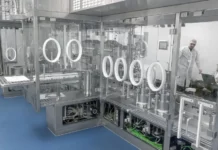
“Only after they pass muster with my microbiologist do they move into circulation for patients,” Mr. Churchill explained. BWH also invested in upgrading on-site cleanroom facilities. Once a new negative-pressure cleanroom is completed, the existing main cleanroom will be upgraded and renovated to further increase capacity. BWH also has purchased four IV compounding robots. A fifth one, dedicated to oncology, is expected in June.
New workflow patterns and staff responsibilities also emerged. The changes were heavily influenced by lean process redesign, a method for streamlining processes or systems by eliminating as much waste and unnecessary work as possible. Some pharmacy technicians, for example, have become automation experts, expanding their skill sets well beyond more traditional tasks, like drawing up syringes in a laminar flow hood. Additionally, the BWH pharmacy used to produce CSPs in batches to cover the following 18 hours of use, but that was not efficient. “Drug regimens change, orders get discontinued, doses get changed. A lot of the labor and materials expended for long batch runs were being wasted,” Mr. Churchill said. Now, the restructured workflow, supported by newer technology and greater staff expertise, allows batches to be produced every four hours. “That was a huge step forward for us.”
Centralized Compounding?
The pharmacy now produces about 70% of the CSPs used at the hospital—up from about 40% two years ago. Going forward, Partners HealthCare, the umbrella system for both BWH and MGH, is contemplating the feasibility of a centralized compounding facility to supply all 13 of its hospitals. In the interim, the steps taken have been challenging and progress gradual. “It’s an ongoing process where you take things in bite sizes that you feel comfortable with,” Mr. Churchill said. “To make the change, operationalize that change, go back and re-evaluate it, then continue to evolve your process with the next change until you finally get it where you want it, takes time and patience. The process simply cannot be rushed.”