






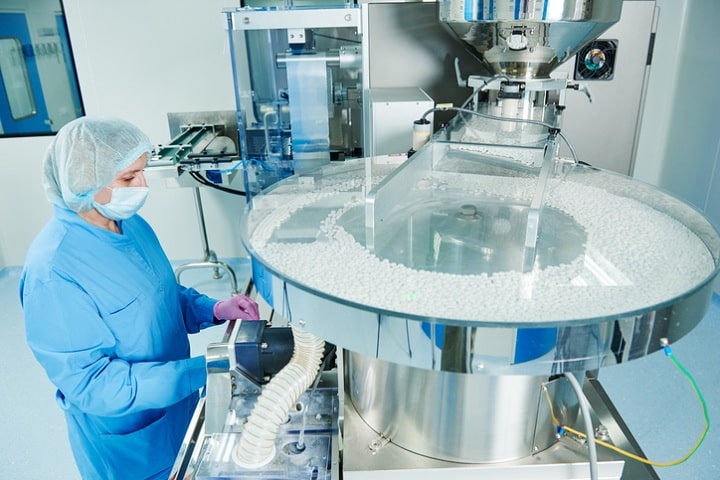
Ahead of P-MEC 2019, the only dedicated pharmaceutical machinery event in Europe this year – co-located with CPhI Worldwide in Frankfurt, 5-7 November – the first ever CPhI Pharmaceutical Machinery Report identifies trends impacting the market. The findings highlight how the changing drugs pipeline and the industry’s drive towards more efficient manufacturing is necessitating new investments in pharma equipment.
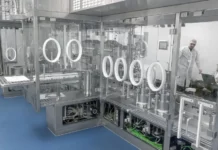
The evolving R&D pipeline of smaller volume drugs, coupled with advanced technologies that remove scale-up challenges – such as single-use equipment and continuous processing – are not only transforming industry attrition rates, but vastly changing the types of machinery used in pharma manufacturing. Moreover, running alongside this pipeline evolution are newer approaches that reduce the number of steps in process development, making production greener and lowering overall cost. Manufacturing is now at a crucial juncture as push and pull drivers – including newer technologies, changing pipelines and demand for lower cost drugs – combine to significantly alter how drugs will be made in the future. The report predicts we are on the cusp of a new age of smart pharma manufacturing, as equipment is set to take centre-stage in the development of advanced medicines.
P-MEC 2019 itself is testament to this trend. Exhibitor numbers have doubled in a single year to over 150, as the industry shifts its perspective on new technologies from ‘in an ideal world we would’ to ‘we must have these to grow’. In an industry that has often been dependent on legacy systems and undertaking manufacturing in ‘the same way as before’ for fear of encountering any potential regulatory hurdles, this is a seismic shift. Significantly, this potentially has huge implications for the entire supply chain and CPhI Worldwide – the largest pharma event in the world with more than 45,000 attendees – is seeing changes across all parts of the show from contract services to ingredients, packaging and finished dosage drugs.
The report also forecasts how flexibility in product design is now integral to the lifespan of equipment – a consequence of new products often being produced for smaller patient cohorts. For example, new types of delivery systems and dosages, mean new packaging and labelling equipment are needed that can adjust to these individual dosage forms.
Reflecting industry drivers, the agenda at P-MEC 2019 explores the implications of patient centricity, evolving equipment for an eco-friendly age, and how new devices used in the biologics industry are affecting equipment considerations and the implications for filling machines.
In another key trend, regulators are striving to make manufacturing processes increasingly standardized and controlled – with technologies that improve quality risk-based methodologies (QRM), Quality by Design (QbD), process analytical technology (PAT) and continuous manufacturing encouraged.
A potential implication of seeking greater control in process methods will be the need for an increased use of real-time monitoring. Significantly, methods from raman and infrared spectroscopy, chromatographic separation to faster technologies such as ultra-performance liquid chromatography (UPLC) or ultra-high performance LC (UHPLC) are proliferating alongside nuclear magnetic resonance (NMR). However, the big challenge that continues to remain is how to build these into commercial production for real-time analysis in enclosed systems, single use technologies, and continuous rigs.
Finally, the report ponders how digital technologies may improve production and machinery as an ‘unknown variable’. For example, the impact that digital technologies will play in reducing downtime and increasing process efficiency through AI. One solution could see the use of connected machines to reduce the need for pharma customers to audit contract manufacturers or ingredient suppliers in person – with real-time product updates supplied automatically, essentially a natural evolution of PAT guidelines.
Orhan Caglayan, Brand Director – CPhI Worldwide & P-MEC, said: “From the optimization of old legacy manufacturing sites to the increased use of testing facilities and equipment, there is genuine excitement around the pharmaceutical machinery industry. This is mirrored by a 50% increase in exhibitors at this year’s P-MEC event, with over 150 confirmed exhibitors so far. What’s more, P-MEC is taking place in Frankfurt, Germany – a hub of manufacturing and Europe’s largest pharma market – and it’s the only pharmaceutical machinery exhibition this year in Europe. So it’s an unmissable opportunity for any company looking to explore the latest technologies to transform the way they work both today and in the future.”
About CPhI
CPhI drives growth and innovation at every step of the global pharmaceutical supply chain from drug discovery to finished dosage. Through exhibitions, conferences and online communities, CPhI brings together more than 100,000 pharmaceutical professionals each year to network, identify business opportunities and expand the global market. CPhI hosts events in Europe, Korea, China, India, Japan, South East Asia, North America, and the Middle East and Africa. Co-locating with ICSE for contract services; P-MEC for machinery, equipment & technology; InnoPack for pharmaceutical packaging; bioLIVE for biopharma; and Finished Dosage Formulation for every aspect of the finished dosage supply chain. CPhI provides an online buyer and supplier directory at CPhI-Online.com.
About Informa Markets
Informa Markets creates platforms for industries and specialist markets to trade, innovate and grow. Our portfolio is comprised of more than 550 international B2B events and brands in markets including Healthcare & Pharmaceuticals, Infrastructure, Construction & Real Estate, Fashion & Apparel, Hospitality, Food & Beverage, and Health & Nutrition, among others. We provide customers and partners around the globe with opportunities to engage, experience and do business through face-to-face exhibitions, specialist digital content and actionable data solutions. As the world’s leading exhibitions organiser, we bring a diverse range of specialist markets to life, unlocking opportunities and helping them to thrive 365 days of the year. For more information, please visit www.informamarkets.com