













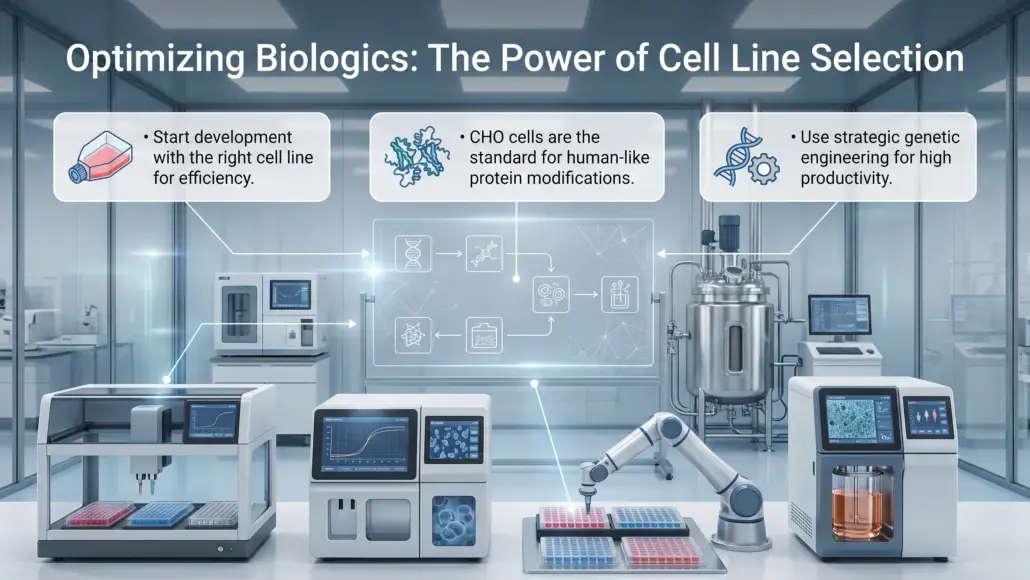
The efficiency of biologics production is fundamentally determined at the start of the development cycle during cell line selection. Chinese Hamster Ovary cells remain the industry standard due to their ability to perform human-like post-translational modifications, which are essential for the efficacy and safety of monoclonal antibodies. Achieving high productivity requires a strategic approach to genetic engineering, ensuring that the selected cell lines possess the metabolic capacity to sustain high growth rates and protein secretion over extended periods. Modern upstream process optimization begins with the integration of site-specific integration technologies, which allow for more predictable and stable expression of the target protein compared to traditional random integration methods.
Researchers are increasingly focusing on metabolic engineering to enhance the robustness of these cell lines. By manipulating key metabolic pathways, scientists can reduce the accumulation of inhibitory by-products like lactate and ammonia, which often limit cell density and viability in large-scale bioreactors. The use of advanced screening platforms allows for the rapid identification of high-performing clones under conditions that mimic the eventual production environment. This early-stage optimization is critical because any limitations in the cell line cannot be easily corrected once the process moves into the manufacturing scale. The goal is to create a cellular factory that is not only productive but also resilient to the physical stresses encountered during industrial cultivation.
Beyond the genetic makeup of the cells, the stability of the expression system must be rigorously evaluated. Genetic drift or loss of the transgene can lead to significant drops in yield and changes in product quality over time. Continuous monitoring of genetic markers and expression levels during the expansion phase provides the necessary data to ensure that the production clones remain consistent. By prioritizing cell line resilience, pharmaceutical companies can lay a solid foundation for subsequent stages of the manufacturing process, ultimately leading to more cost-effective and reliable biologics production.
Media Formulation and Nutrient Feed Strategies
The composition of the cell culture media is a primary lever in upstream process optimization, directly influencing both the growth rate of the cells and the quality of the final biologic. Traditional chemically defined media must be meticulously balanced to provide the essential amino acids, vitamins, and minerals required for cellular metabolism. Each cell line has unique nutritional requirements, necessitating a customized approach to media development. Small variations in the concentration of trace elements can have profound effects on the glycosylation patterns of the protein, which are critical for its biological activity and immunogenicity.
Developing an effective feeding strategy is just as important as the initial media composition. Fed-batch cultivation, the most common industrial method, involves the periodic addition of concentrated nutrients to sustain cell growth and extend the duration of the production phase. The timing and composition of these feeds must be carefully controlled to avoid nutrient depletion or the buildup of toxic metabolites. Advanced monitoring techniques, such as online Raman spectroscopy, allow for the real-time measurement of nutrient levels in the bioreactor. This data enables the implementation of automated feeding loops that adjust the nutrient supply based on the actual metabolic demand of the cells, rather than relying on fixed schedules.
In addition to basic nutrients, the use of specialized additives can further enhance production efficiency. Chemically defined supplements that mimic the effects of serum can boost cell viability and protein secretion without the risks associated with animal-derived components. The industry is also exploring the use of high-throughput media screening platforms that utilize miniaturized bioreactors to test hundreds of different media combinations simultaneously. This accelerated development process allows for the identification of optimal nutrient balances in a fraction of the time required by traditional methods, significantly reducing the overall development timeline for new biologics.
Bioreactor Control and Environmental Parameters
Maintaining a consistent environment within the bioreactor is essential for achieving high yields and ensuring product quality. Parameters such as temperature, pH, dissolved oxygen, and carbon dioxide levels must be tightly controlled within a narrow range. Even minor fluctuations can lead to cellular stress, resulting in decreased productivity or alterations in the protein structure. Modern upstream process optimization involves the use of sophisticated control systems that integrate data from multiple sensors to maintain the desired setpoints. The move toward single-use bioreactors has also introduced new considerations, as the physical properties of these systems can differ from traditional stainless steel tanks.
Oxygen transfer is often the limiting factor in high-density cell cultures. As the cell concentration increases, the demand for oxygen grows, requiring efficient aeration and agitation strategies. However, excessive agitation can cause shear stress, damaging the delicate mammalian cells. Scientists must find a balance between providing adequate oxygen and minimizing physical damage. The design of the impeller and the sparging system plays a critical role in this process. Computational fluid dynamics modeling is increasingly used to simulate the environment inside the bioreactor, allowing for the optimization of mixing and mass transfer before the physical process is even started.
Temperature shifts are another common strategy used to improve biologics production. By lowering the temperature during the production phase, researchers can slow down cellular metabolism and extend the life of the cells, often leading to a significant increase in the final protein concentration. This requires a deep understanding of the cellular response to temperature changes, as different cell lines may react differently. The integration of process analytical technology allows for the continuous tracking of these environmental variables, providing a detailed record that is essential for regulatory compliance and process validation.
Transition to Continuous Manufacturing and Perfusion
The pharmaceutical industry is gradually moving away from traditional fed-batch processes toward continuous manufacturing, with perfusion technology playing a central role. In a perfusion system, fresh media is continuously added to the bioreactor while the cell-free product is removed, allowing the cells to be maintained at extremely high densities for several weeks or even months. This approach can lead to significantly higher volumetric productivity and a smaller manufacturing footprint compared to batch processes. Upstream process optimization for perfusion requires a shift in mindset, as the focus moves from managing a single batch to maintaining a steady state over an extended period.
One of the primary challenges in perfusion is the effective separation of the cells from the harvest stream. Various technologies, such as acoustic wave separation and tangential flow filtration, are used to retain the cells within the bioreactor. The choice of cell retention device depends on the scale of production and the sensitivity of the cells. Maintaining the stability of the system over long durations also requires a comprehensive strategy for managing the accumulation of cellular debris and potential contaminants. Continuous monitoring of the metabolic state of the cells is vital to ensure that the culture does not drift away from the optimal production window.
Despite the complexities, the benefits of continuous manufacturing are compelling. It allows for the production of labile proteins that might be degraded if left in a batch bioreactor for several days. Additionally, the steady-state nature of the process facilitates better control over product quality, as the environmental conditions remain constant. As the industry gains more experience with these systems, the adoption of perfusion technology is expected to grow, driving further improvements in the efficiency and cost-effectiveness of biologics production globally.
Scaling Up and Regulatory Quality Standards
Moving an optimized upstream process from the laboratory to the commercial scale is a complex undertaking that requires careful consideration of scaling laws and equipment differences. The goal is to ensure that the performance observed in small-scale models is replicated in large production bioreactors. Upstream process optimization must account for the differences in mixing times, pressure gradients, and gas exchange rates that occur at larger volumes. Scale-down models are essential for troubleshooting and for conducting the necessary experiments to define the design space for the process.
Regulatory agencies place a high priority on the consistency and quality of biologics. Any changes in the upstream process, such as a shift in the cell line or a major change in the media composition, must be thoroughly validated to ensure that they do not affect the safety or efficacy of the drug. The use of quality by design principles is crucial here, as it provides a framework for understanding how variations in the process impact the critical quality attributes of the product. Detailed documentation of the process development and the rationale for the chosen parameters is a requirement for successful regulatory submission.
The integration of advanced data analytics and machine learning is also beginning to play a role in upstream optimization. By analyzing large datasets from past production runs, companies can identify subtle patterns and correlations that might be missed by human observers. This can lead to more accurate predictions of process performance and the identification of new opportunities for efficiency gains. As the pharmaceutical sector continues to evolve, the ability to rapidly develop, optimize, and scale upstream processes will be a key factor in bringing innovative biologics to patients more quickly and affordably.