










At Bruker’s virtual 4D-Proteomics™ eXceed Symposium (eXceed Symposia 2021 | Bruker), Bruker Corporation (Nasdaq: BRKR) today announced the launch of two new timsTOF instruments. They further advance and enable new applications and methods in unbiased proteomics, epiproteomics/PTM characterization, and unbiased, deep multiomic biomarker discovery, for example in cancer liquid biopsy research. Bruker’s collaborators are making major progress in unbiased single cell proteomics, phosphoproteomics and plasma proteomics, leveraging the speed, sensitivity and dynamic range of large-scale CCS-enabled 4D-Proteomics and 4D-Epiproteomics.
At the end of 2020, a breakthrough paper by the Mann-group demonstrated unbiased, true single-cell proteomics on over 1,400 protein groups on a timsTOF R&D prototype to address new quantitative questions in single-cell biology and pathobiology.1 Bruker has accelerated its product development and today launches the ultra-high sensitivity timsTOF SCP system for unbiased, quantitative single-cell 4D-Proteomics, and for ultra-sensitive neoantigen discovery in immunopeptidomics.
Since its introduction in 2017, the timsTOF Pro system has offered researchers new capabilities in unbiased CCS-enabled 4D-Proteomics, typically on 5x-20x lower sample amounts and with 3x-5x faster run times for single shot, deep proteomics – with higher throughput and unprecedented robustness.
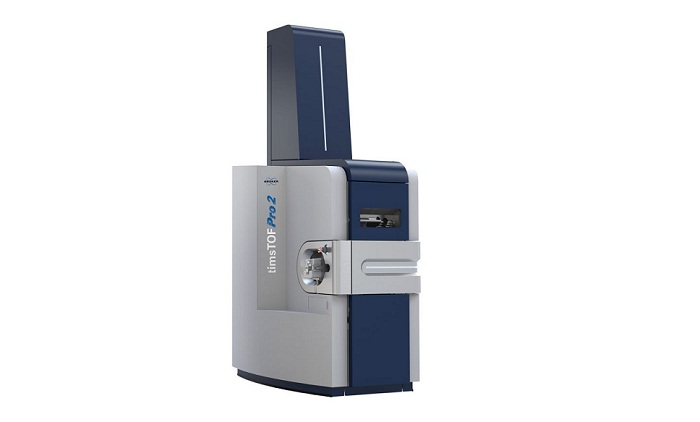
With the introduction of the next-generation timsTOF Pro 2, Bruker continues the revolution in CCS-enabled 4D-Proteomics, as well as in 4D-Epiproteomics, defined here broadly as the characterization of all protein posttranslational modifications (PTMs). The timsTOF Pro 2 offers deeper proteome coverage of >6,000 protein groups and >60,000 unique peptides in 60 minute gradients on 200 ng HeLa digests. It also achieves good depth of proteome and epiproteome coverage at 10x lower amounts, e.g., with ~4,000 proteins and ~30,000 peptides on 20 ng digests. The outstanding timsTOF Pro 2 sensitivity significantly enhances methods to detect post-translational modificiations (PTMs), such as phosphoproteomics and ubiquitination studies, for CCS-enabled, unbiased, large-scale 4D-Epiproteomics, which is tremendously important in physiology, cell biology and disease biology, especially in cancer.
Bruker also announced new capabilities in PaSER real-time search software for 4D-Proteomics. The new PaSER 2022 offers large-scale CCS-enabled bioinformatics, leveraging the unique tims/PASEF methods. For example, the new TIMScore™ increases the confidence of peptide IDs by leveraging the fourth dimension of large-scale collision cross sections (CCS) on all measured peptides. Increased confidence using CCS reduces ambiguities of redundant peptide sequences – resulting in more protein group and unique peptide identifications based on the same FDR threshold.
Frank H. Laukien, Bruker President and CEO, commented: “I believe that the timsTOF SCP is a revolutionary new tool for unbiased, deep and quantitative single-cell biology that is complementary to scRNA-seq. In the future, basic research in single-cell biology and pathogenesis will greatly benefit from ‘having both eyes open’ in gene expression, by combining transcriptomics with unbiased, deep and quantitative proteomics and epiproteomics data for multiomic biomarker panels.”
Dr. Laukien continued: “In liquid biopsies there is an unmet clinical need for greater cancer stage I/II detection sensitivity and improved positive predictive values, as well as for earlier detection of therapy resistance. For integrated multiomic deep learning in both, cancer cell genomics and epiproteomics, as well as in host immune response and tumor microenvironment, unbiased proteomics and PTMs are highly complementary to NGS for achieving further major progress in PPV for the benefit of patients.”
A. timsTOF SCP Launch
The timsTOF SCP is the culmination of a collaboration with the laboratory of Professor Matthias Mann at the Max Planck Institute of Biochemistry in Martinsried, Germany, and with Evosep on new Whisper methods at ultra-low flow rates of ~100 nL/min.
The timsTOF SCP achieves 5 times higher ion transmission for data-independent dia-PASEF, or parallel reaction monitoring prm-PASEF methods. The dia-PASEF2 method has demonstrated true, unbiased 4D-Proteomics from single cells1 with quantitation of ~1,500 proteins/cell, in hundreds of isolated single cells ex situ, in combination with the Evosep One LC with Whisper. The timsTOF SCP is a dedicated ultra-high sensitivity instrument for unbiased single cell proteomics, after laser capture microdissection of one or a few cells, as well as for ultra-sensitive neoantigen discovery in immunopeptidomics in the field of immunooncology research. With the timsTOF SCP, a system is now available to expand the single-cell biology horizons beyond genomics and transcriptomics to unbiased, quantitative 4D-Proteomics.
Quantitative biology can now be done also with unbiased single cell proteomics, as cells at different stages in the growth cycle have a protein core with sufficient copy numbers to observe statistically relevant changes in abundance, when compared to sparse mRNA copy numbers.
Professor Matthias Mann commented: “I always said that single cell proteomics would not happen in my lifetime, but I’m happy to have been proven wrong. Single-cell technologies are revolutionizing biology but are today mainly limited to imaging and deep sequencing. However, proteins are the main drivers of cellular function and in-depth characterization of individual cells by mass spectrometry (MS)-based proteomics using instrumentation like the timsTOF SCP will be highly complementary. Our laboratory has been very pleased with the collaboration with Bruker, and I congratulate the Bruker team on the rapid commercialization of the novel timsTOF SCP technology.”
B. Next-generation timsTOF Pro 2 Launch
The timsTOF Pro 2 is the new proteomics workhorse for robust, unbiased, deep and quantitative 4D-Proteomics and 4D-Epiproteomics for plasma, tissue samples and from cell cultures. Further design advances combined with enhanced dda-PASEF, dia-PASEF and prm-PASEF methods deliver industry-leading performance, with unparalleled robustness and throughput. The timsTOF Pro 2 allows the detection of > 6,000 proteins and
> 60,000 peptides by dda-PASEF with 60 minute gradients on 200 ng of digest. It also has new high sensitivity methods that enable very good proteome coverage with 10x less digest, down to 20 ng, for >3,500 protein groups and >25,000 unique peptides using a 30 minute gradient.
dia-PASEF workflows on timsTOF Pro 2 include an improved interface for designing experiments, and can now identify ~8,000 protein groups and 70,000 peptides in 60 minutes on 200 ng of digests.
These timsTOF Pro 2 performance improvements are important for 4D-Epiproteomics, and particularly phosphoproteomics. Phosphorylation is key to signaling and is often mis-regulated in cancer and other diseases. Phosphopeptides are enriched prior to analysis, and researchers often started with several milligrams of biological material to isolate a sufficient quantity of phosphopeptides for analysis. As shown by Professor Stefan Tenzer at the Institute for Immunology of the University Medical Center of the Johannes-Gutenberg University Mainz, with the timsTOF Pro 2 it is now possible to start from just 150 ug of protein and identify 27,768 unique phosphopeptides. In particular, 457 co-eluting positional phosphorylation isomers were resolved by the combination of TIMS and PASEF. Even with 25 ug of protein, >4,400 phosphopeptides can be reproducibly identified, paving the way toward phosphoproteomics on needle biopsies.
Professor Tenzer stated: “Besides its high sensitivity, a unique aspect of the TIMS technology is its capability to resolve positional phosphorylation isomers in the gas phase by ion mobility, thus providing more detailed insights into signaling pathways.”
Sensitivity is absolutely crucial in immunopeptidomics, and Professor Janne Lehtiö of the Science for Life Laboratory, Department of Oncology-Pathology at the Karolinska Institute in Stockholm, Sweden, added: “We have been impressed with the performance of the timsTOF Pro. In particular, the speed and sensitivity of the instrument enable us to see more immunopeptides from limited amounts of starting material, which we expect to be particularly valuable for neoantigen discovery and the development of personalized therapies for cancer immunooncology treatments.”
C. New PaSER Capabilities
New functionalities of PaSER 2022 include: MOMA Viewer, real-time de novo peptide sequencing and TIMScore™ for unbiased 4D-Proteomics, in addition to ‘Run & Done’ search.
Sebastian Vaca, PhD, Research Scientist in the Carr Lab at the Broad Institute of MIT and Harvard, explained: “Real-time results by PaSER on our timsTOF Pro have been a huge time saver. They allows us to develop methods faster, inform on LC and instrument performance, and provide a major gain in the efficiency of proteomics and PTM research.”
PaSER now has a MOMA (mobility offset mass aligned) viewer to characterize co-eluting isomeric or isobaric ions by large-scale CCS. The GPU-based search has been extended into immunoproteomics. Working with Professor Tony Purcell and Bioinformatics Solutions Inc., the ability to perform real-time de novo sequence assignment delivers new capabilities for novel neoantigen discovery.
Finally, PaSER 2022 incorporates a new CCS-enabled database search algorithm, called TIMScore™, developed together with Professor John Yates, and driven by machine learning. TIMScore becomes the first fundamentally CCS-enabled database search algorithm, increasing the number of protein and peptides identified, while maintaining FDR control and real-time search speeds.
About Bruker Corporation
Bruker is enabling scientists to make breakthrough discoveries and develop new applications that improve the quality of human life. Bruker’s high performance scientific instruments and high value analytical and diagnostic solutions enable scientists to explore life and materials at molecular, cellular and microscopic levels. In close cooperation with our customers, Bruker is enabling innovation, improved productivity and customer success in life science molecular and cell biology research, in applied and pharma applications, in microscopy and nanoanalysis, as well as in industrial applications. Bruker offers differentiated, high-value life science and diagnostics systems and solutions in preclinical imaging, clinical phenomics research, proteomics and multiomics, spatial and single-cell biology, functional structural and condensate biology, as well as in clinical microbiology and molecular diagnostics.