








Close
CDMO Safety Testing 2026
Novotech

Boehringer Ingelheim Launches New AI R&D Centre in London

Note* - All images used are for editorial and illustrative purposes only and may not originate from the original news provider or associated company.

Subscribe

- Never miss a story with notifications

- Gain full access to our premium content

- Browse free from any location or device.

Media Packs

Expand Your Reach With Our Customized Solutions Empowering Your Campaigns To Maximize Your Reach & Drive Real Results!

โ€“ Access the Media Pack Now

โ€“ Book a Conference Call

โ€“ Leave Message for Us to Get Back

Related stories

BeOne Signs $2B Trispecific Antibody Deal with Huahui Health

BeOne Medicines has entered into a high-value agreement with...

Quantum Machine Learning in Pharma Research Growth

The convergence of artificial intelligence and quantum processing is opening new avenues for rapid discovery and innovation within the life sciences. By utilizing advanced mathematical models that operate across multi-dimensional datasets, researchers can now identify complex biological patterns and predict molecular behaviors with a speed that surpasses traditional computational methods. This transformation is accelerating the development of novel therapies and providing deeper insights into disease mechanisms, fundamentally altering the trajectory of pharmaceutical research and development.
- Advertisement -

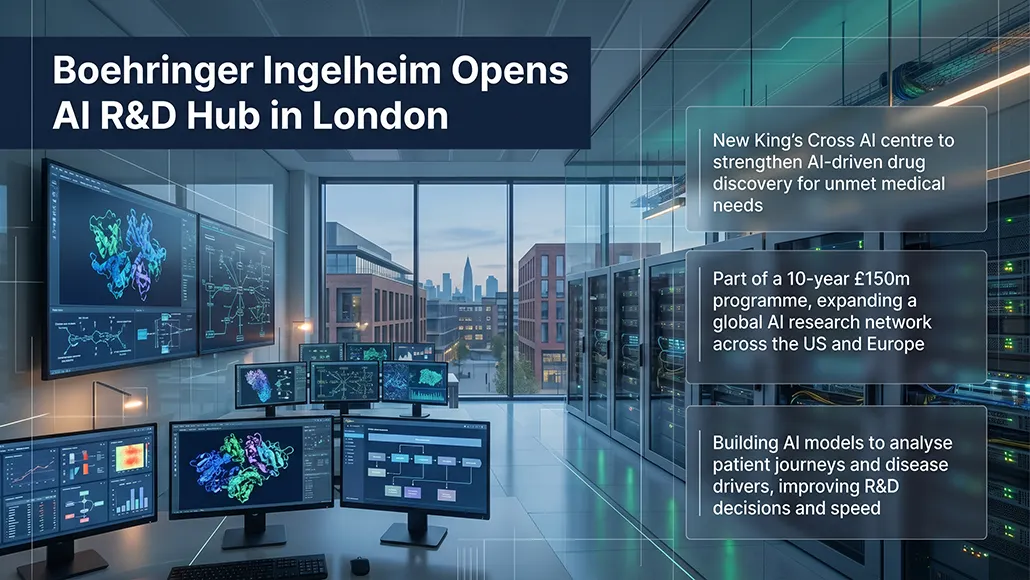
Boehringer Ingelheim has introduced a new artificial intelligence (AI) and machine learning (ML) facility in London, strengthening its efforts to integrate advanced technologies into pharmaceutical research. The AI R&D centre will focus on applying AI models to support the discovery and development of targeted medicines, particularly for patients with unmet medical needs.

Located in Kingโ€™s Cross, the Computational Innovation site forms part of a broader ยฃ150m ($202.7m) investment programme spread across 10 years. The company expects the initiative to enhance its ability to understand biological processes that influence patient outcomes, while also improving identification of mechanisms with a higher likelihood of success in drug development. The London facility joins similar AI-focused sites already operating in the US, Austria, and Germany, expanding Boehringerโ€™s global research footprint.

The company indicated that the site will help accelerate development timelines and improve decision-making in R&D. Activities at the AI R&D centre will include building foundational AI models to analyse patient journeys, identify disease drivers, and determine root causes, ultimately supporting the development of more precise therapies. The facility, which officially opened on 20 April, is expected to onboard its first 50 AI specialists by the end of 2027.

Paola Casarosa, global head, innovation unit at Boehringer Ingelheim, commented: โ€œEstablishing a presence in London allows us to leverage the UKโ€™s rich data resources and infrastructure, while connecting with world-class talent across academia, biotechnology and AI ecosystems to enable innovation for patient benefit.โ€ The move aligns with wider ambitions to strengthen Londonโ€™s life sciences ecosystem, particularly following the London Cancer Hubโ€™s $1bn expansion announcement in February 2026. UK science minister Lord Patrick Vallance added: โ€œAI is unlocking opportunities to advance discovery in life sciences like never before and Boehringerโ€™s decision to open its new hub in Kingโ€™s Cross will ensure they can both access and contribute to a flourishing base for innovation in London.โ€

Latest stories

Related stories

BeOne Signs $2B Trispecific Antibody Deal with Huahui Health

BeOne Medicines has entered into a high-value agreement with...

Quantum Machine Learning in Pharma Research Growth

The convergence of artificial intelligence and quantum processing is opening new avenues for rapid discovery and innovation within the life sciences. By utilizing advanced mathematical models that operate across multi-dimensional datasets, researchers can now identify complex biological patterns and predict molecular behaviors with a speed that surpasses traditional computational methods. This transformation is accelerating the development of novel therapies and providing deeper insights into disease mechanisms, fundamentally altering the trajectory of pharmaceutical research and development.

Quantum Sensors Enabling Advanced Drug Diagnostics

The landscape of medical diagnostics is being reshaped by the introduction of sensing technologies that operate with atomic-level sensitivity. By providing high-fidelity measurements and real-time data, these tools allow for the detection of subtle biological changes and chemical markers that were previously invisible to conventional equipment. This advancement is enhancing the precision of drug testing and clinical monitoring, leading to earlier disease detection and more effective therapeutic interventions across the global healthcare spectrum.

Subscribe

- Never miss a story with notifications

- Gain full access to our premium content

- Browse free from any location or device.

Media Packs

Expand Your Reach With Our Customized Solutions Empowering Your Campaigns To Maximize Your Reach & Drive Real Results!

โ€“ Access theMedia Pack Now

โ€“ Book a Conference Call

โ€“ Leave Message for Us to Get Back

Translate ยป