











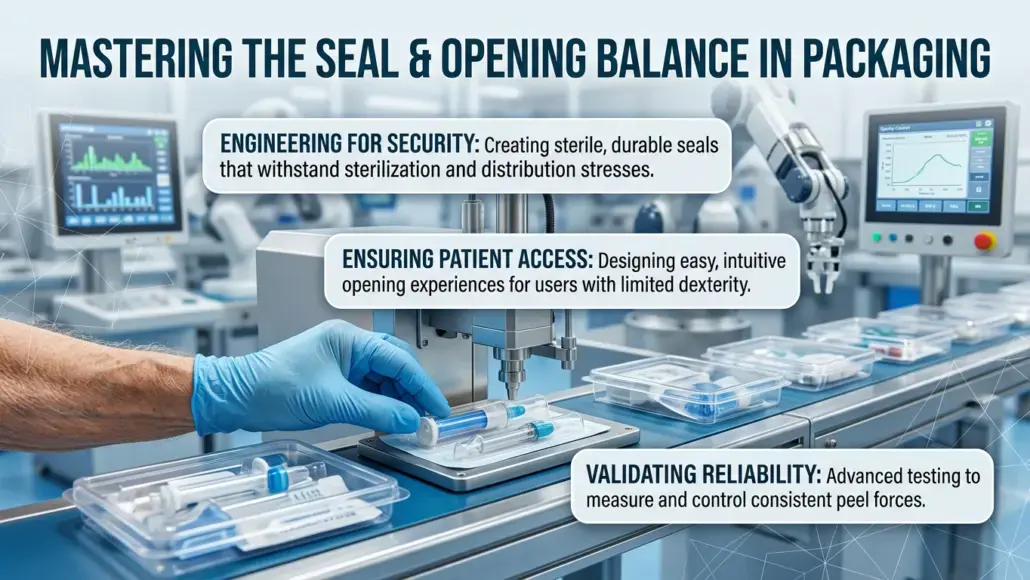
The design of pharmaceutical packaging must satisfy two inherently contradictory requirements: the need for a secure, hermetic seal and the requirement for an easy, intuitive opening experience. For a sterile medical device or a blister-packed medication, the seal must be strong enough to withstand the stresses of sterilization and distribution, yet it must also be accessible to patients, many of whom may be elderly or suffering from conditions that limit their physical strength. Achieving this balance is a critical engineering challenge that is addressed through the rigorous application of peel force testing. By quantifying the mechanical behavior of the seal during opening, manufacturers can optimize their designs to provide high opening reliability, ensuring that the medication is accessible when needed without compromising its integrity.
Human Factors and the Dynamics of Package Access
The concept of opening reliability is deeply rooted in human factors engineering. When a patient or clinician attempts to open a pharmaceutical package, they apply a complex series of forces that must overcome the internal resistance of the seal. If the force required to initiate the peel is too high, the user may experience frustration or be forced to use sharp implements, which can lead to product contamination or injury. This is especially critical in emergency settings or for patients with arthritis or other dexterity impairments. Therefore, the goal of packaging design is to create a “user-friendly” opening that requires a consistent and manageable amount of effort.
Peel force is defined as the force required to separate the two layers of a laminate at a specific angle and speed. The dynamics of this process involve two distinct phases: initiation and propagation. Initiation is the moment when the first part of the seal begins to separate, often requiring a higher peak force to overcome the initial bond strength. Propagation is the subsequent phase where the seal continues to peel back across the remaining surface area. A well-engineered package will exhibit a smooth and consistent propagation force, avoiding sudden “jerks” or tearing that could result in product spillage or incomplete access.
To ensure opening reliability, designers must consider the geometry of the package and the placement of the opening tabs. A larger, more accessible tab provides a better mechanical advantage for the user, making it easier to initiate the peel. The angle at which the user pulls the tab also influences the force required, as pulling at an acute angle increases the stress on the bond interface. By understanding these human-package interactions, engineers can design packages that are not only secure but also easy to use, fulfilling the fundamental purpose of pharmaceutical packaging: to deliver medication safely and effectively to the patient.
Instrumentation and Methodology for Peel Force Analysis
The quantification of opening reliability is achieved through the use of high-precision tensile testing equipment. These instruments are designed to pull the two layers of a seal apart at a constant speed while measuring the force applied in real-time. The resulting data is plotted as a “force-distance curve,” which provides a detailed fingerprint of the seal’s mechanical performance. This curve allows engineers to identify the peak initiation force, the average propagation force, and any irregularities that might indicate a potential defect in the sealing process.
- Standardized Testing Speed: Most pharmaceutical peel tests are conducted at a speed of 200 to 300 mm/min to simulate the typical speed at which a person opens a package.
- Fixed Angle Testing: The use of 90-degree or 180-degree peel tests ensures that the data is comparable across different materials and batches.
- Environmental Conditioning: Samples are often conditioned at specific temperature and humidity levels before testing to account for the impact of storage conditions on the seal strength.
- Statistical Sampling: A sufficient number of samples must be tested to ensure that the results are statistically significant and representative of the entire production lot.
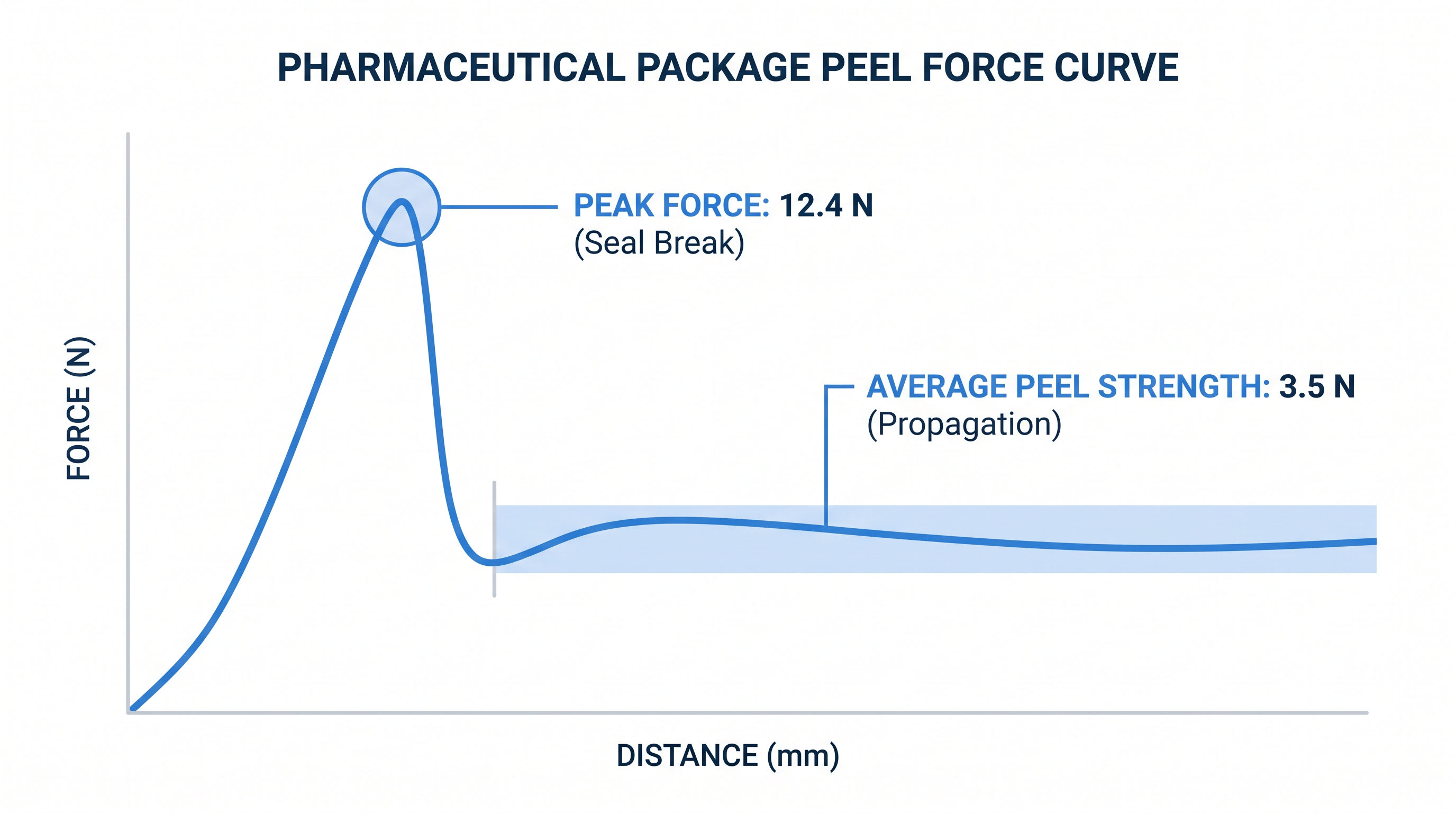
The data collected during these tests is essential for the validation of die-cut lid engineering and other closure systems. By comparing the test results against the established specifications, manufacturers can verify that their processes are under control and that their products meet the required standards for opening reliability. This quantitative approach reduces the reliance on subjective “feel” and provides a documented trail of evidence that can be used for regulatory compliance and continuous improvement. Advanced testing systems also allow for the integration of digital data into the broader quality management system, facilitating real-time monitoring and trend analysis.
Balancing Seal Strength and Patient Accessibility
One of the most significant challenges in pharmaceutical packaging is finding the “sweet spot” between seal integrity and ease of opening. A seal that is exceptionally strong may provide a perfect sterile barrier but fail the test of opening reliability. Conversely, a package that is very easy to open may be susceptible to accidental breaches during the distribution cycle. To achieve the ideal balance, engineers use specialized sealant resins and co-extruded films that are designed to fail cohesively within the sealant layer rather than adhesively at the interface.
A cohesive failure occurs when the internal structure of the sealant material breaks apart, leaving a thin layer of polymer on both the container and the lid. This type of failure is preferred because it provides a very consistent and predictable peel force, independent of the minor variations in the container rim surface. It also provides a clear visual indication that the package has been opened, which is a valuable anti-tampering feature. By precisely controlling the chemical composition of the sealant, manufacturers can “tune” the opening force to meet the needs of specific patient populations, ensuring that the package is accessible to everyone.
Furthermore, the choice of lidding material plays a role in the overall opening experience. If the material is too brittle, it may tear during the peeling process, making it difficult for the user to remove the entire lid. To prevent this, laminates often include a layer of oriented polyester (PET) or nylon to provide the necessary tensile strength and tear resistance. This structural reinforcement ensures that the lid remains intact throughout the entire opening sequence, contributing to a high level of opening reliability. The integration of these various materials into a functional laminate is a core aspect of modern pharmaceutical packaging science.
Integrating Testing Results into Product Development
Peel force testing is not just a quality control tool; it is also an essential part of the product development process. During the early stages of design, testing can be used to evaluate different material combinations and to optimize the sealing parameters. By identifying potential issues early on, engineers can make the necessary adjustments before the design is finalized, reducing the risk of costly delays and product recalls. This proactive approach to testing is a key driver of innovation, allowing for the development of more advanced and user-friendly packaging solutions.
- Material Compatibility Studies: Testing ensures that the sealant layer is compatible with the container material across a range of processing temperatures.
- Sterilization Impact Analysis: Many pharmaceutical packages must undergo Gamma or Ethylene Oxide (EtO) sterilization, which can affect the chemical structure of the sealant and change the peel force.
- Accelerated Aging Studies: Testing after exposure to high heat and humidity helps to determine how the opening reliability will change over the product’s shelf life.
- Packaging Validation: Peel force data is a critical component of the validation dossier, providing the evidence needed to support the claim that the process is robust and reliable.
The results of these tests are also used to inform the development of instructions for use (IFU) and other patient-facing documentation. If a package requires a specific opening technique, this can be clearly communicated to the user through diagrams and text. By providing patients with the information they need to open the package correctly, manufacturers can further enhance the opening reliability and improve the overall patient experience. This holistic approach to design and testing ensures that the packaging is a positive contributor to the success of the medication.
Future Perspectives on Accessibility and Smart Testing
As the pharmaceutical industry moves toward more patient-centric solutions, the demand for high opening reliability will continue to grow. This is driving research into “smart” packaging systems that can provide assistance with the opening process. For example, some manufacturers are experimenting with incorporated sensors that can detect when a user is struggling to open a package and provide feedback or even trigger an automated opening mechanism. While these technologies are still in their infancy, they represent a potential future where the barriers to medication access are significantly reduced.
The automation of peel force testing is another significant trend. Robotic testing systems can perform large numbers of tests with a high degree of precision and repeatability, reducing the risk of human error and improving the efficiency of the quality assurance process. These systems can also be integrated with digital twins and other simulation tools to provide a more comprehensive view of the packaging performance. By combining physical testing with digital modeling, manufacturers can achieve a new level of insight into the factors that influence opening reliability.
The ongoing commitment to excellence in peel force testing is essential for the continued safety and success of the pharmaceutical industry. By focusing on the fundamentals of human factors, material science, and precision instrumentation, manufacturers can ensure that their products are protected by packaging that is both secure and accessible. As technology continues to advance, the integration of new materials and digital tools will further enhance the functionality and reliability of pharmaceutical closures, providing a safer and more efficient future for patients and healthcare providers worldwide.