








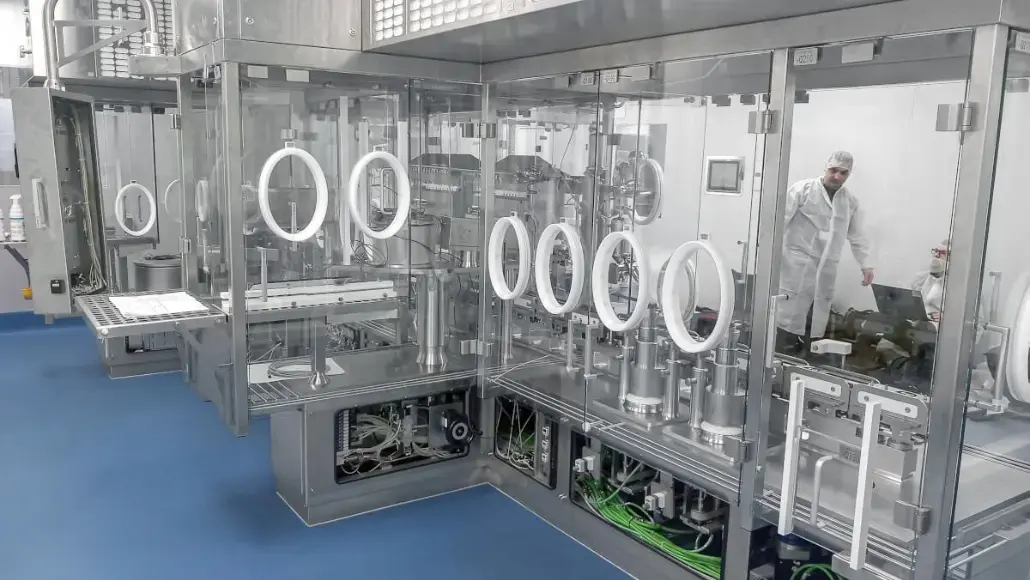
Compliance with EU GMP Annex 1 is one of the key challenges currently facing pharmaceutical manufacturers and CMOs. For Inibsa, a global leader in the dental market, this required upgrading its production facility with filling lines equipped with Restricted Access Barrier Systems. In collaboration with its long-standing partners Imco and Syntegon, Inibsa not only implemented a new RABS filling line but also retrofitted an existing line, ensuring a smooth transition with minimal downtime.
Since it came into effect in August 2023, EU GMP Annex 1 has changed the pharmaceutical manufacturing landscape significantly. One of its primary objectives is to separate the aseptic process area from the operator environment to reduce human intervention and the risk of product contamination to a minimum. The document clearly recommends the use of appropriate barrier technologies like isolators and Restricted Access Barrier Systems (RABS). Hence, pharmaceutical manufacturers and Contract Manufacturing Organizations (CMOs) require at least RABS for the approval of new products.
Inibsa: a long history of dental health

This also applies to Inibsa, a leader in the global dental market with a long history of innovation. It started back in 1948 with the ambitious aim to improve the health of people in Spain. The company introduced the first dental products into its portfolio in the1970s, followed by the launch of the first Inibsa-branded anesthetics in 1985. Today, the company is the second-largest producer of dental anesthesia worldwide and operates in more than 60 countries all over the world. At its headquarters in Lliçà de Vall, close to Barcelona in Spain, Inibsa produces medicines for its numerous customers as well as its own products.
“Inibsa has always strived to be a pioneer in product development and services for our CMO customers, dental professionals, and patients,” says Raquel Arenós, Chief Operating Officer at Inibsa. “The same of course accounts for our production facility, which we are continuously expanding and adapting to meet new requirements.” The latest adaptation consisted in dividing the production space into two separate sterile areas, one of which is specifically designed for fill-finish operations with RABS in line with Annex 1 requirements.
Experience and close cooperation are key

To equip the new sterile area with the matching equipment and further expand production capacities, Inibsa decided to purchase a new filling and closing line with integrated RABS. “As always with new machine projects, we turned to our partner Imco to initiate the process,” Raquel Arenós recalls. In the highly competitive Spanish market, Imco acts as first point of contact to local companies for global equipment supplier Syntegon and has facilitated many important projects over the years. “We have a long history of working with Imco. They know our facility, how we work, and understand our needs – and support us in speeding up the process.”
Syntegon and Inibsa also look back on a successful cooperation during the past ten years, in which three Syntegon MLD cartridge filling lines have already been installed at the facility. One of the main benefits lies in consistent project management. Danilo Bongiovanni, Service Project Engineer at Syntegon, already accompanied the installation of the first MLD line at Inibsa and supported the new project from user requirement specifications right through to ramp-up. “During the ordering process of the new line, we quickly realized that we also wanted to upgrade one of the existing lines with RABS – and knew that Syntegon and especially Danilo have the technical expertise and experience we needed in an area that was new to us,” says Enara Pedroviejo, Production Manager at Inibsa.
RABS upgrade for faster Annex 1 compliance
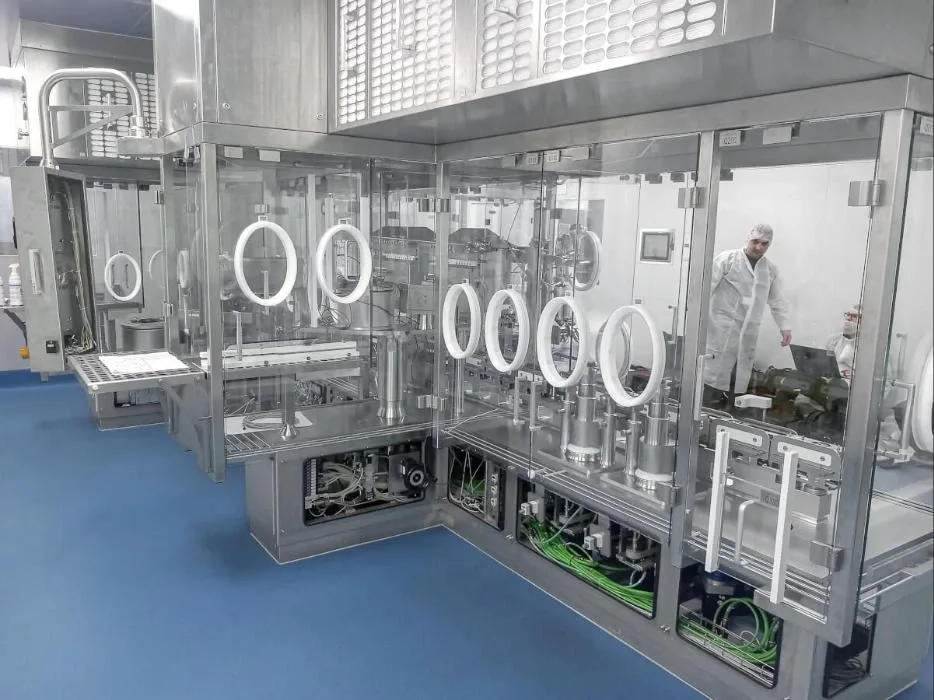
In the years following the publication of Annex 1, the industry witnessed a veritable “run” on RABS upgrades. As Danilo Bongiovanni confirms, “the demand is still rising. We have already realized more than 30 successful RABS upgrades. Hence, we know exactly how to adapt our customers’ lines to their individual requirements as quickly as possible.” Apart from a number of constructional particularities at the production site, the team solved several technical challenges: aligning the RABS glove ports to different operator needs, implementing a glove testing system, and training the staff on a significantly different line than they were used to.
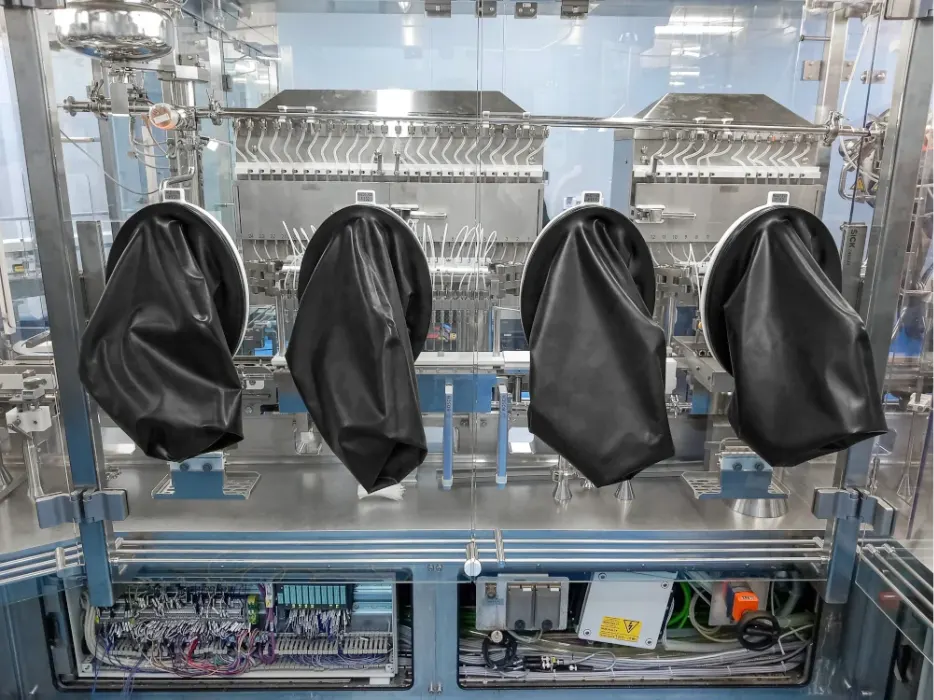
Based on experience gained from numerous RABS retrofit projects, Syntegon designed a mobile mock-up frame on wheels with height- and side-adjustable glove ports to define the future glove positions together with the constructor and the on-site staff. Glove ports are needed to avoid opening the glass doors, for example to change settle plates for environmental monitoring or in the case of a manual intervention for troubleshooting. The mock-up made it possible to simulate and evaluate routine operations and interventions in each of the positions of the line and to determine the ideal location of the gloves. “Accessibility and ease of use are very important in daily operations,” Enara Pedroviejo underlines.
A seamless solution for technical challenges
“Most of our operators are female, while most maintenance technicians are male – so we faced quite a difference in height when defining the right position of the gloves,” Enara Pedroviejo explains. Once the best possible compromise was found for all members of staff, the line was equipped with 21 glove ports. The gloves themselves posed yet another challenge: According to Annex 1, they “should be visually examined with each use, and integrity testing should be performed at periodic intervals.” Inibsa opted for Syntegon’s KHD 3000 stand-alone online glove testing system. All gloves can be tested simultaneously while the measurement data is transferred to the HMI immediately via Wi-Fi.
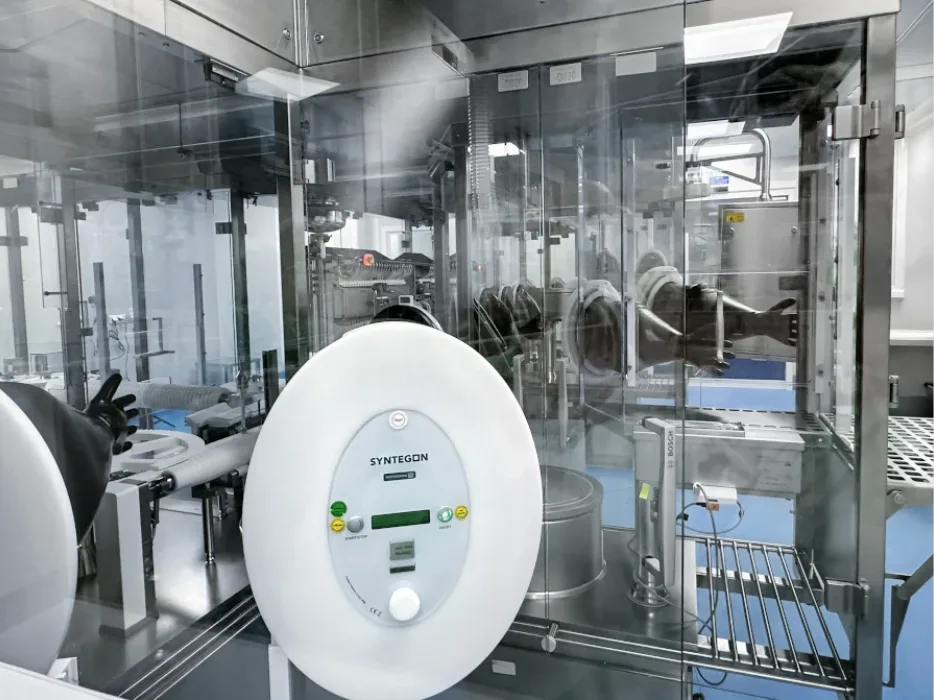
Following the mock-up phase, the existing MLD filling and closing line was retrofitted with the defined RABS system. The experts from the Syntegon subsidiary Valicare qualified and validated both the new process and the new glove testing system. During start-up, all Inibsa operating and maintenance personnel had to undergo intensive training to facilitate the shift from the old to the new sterile area. They were trained in three shifts for one week each on the gloves, ports, and testing system. Today, the RABS mock-up model is installed in Inibsa’s training center, making sure that both existing and new staff is familiar with the processes of a RABS line without further downtimes.
A major intervention with a successful outcome

Looking back at the project, the Inibsa experts agree that a RABS retrofit is a major intervention. “Whoever wants to implement such an upgrade must know that it has a significant impact on both the site capacity during the project and the overall OEE of the line. Hence, it is very important to realize the implementation as quickly as possible to keep downtimes to a minimum,” Enara Pedroviejo explains. “A close collaboration with the project partners is essential for success,” Raquel Arenós adds. “And once the line is running smoothly, it significantly reduces contamination risks and increases quality – which is exactly what the inspection authorities and our customers expect from an industry leader.” In fact, Inibsa has already won a new customer for their CMO business, which would not have been possible without an Annex 1-compliant line.