












Over the past two decades partnering with pharmaceutical leaders, I have witnessed a profound revolution in how modern plants operate.
Facilities poured capital into technological infrastructure to upgrade shop floors, secure regulatory compliance, and achieve transparency that once seemed unattainable. ERP software centralized enterprise planning, MES overhauled shop-floor execution, QMS locked down compliance standards, and LIMS elevated quality testing. Layered with modern automation, data historians, robotics, and connected industrial sensors, these tools completely restructured plant activity.
These initiatives established an indispensable digital baseline, unlocking genuine business value and transforming manufacturing norms across the sector.
A Crucial Shift in Plant Priorities
A decade ago, the primary mandate was sheer digitization: decommission paper, implement enterprise software, and automate data capture. Today’s executive discussions sound fundamentally different. Site leaders must pivot faster, diagnose unexpected production snags immediately, eliminate functional silos, and extract higher returns from the software stacks they spent millions deploying.
Bridging the Gap Between Raw Information and Real Context
The bottleneck is no longer an absence of metrics. Production facilities generate massive volumes of information every second. Every single batch cycle, process alarm, routine service log, deviation event, lab outcome, and machine variable is recorded somewhere. Point solutions diligently log and archive transactions across the enterprise.
Yet this wealth of information remains trapped in discrete silos, leaving personnel to manually assemble the narrative. When an anomaly surfaces, teams must cross-examine execution logs, equipment histories, QA archives, shift handovers, and historical incident reports. Because these clues are scattered, critical hours are wasted hunting down files and reconciling discrepancy reports rather than resolving the core issue.
Data alone does not drive solutions; perspective does. Operational intelligence provides precisely that missing context. It clarifies not just the immediate occurrence, but its root significance, downstream risks, and the most effective corrective course.
The payoff is substantial. Plants capable of making rapid, context-rich choices foster sharper collaboration, curb unplanned downtime, maximize equipment effectiveness, shorten deviation cycles, and build resilient, responsive operations. In a tightening global market, that operational clarity becomes an essential commercial edge.
Shifting Focus from Static Transactions to Daily Judgments
Legacy enterprise platforms were built around transactional records. They excelled at governing distinct functional silos-supply chains in ERP, shop-floor tasks in MES, compliance trails in QMS, and sample results in LIMS.
While those administrative architectures remain vital, peak performance is never defined by isolated records. Success hinges on hundreds of human judgments executed around the clock: during shift changeovers, tier reviews, root-cause investigations, preventive maintenance, workload distribution, and lean improvement sprints.
The sounder those everyday decisions, the wider the performance gap between top performers and their peers. The sharpest operations are not necessarily the ones accumulating the most storage bytes or deploying the largest software catalog. Instead, they are the teams capable of integrating human insight, operational records, and tactical processes to enable rapid problem-solving and clean execution.
Bridging Disparate Systems with an Integrated Operational Layer
This need for shared understanding is fueling the rise of Intelligent Operations Platforms.
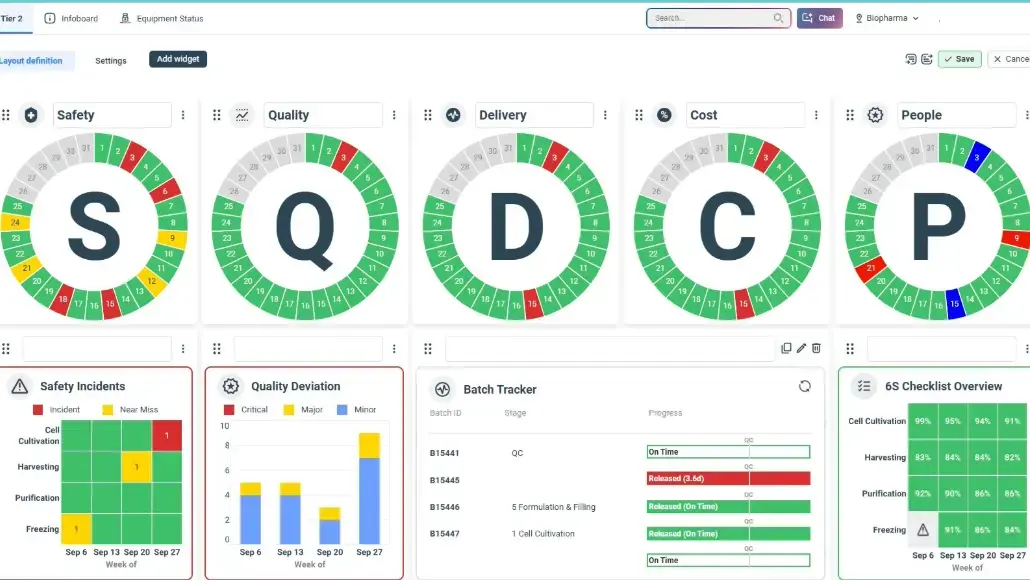
Rather than replacing core platforms like ERP, MES, or LIMS, an operations platform serves as a unifying layer running above them. It harmonizes transactional repositories, dynamic workflows, shop-floor know-how, and plant history into a cohesive operational control space.
By linking maintenance records, deviation tracking, line interventions, operator observations, and machine metrics, sites move away from fragmented data viewing. Instead, teams gain a clear, unfolding window into live operational conditions.
The Next Competitive Edge
The previous era was spent constructing digital baselines. The coming years will center on making those environments truly intelligent.
Throughout my career, my objective has been guiding drug manufacturers toward smarter execution models. That exact principle powers the evolution of Seqonis at eschbach, reflecting where pharmaceutical execution must head.
Moving forward, industry leadership will not belong to the sites with the highest number of software vendors. It will belong to the organizations that best connect those applications with the frontline teams running the operation every day.