













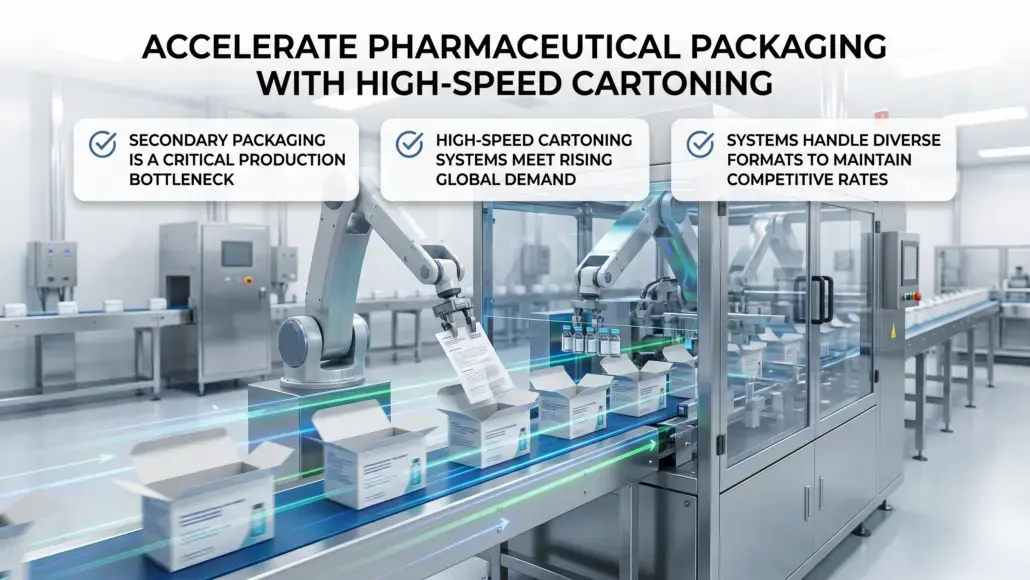
The secondary packaging phase of pharmaceutical manufacturing is often a bottleneck in the production cycle, where the speed and efficiency of the entire line are determined by the ability to place primary containers into cartons alongside necessary leaflets and inserts. As demand for pharmaceutical products increases globally, manufacturers are turning to high-speed cartoning systems to maintain competitive production rates. These systems are engineered to handle a wide variety of formats, from small vials and ampoules to larger bottles and blister packs, at speeds that can exceed several hundred cartons per minute. By automating the folding, loading, and sealing processes, these machines eliminate the need for manual labor and reduce the risk of human-induced errors, which is critical in an industry where accuracy is paramount. The integration of such advanced machinery is a strategic investment aimed at maximizing the return on capital equipment and ensuring that the facility can meet peak market demands.
The transition to automated secondary packaging is not merely a matter of increasing mechanical speed; it requires a holistic approach to line design and integration. A cartoning machine must be perfectly synchronized with the upstream primary packaging equipment and the downstream case packing and palletizing stations. Any mismatch in speed or a failure in the communication between these units can lead to backlogs or starved machines, both of which negatively impact the Overall Equipment Effectiveness (OEE). Modern high-speed cartoning systems utilize sophisticated servo-driven technology and real-time monitoring to ensure smooth operation and to provide the flexibility needed for rapid product changeovers. This adaptability is essential in today’s pharmaceutical market, where smaller batch sizes and more frequent product transitions are becoming the norm due to the rise of personalized medicine and specialized therapies.
Continuous Motion Mechanics for Secondary Packaging
The technical foundation of these high-performance units is often based on continuous motion mechanics. Unlike intermittent motion machines that stop to perform each step of the cartoning process, continuous motion systems maintain a constant flow of cartons and products throughout the entire operation. This approach significantly reduces the mechanical stress on the components and allows for much higher throughput rates. In a continuous motion cartoner, the product and the carton are brought together gradually, with the insertion process occurring as they move parallel to each other. This specialized design ensures that even fragile items, such as pre-filled syringes or glass vials, are handled gently and securely, minimizing the risk of breakage or cosmetic damage during the high-speed loading phase.
Precision in continuous motion systems is achieved through the use of electronic camming and multi-axis servo controls. These technologies allow for the exact timing of the carton opening, product insertion, and flap closing mechanisms, even at maximum speeds. The ability to fine-tune the motion profiles for different carton sizes and weights is a key advantage, as it allows the manufacturer to optimize the machine’s performance for every specific product in their portfolio. Additionally, continuous motion systems are generally quieter and more energy-efficient than their intermittent counterparts, as they avoid the constant acceleration and deceleration cycles that consume high amounts of power and lead to mechanical wear. By investing in these advanced mechanical designs, pharmaceutical companies can achieve a more stable and reliable packaging process that utilizes automated secondary packaging to drive efficiency.
Robotic Integration and Modular System Flexibility
The integration of robotics into secondary packaging workflows has revolutionized the way products are handled. Robots are used for a variety of tasks, including the picking and placing of products into the infeed conveyor, the handling of multi-component kits, and the precise insertion of Patient Information Leaflets (PILs). Modern robotic arms are equipped with specialized end-of-arm tooling (EOAT) designed specifically for pharmaceutical applications, ensuring that products are moved with high precision and without contamination. The use of robotics also provides unparalleled flexibility, as the same machine can be reconfigured for different products simply by changing the software program and the EOAT, rather than requiring extensive mechanical adjustments.
Modular design is another characteristic of high-speed cartoning systems. By building the machine from standardized, interchangeable modules, manufacturers can easily scale their operations or add new capabilities as their needs evolve. For example, a basic cartoning line can be upgraded with additional modules for serialization, tamper-evident labeling, or leaflet folding without the need for a complete system overhaul. This modularity not only reduces the initial lead time for the equipment but also simplifies maintenance and troubleshooting. When a specific module requires service, it can often be accessed or replaced without affecting the rest of the line. This approach to system architecture is a key factor in maintaining high levels of availability and ensuring that these machines remain a long-term asset for the manufacturing facility.
Improving Overall Equipment Effectiveness in Pharma Facilities
Overall Equipment Effectiveness (OEE) is the gold standard for measuring the productivity of a pharmaceutical manufacturing line. It is a composite metric that takes into account availability, performance, and quality. Modern high-speed cartoning systems are designed to maximize all three of these components. Availability is improved through the use of reliable components and predictive maintenance tools that identify potential failures before they cause downtime. Performance is maximized by operating at high speeds with minimal interruptions. Quality is ensured through the integration of advanced inspection systems that verify the presence of the product, the leaflet, and the correct carton printing, rejecting any non-conforming units in real-time.
A major contributor to OEE is the reduction of scheduled downtime, particularly during product changeovers. Sophisticated cartoning systems feature tool-less changeover capabilities and digital position indicators that allow operators to switch between different formats in a fraction of the time required for older machines. Some systems even offer automated changeover sequences, where the machine adjusts its own guides and settings based on the selected recipe in the HMI. This level of automation reduces the reliance on highly skilled mechanical technicians and ensures that the machine returns to its optimal performance state quickly after a transition. By minimizing the time spent on non-productive tasks, pharmaceutical companies can significantly increase their total output.
Changeover Optimization and Tooling Efficiency Strategies
The ability to perform rapid and reliable changeovers is critical for maintaining high-speed cartoning systems in a multi-product environment. As the industry moves away from high-volume blockbuster drugs toward more diverse portfolios, the number of changeovers per shift is increasing. To address this, equipment manufacturers are focusing on “Single-Minute Exchange of Die” (SMED) principles, ensuring that all necessary adjustments can be made quickly and without specialized tools. Color-coded parts, etched markings, and standardized fasteners are all used to simplify the process for the operator. Additionally, the use of lightweight materials for changeover parts reduces the physical strain on the staff and speeds up the handling process.
Efficiency in tooling also involves the management of the cartons themselves. High-speed systems require cartons that are consistent in their dimensions and scoring, as even small variations can lead to jams in the feeding or opening mechanisms. Working closely with carton suppliers to ensure high-quality materials is a vital part of the overall throughput strategy. Many modern cartoners include “smart” feeding systems that can detect and compensate for minor variations in carton quality, further reducing the risk of interruptions. By combining optimized mechanical adjustments with high-quality consumables and advanced control software, pharmaceutical manufacturers can ensure that their cartoning operations remain a high-speed, high-efficiency part of the production process. This focus on every detail of the secondary packaging workflow is what ultimately drives the success of automated cartoning equipment.
The adoption of advanced cartoning technology is a clear response to the growing demands of the global pharmaceutical market for higher efficiency, better quality, and greater flexibility. Through the application of continuous motion mechanics, robotic integration, and a focus on OEE, these systems provide a sturdy solution for the challenges of secondary packaging. The ability to handle diverse formats at extreme speeds while maintaining the highest standards of accuracy is essential for the modern pharmaceutical facility. As technology continues to advance, we can expect to see even greater levels of intelligence and connectivity in cartoning machinery, further cementing its role as a critical enabler of pharmaceutical production throughput. The ongoing investment in these systems reflects the industry’s commitment to operational excellence and its dedication to delivering life-saving medications to patients as efficiently as possible. By optimizing every aspect of the secondary packaging workflow, pharmaceutical companies can achieve a level of productivity that was previously unattainable. This focus on efficiency ensures that the production line can keep pace with the rapid advancements in drug development and the increasing global demand for high-quality treatments. The integration of advanced cartoning technology is a key component of a broader strategy to improve manufacturing flexibility and to reduce the time-to-market for new products. As the pharmaceutical sector becomes more competitive, the ability to operate at peak efficiency will be a major differentiator for successful manufacturers. Through the continuous improvement of mechanical design and digital control, high-speed cartoning systems will continue to play a vital role in the future of pharmaceutical production, providing the speed and reliability needed to serve a growing global population.