













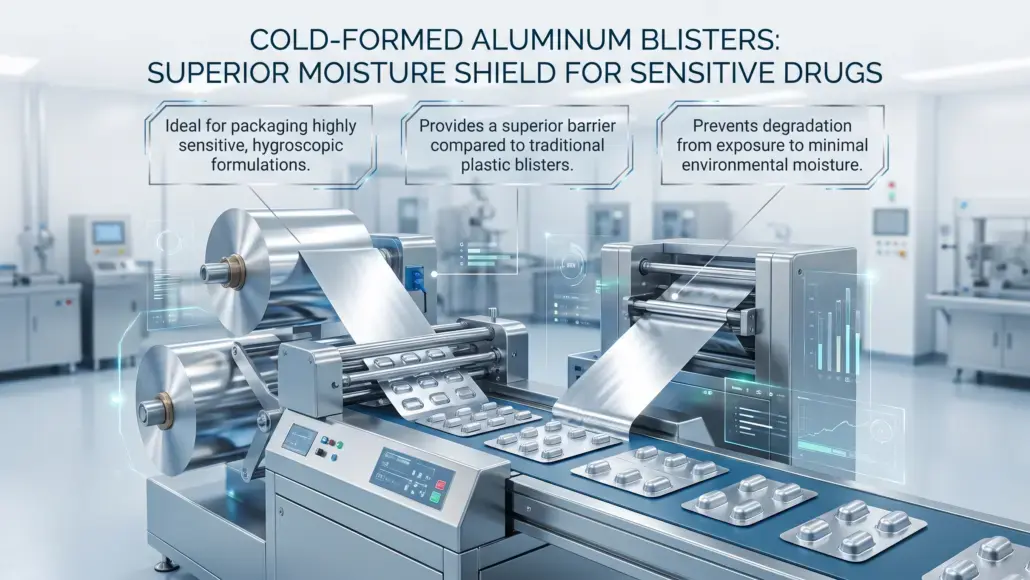
The pharmaceutical packaging sector has witnessed a significant shift toward specialized formats that provide absolute protection for highly sensitive drug products. Among these, the use of cold-formed aluminum blisters has become a cornerstone for packaging hygroscopic formulations that are susceptible to degradation when exposed to even minimal amounts of environmental moisture. Unlike traditional thermoformed plastic blisters, which rely on the barrier properties of various polymers, cold-formed aluminum (often referred to as Alu-Alu) provides an impermeable barrier against water vapor, oxygen, and light. This makes it an ideal choice for medications that require the highest levels of stability to ensure their therapeutic efficacy over extended periods. The adoption of this technology is particularly prevalent for high-value drugs, including certain antibiotics, antivirals, and specialized oncology treatments, where any compromise in stability could lead to significant clinical consequences.
The technical superiority of these specialized blisters lies in the material’s inherent physical properties. Aluminum foil, when combined with specialized laminates, can be deformed under high pressure without the application of heat, a process known as cold-forming. This allows for the creation of individual cavities that completely encapsulate each dose in a metallic cocoon. Because aluminum is a solid metal, it does not possess the microscopic pores or free volume typically found in plastics, meaning that the Water Vapor Transmission Rate (WVTR) is effectively zero. This total barrier protection is crucial for drugs that are sensitive to hydrolysis or those that exhibit changes in physical form, such as crystallization or color changes, upon exposure to moisture. As pharmaceutical companies expand into global markets with diverse climatic zones, the reliability of cold-formed aluminum blisters becomes an essential factor in maintaining global quality standards.
Material Properties of Specialized Aluminum Foil Laminates
The construction of the material used in these high-barrier systems is a complex multi-layer laminate. Typically, this structure consists of an outer layer of oriented polyamide (OPA), a central layer of aluminum foil, and an inner layer of polyvinyl chloride (PVC) or another sealant film. Each layer serves a specific purpose in the final package. The OPA provides the necessary mechanical strength and flexibility to allow the laminate to be drawn into deep cavities without tearing. The aluminum foil acts as the functional barrier, preventing the passage of any molecules or light. The inner PVC layer serves as the heat-seal medium that allows the formed blister to be bonded to a lidding foil, ensuring a hermetic seal for each individual pocket.
The thickness of the aluminum foil layer is a critical parameter in determining the performance of the blister. Manufacturers must balance the need for a comprehensive barrier with the mechanical requirements of the forming process. If the aluminum is too thin, it may develop pinholes during the cold-forming stage, which would compromise the moisture protection. Conversely, if it is too thick, the material may be too rigid to form properly or could lead to excessive costs. Advances in metallurgy and laminate engineering have led to the development of high-performance foils that offer increased ductility, allowing for deeper and more complex cavity shapes while maintaining total barrier integrity. These innovations enable pharmaceutical companies to package larger or more uniquely shaped tablets and capsules in cold-formed aluminum blisters without sacrificing protection.
Mechanical Integrity and Forming Precision in Blister Packs
The process of creating these metallic containers requires specialized machinery and precision-engineered tooling. Unlike thermoforming, where plastic is softened by heat and then pulled into a mold using a vacuum, cold-forming involves using mechanical plugs or punches to force the laminate into a die cavity at room temperature. This process places significant stress on the material, requiring a high degree of synchronization between the forming station and the material feed system. The design of the forming tools is critical to ensure that the material is distributed evenly across the cavity walls, preventing localized thinning or fracturing. Precision engineering ensures that each blister is uniform in shape and size, which is essential for both the filling process and the subsequent sealing operation.
The mechanical integrity of the final package is also a major consideration. These specialized formats are inherently more rigid than their plastic counterparts, providing excellent physical protection for the contents. This rigidity helps to prevent the tablets from being crushed during handling or transport, which is especially important for fragile dosage forms like lyophilized or rapidly disintegrating tablets. Additionally, the opacity of the aluminum provides total protection from ultraviolet and visible light, which can degrade certain light-sensitive active pharmaceutical ingredients. By combining mechanical strength with absolute barrier properties, cold-formed aluminum blisters offer a comprehensive solution for the most challenging pharmaceutical formulations, ensuring that the product remains in its pristine state from the factory to the patient.
Comparison of Cold-Forming and Thermoforming Processes
When selecting a packaging format, pharmaceutical manufacturers must weigh the advantages of these aluminum systems against traditional thermoforming options. Thermoforming is generally faster and more cost-effective for drugs that are not extremely sensitive to moisture, as it uses less expensive materials and operates at higher speeds. However, even high-barrier plastics like polychlorotrifluoroethylene (PCTFE) or cyclic olefin copolymers (COC) have measurable moisture transmission rates. For products where even a trace of moisture can be detrimental, the additional cost of cold-forming is justified by the increased stability and longer shelf life it provides. Additionally, cold-forming does not require the heating of the packaging material, which can be an advantage for some temperature-sensitive products, although the drug itself is typically not exposed to heat during the thermoforming process anyway.
The choice between these formats also involves considerations of package size and patient convenience. Aluminum blisters are generally larger than thermoformed ones because the laminate requires more space for the forming shoulders around each cavity to prevent tearing. This can lead to larger secondary packaging and increased shipping costs. However, the superior protection offered by these systems can sometimes allow for simpler secondary packaging, as the primary blister provides such a sturdy barrier. For the patient, the “push-through” feature of a blister pack remains one of the most convenient and intuitive ways to access medication while maintaining the stability of the remaining doses. This individual dose protection is a significant advantage over bottle packaging, where the entire contents are exposed to the atmosphere every time the bottle is opened.
Addressing Global Distribution Challenges for Sensitive Drugs
The globalization of the pharmaceutical supply chain has introduced new challenges for maintaining the stability of sensitive medicines. Products are often manufactured in one part of the world and then shipped to markets with vastly different environmental conditions. The international community classifies climates into four zones, with Zone IV (hot and humid) posing the greatest risk to drug stability. Cold-formed aluminum blisters are the preferred choice for products destined for these regions, as they provide a consistent and predictable barrier that is independent of ambient humidity levels. This reliability simplifies the regulatory approval process, as manufacturers can provide stability data that remain valid across all climatic zones, reducing the need for region-specific packaging variations.
Additionally, the durability of aluminum makes it well-suited for the rigors of long-distance transport and storage in less-than-ideal conditions. In many developing markets, the cold chain or climate-controlled warehousing may not be consistently available. In such scenarios, the packaging serves as the last line of defense for the drug product. The use of these high-barrier systems ensures that the medication remains potent and safe for the patient, even if the logistics chain is compromised. This capability is a vital component of global health initiatives, where the delivery of effective medicines to remote or underserved areas is essential. By investing in specialized packaging, pharmaceutical companies demonstrate their commitment to patient safety and quality on a global scale, ensuring that their products perform as intended wherever they are needed.
The development and application of these aluminum containers represent a pinnacle of barrier technology in the pharmaceutical industry. By providing an absolute defense against moisture, oxygen, and light, these blisters ensure the stability of the most sensitive drug formulations. The technical complexity of the laminates, the precision of the forming process, and the strategic advantages for global distribution all contribute to the widespread adoption of this format. While more demanding in terms of material cost and machine configuration, the benefits for drug efficacy and patient safety are clear. As the pharmaceutical industry continues to develop new and more potent therapies, the role of cold-formed aluminum blisters will remain central to the success of modern medicine, providing the necessary protection to bring life-saving treatments to patients around the world.