







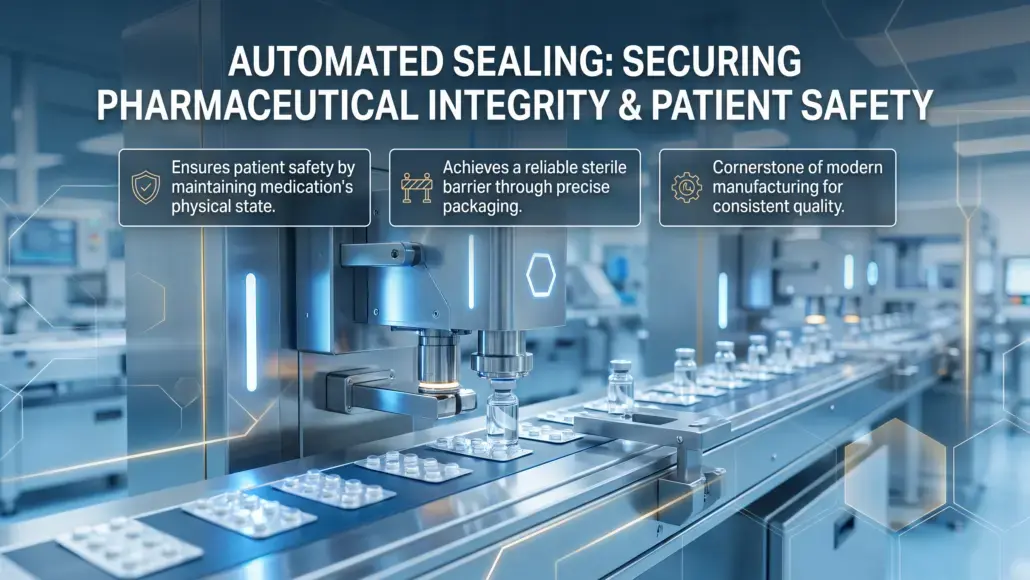

The pharmaceutical industry operates under a mandate of uncompromising quality, where the safety of the patient is directly linked to the physical state of the medication at the time of administration. A critical component of this safety chain is the maintenance of a sterile barrier, which is achieved through precise and reliable packaging processes. The adoption of automated sealing technologies improving pharmaceutical package integrity has become a cornerstone of modern manufacturing, providing a level of consistency and security that manual or semi automated processes cannot match. These systems are designed to create airtight and leak proof seals that protect pharmaceutical products from contamination, moisture, and oxidation. The complexity of these systems is significant, involving a sophisticated interplay between temperature, pressure, and dwell time, all of which must be monitored and controlled in real time to ensure that every package meets the required specifications. As drug formulations become more sensitive to environmental factors, the importance of these sealing technologies only increases, necessitating a thorough examination of the engineering and validation processes that underpin their operation.
Thermal Dynamics and Pressure Control in Secondary Packaging
The foundation of a successful seal lies in the precise application of heat and pressure to the packaging materials. Whether dealing with plastic films, laminates, or induction liners, the goal is to reach the exact melting point of the bonding layers without causing damage to the surrounding structure or the product itself. These advanced sealing platforms utilize thermal control algorithms that can adjust the heat output of the sealing bars in response to minute changes in production speed or ambient temperature. This dynamic adjustment is essential for preventing under sealing, which could lead to leaks, or over sealing, which might compromise the structural integrity of the material or make the package difficult for the end user to open. The calibration of these thermal systems is a continuous process, requiring regular verification through calibrated thermocouples and thermal imaging equipment.
Pressure control is equally vital, as it ensures that the bonding surfaces are held in intimate contact during the sealing process. In high speed packaging lines, the window for creating a seal is extremely narrow, often measured in milliseconds. Automated systems use precision actuators and load cells to apply a consistent force across the entire sealing area, regardless of variations in material thickness. This consistency is particularly important when sealing complex geometries or multi layered structures, where uneven pressure could lead to weak spots in the sterile barrier. The integration of high resolution encoders allows the system to track the position of the sealing heads with sub millimeter accuracy, ensuring that the pressure is applied exactly where and when it is needed. By optimizing the relationship between heat and pressure, manufacturers can achieve high throughput levels without sacrificing the long term stability of the pharmaceutical product.
Sensor Based Quality Assurance for Sterile Barrier Maintenance
To guarantee the integrity of every seal, modern packaging lines are equipped with a suite of sophisticated sensors that provide real time feedback on the sealing process. These sensors can detect anomalies such as temperature fluctuations, pressure drops, or the presence of foreign particles in the sealing area. If a potential defect is identified, the system can automatically flag the affected package for rejection, preventing it from moving further down the supply chain. This proactive approach to quality assurance is a significant advancement over traditional destructive testing methods, which only provide a statistical snapshot of production quality. By monitoring every single unit, these precision systems provide a much higher level of confidence in the final product.
Vision systems have also become an integral part of the sealing process, providing a visual confirmation of seal quality and position. These systems use high speed cameras and intelligent image processing software to analyze the seal pattern, looking for signs of incomplete bonding, wrinkles, or misalignment. In many cases, these vision systems can detect defects that are invisible to the human eye, providing an additional layer of protection for the patient. The data generated by these sensors and vision systems is archived as part of the electronic batch record, providing a comprehensive audit trail for regulatory compliance. This level of transparency is essential for maintaining the trust of regulatory agencies and for ensuring that the manufacturer can respond quickly and effectively in the event of a quality issue.
Validation Protocols for High Speed Sealing Operations
Validation is a rigorous and necessary process in pharmaceutical manufacturing, intended to prove that a process consistently produces a result that meets all requirements. For sealing operations, this involves a series of tests to establish the operational range of the equipment and to verify its performance under worst case conditions. Automated sealing technologies improving pharmaceutical package integrity simplify the validation process by providing precise control over all process variables, allowing for reproducible results that are easy to document. The validation protocol typically includes Installation Qualification (IQ), Operational Qualification (OQ), and Performance Qualification (PQ), each of which must be completed and documented in accordance with global regulatory standards.
During the OQ phase, the manufacturer establishes the “design space” for the sealing process, identifying the range of temperature, pressure, and time within which a successful seal can be produced. This involves running the equipment at the extremes of these variables and testing the resulting seals for strength and integrity. Once the design space is established, the PQ phase involves monitoring the process over a series of production runs to ensure that it remains stable and consistent. The data collected during these validation exercises provides a baseline against which future performance can be measured, allowing for early detection of process drift or equipment wear. By adhering to these rigorous validation protocols, pharmaceutical manufacturers can ensure that their sealing processes are not only effective but also compliant with the highest standards of quality and safety.
Advancements in Induction Sealing for Solid Dosage Forms
Induction sealing is a widely used technology in the pharmaceutical industry, particularly for solid dosage forms like tablets and capsules packaged in plastic bottles. This process involves using an electromagnetic field to heat a metallic foil liner inside the bottle cap, which then bonds to the rim of the container. Automated sealing technologies improving pharmaceutical package integrity have significantly enhanced the speed and reliability of induction sealing, allowing for throughput rates of hundreds of bottles per minute. The precision of the induction field is critical, as insufficient heat will result in a weak seal, while excessive heat can melt the cap or damage the liner. Modern induction sealers use digital power supplies and high frequency generators to maintain a precise and stable electromagnetic field, ensuring that each bottle receives the exact amount of energy required.
One of the key benefits of induction sealing is that it provides a tamper evident seal that is easy for the patient to verify. The presence of an intact foil liner gives the consumer confidence that the product has not been opened or altered since it left the manufacturer. Additionally, induction sealing provides an excellent barrier against moisture and oxygen, which is essential for maintaining the potency and stability of many solid dosage medications. The latest advancements in induction technology include the integration of cap detection and liner verification sensors, which ensure that every bottle has a cap and that the liner is correctly positioned before the induction field is applied. These features further reduce the risk of non compliant products reaching the market and help to maintain the high throughput levels required in modern pharmaceutical production.
Impact of Material Science on Sealing Performance
The performance of any sealing system is inextricably linked to the properties of the packaging materials themselves. Advances in polymer science have led to the development of new films and laminates that offer superior barrier properties and easier sealability. These materials are often composed of multiple layers, each providing a specific function such as moisture resistance, oxygen barrier, or structural strength. Automated sealing technologies improving pharmaceutical package integrity must be capable of handling these advanced materials, which may have narrow sealing windows or require specific heating and cooling profiles. The interaction between the sealing equipment and the material is a key area of research, with manufacturers working closely with material suppliers to optimize the performance of the entire packaging system.
Sustainability is also becoming a major factor in material selection, with a growing emphasis on recyclable or biodegradable packaging. These new materials can present challenges for traditional sealing processes, as they may have different thermal properties or lower tensile strength. However, the latest automated sealing systems are designed with the flexibility to adapt to these new materials, providing the necessary control to create high quality seals while minimizing environmental impact. The development of mono material laminates, for example, simplifies the recycling process but requires very precise temperature control to avoid damaging the material. By staying at the forefront of material science and equipment design, pharmaceutical manufacturers can ensure that their packaging processes remain both effective and sustainable in a rapidly changing global market. This commitment to innovation is essential for the long term success of the industry and for the continued protection of patient health worldwide.