







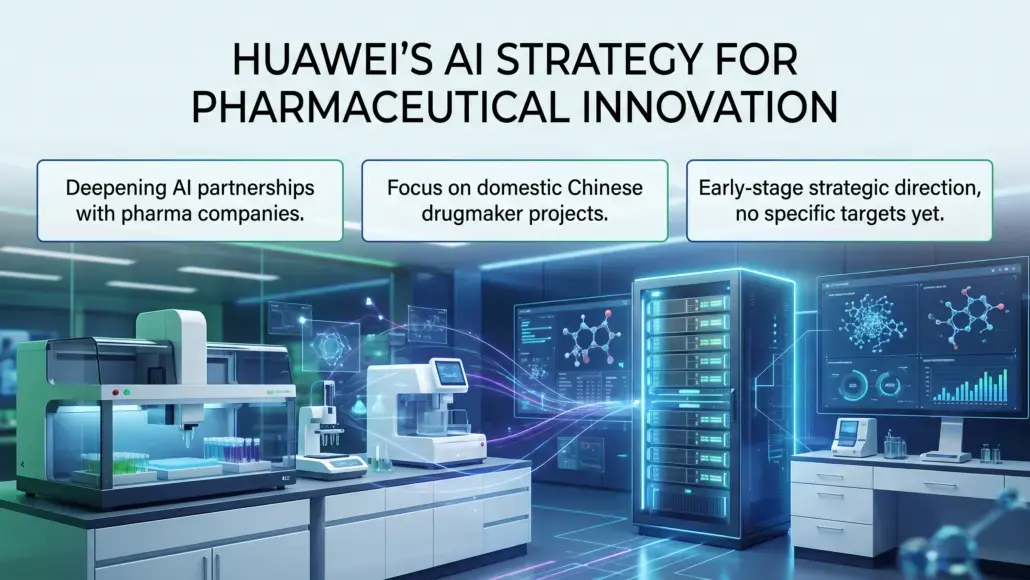
Huawei intends to deepen its artificial intelligence partnerships with pharmaceutical companies, according to William Zhang, president of the company’s healthcare business unit, who confirmed to Reuters that the firm’s current AI drug projects run predominantly with domestic Chinese drugmakers. The company’s broader direction in the pharmaceutical space is taking shape, though it remains at an early stage with no named prospective partners and no numerical targets attached to its stated ambitions.
A Statement of Direction, Not a Formal Announcement
Zhang made clear that the company is oriented toward expansion across the drug development value chain. “As we further deepen our research into AI in the medical field, we’ll have more collaboration and results emerging with pharmaceutical companies from drug manufacturing to clinical to final implementation,” he said. He also referenced existing collaborations in clinical practice within hospitals but did not name specific institutions or detail the nature of those arrangements.
What Huawei has disclosed publicly is notably specific in scope. The company sells compound screening tools alongside its Ascend and Kunpeng chips — the same domestically developed hardware stack it has been building since US sanctions pushed it to pursue self-reliant alternatives. Huawei AI drug discovery efforts, as presented, are grounded firmly in this infrastructure-first approach.
The Guangzhou Pharmaceutical Deal Examined
The most concrete project Huawei has pointed to is an agreement announced in May with Guangzhou Pharmaceutical Holdings, a state-owned enterprise. Huawei described the arrangement as the industry’s first production validation of independently developed AI drug research models adapted to run on Ascend and Kunpeng hardware.
The language here warrants careful reading. “Independently developed” in this context translates a Chinese term denoting domestically developed, not models built by Huawei itself. The AI drug research models in question belong to StoneWise, a Beijing-based AI drug design company that was the third party to the agreement. Huawei’s role was providing the silicon and completing the software porting work required to run StoneWise’s models on its own chips.
That contribution carries real significance in the context of building a drug discovery pipeline that operates without American chips, but it is infrastructure work rather than scientific development.
The Pangu Drug Molecule Model and Earlier Collaborations
Huawei does have a proprietary AI model for pharmaceutical applications. The Pangu drug molecule model was released in 2021, developed in partnership with the Chinese Academy of Sciences and trained on 1.7 billion existing compounds to predict how molecules bind to biological targets.
The company also holds an older collaboration with Yunnan Baiyao, dating to 2022, under which the drugmaker contributes botanical compound libraries while Huawei provides cloud computing capacity and AI tools. Neither this arrangement nor the Guangzhou Pharmaceutical work has produced a named drug candidate that has entered clinical trials.
Scale Gap with Global Competitors
The competitive context places Huawei’s current pharmaceutical footprint in perspective. Nvidia has established AI partnerships with major global pharmaceutical companies including Eli Lilly and Novo Nordisk. The Lilly arrangement alone involves a co-innovation laboratory with up to one billion US dollars committed jointly over five years.
Against that benchmark, Huawei’s disclosed pharmaceutical work consists of one three-party ecosystem agreement at proof-of-concept stage and a four-year-old cooperation deal. Zhang did not attempt to obscure this asymmetry.
Policy Tailwinds Supporting the Domestic Push
What Huawei does have in its favour is a supportive policy environment. Biopharmaceuticals were designated an emerging pillar industry in this year’s government work report. AI applications in pharmaceuticals are written into China’s fifteenth five-year plan. A state-backed body inaugurated in June lists Huawei on the supply side of the AI drug development ecosystem, alongside companies such as Kingdee and XtalPi.
The domestic orientation Zhang described also reflects an external constraint. US export guidance issued last year indicated that using Huawei’s Ascend accelerators is likely to breach American controls, which significantly limits the international addressable market for a product pitch built around that hardware.
The Broader AI Drug Discovery Landscape
The wider field offers context that applies across the industry rather than to Huawei specifically. Approximately sixty billion US dollars has been invested into AI drug discovery globally. No AI-discovered drug has yet received regulatory approval anywhere in the world, though the number of AI-derived candidates in development pipelines had reached 179 by June, compared with four in 2017, and nine have advanced to Phase III trials.