






For years, APAC was mainly known for producing medicines on a scale.
That picture is changing quickly.
In 2026, the region is becoming a place where drugs are discovered, developed, tested, manufactured and increasingly commercialized. Asia now accounts for around 43% of the global innovative pharmaceutical pipeline, compared with 28% five years ago.
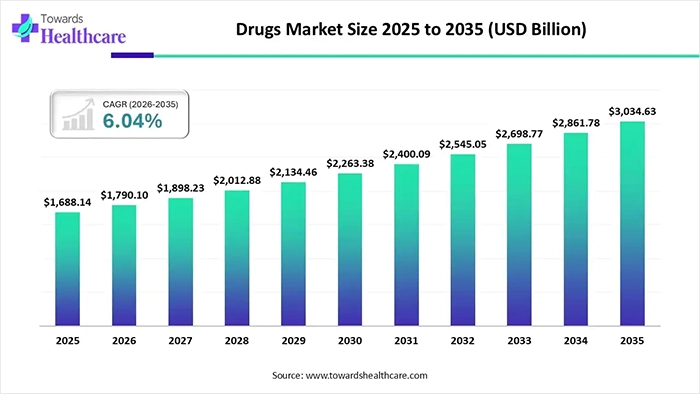
According to Towards Healthcare Research and Consulting, the global drugs market size recorded US$ 1688.14 billion in 2025, set to grow to US$ 1790.05 billion in 2026 and projected to hit nearly US$ 3034.63 billion by 2035, with a CAGR of 6.04%.
Five Years That Changed the Industry
The biggest transformation has happened in R&D.
China, South Korea, Japan, India and Singapore are building capabilities that go far beyond traditional generics and contract manufacturing.
The pipeline is also becoming more sophisticated.
Cell and gene therapies, antibody-drug conjugates, bispecific antibodies and nucleic-acid medicines now make up about one-third of Asia-originated assets.
This is an important shift because APAC is no longer competing only on cost.
It is increasingly competing on science, speed, clinical expertise and technology.
China Is Changing the Competitive Map
China has become the biggest driver of APAC’s pharmaceutical transformation. It represents roughly 29% of the global innovative pipeline, while Chinese companies are increasingly licensing their discoveries to global pharmaceutical companies.
The country is also becoming extremely important in clinical research.
China registered 5,215 clinical trials in 2025, roughly twice its 2020 level.
India’s Opportunity is Different
India has a different advantage: scale combined with affordability.
Its strengths in generics, APIs, vaccines and manufacturing are now being connected with biotechnology, clinical research and AI.
Clinical research is expanding rapidly as well.
Around 27,000 new clinical trials were registered in India between January 2024 and June 2025, according to data cited by the BMJ.
The opportunity is to move from being the pharmacy of the world toward becoming a larger contributor to innovative drug development.
The Manufacturing Revolution
The next manufacturing battle will not simply be about building more plants.
It will be about building smarter plants.
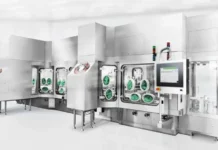
AI, automation, digital manufacturing, real-time quality monitoring and advanced analytics are changing how pharmaceutical facilities operate.
The focus is moving toward producing complex biologics, cell therapies, mRNA products and other advanced medicines at commercial scale.
What Could Hold APAC Back?
The region still has serious challenges.
Regulatory differences, shortage of specialized talent, fragmented healthcare systems and uneven digital infrastructure can slow development.
Geopolitical tensions are another concern.
Companies increasingly need supply chains that are not only efficient, but also diversified and resilient.
Let’s See the Opportunity
The opportunity is to build a connected APAC pharmaceutical ecosystem.
Discovery could happen in China or South Korea, clinical development could involve India, Australia or Japan, manufacturing could be distributed across several markets, and commercialization could span the entire region.
That model could make APAC more than a collection of individual markets.
It could become a single strategic engine for global pharmaceutical innovation.
What 2026 Really Represents
The APAC pharmaceutical industry is entering a different phase.
The question is no longer whether Asia can participate in global pharma innovation.
The more important question is how much of the next generation of medicines will originate there.
If the last five years were about proving APAC’s capabilities, the next five could be about scaling them.
And that may be the real pharmaceutical revolution: APAC is moving from the supply chain to the innovation chain.