







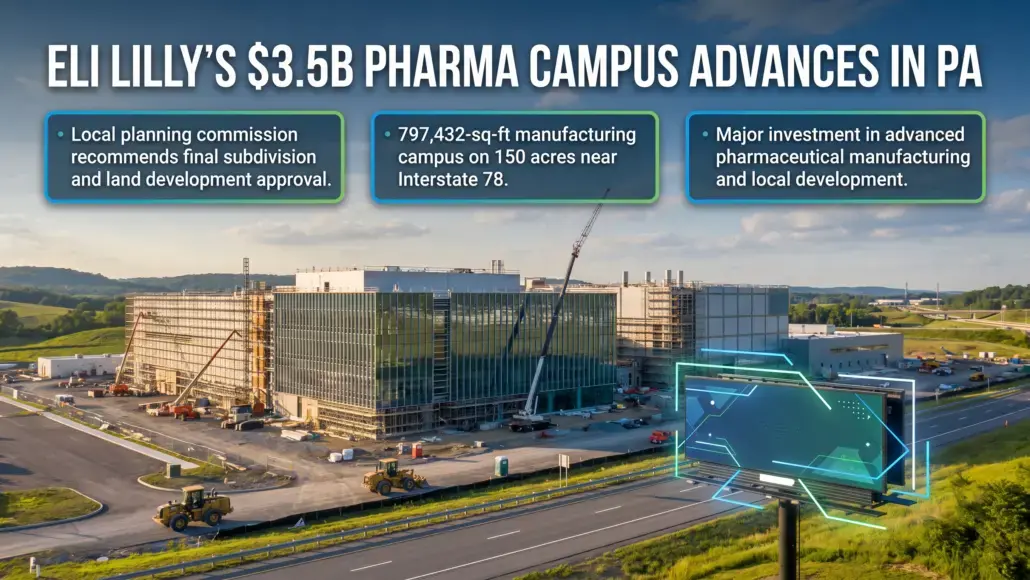
A planned $3.5 billion pharmaceutical manufacturing campus in Upper Macungie Township, Pennsylvania, has advanced through the local development process after the Upper Macungie Planning Commission recommended final subdivision and land development approval on August 19, 2026. Known as Project Kennedy, the development by Eli Lilly calls for a 797,432-square-foot manufacturing campus on approximately 150 acres near Fogelsville, west of Allentown and close to Interstate 78. The project is expected to generate about 2,000 construction jobs during its buildout, with manufacturing operations scheduled to begin in 2031.
The development has progressed through local planning since earlier this year. An Upper Macungie Township Planning Commission agenda dated March 18, 2026, identified the project as Docket No. 2409 and outlined plans for a 797,432-square-foot pharmaceutical manufacturing facility at 8810-9802 Main Street, together with parking, stormwater management and utility infrastructure. The site will accommodate manufacturing buildings, utilities, parking, security systems and worker amenities. Construction will take place in phases, with the first phase including an amenities building and visitor center in the southwestern portion of the property. Above-ground and below-ground utilities are planned, while the completed operation is expected to run across three shifts lasting between eight and 12 hours. The Eli Lilly manufacturing campus is expected to remain under construction through 2029.
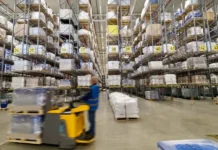
The planned facility will concentrate on the final assembly and packaging of injectable medicines. Products expected to be handled at the site include Zepbound, Eli Lilly’s weight-loss medicine, as well as Retatrutide, a next-generation treatment that remains in clinical trials. The Pennsylvania operation is not designed to manufacture every pharmaceutical ingredient onsite. Instead, externally manufactured pharmaceutical ingredients will be combined into finished solutions before injectable medicines are prepared for retail packaging. The campus will also include logistics and storage infrastructure, as well as automated storage and retrieval capabilities to support movement of materials throughout the facility. Earlier planning information indicated that the development could generate approximately 45 trucks per day, or about 90 truck trips, with dedicated access arrangements planned for trucks and passenger vehicles.
The scale of Project Kennedy will also require a substantial construction workforce and supporting infrastructure. Project officials told local planners that approximately 1,200 construction workers are expected to use rented parking facilities on Tilghman Street and travel to the site by shuttle buses, while another 300 administrative employees will use rented parking and shuttle transportation. The entire workforce is not expected to be onsite simultaneously. Multiple worker welfare areas will provide food during shifts, with workers expected to remain onsite for their full shifts. Security measures will include multiple checkpoints, vehicle tire washing before entry, card-access controls and a visitor center for screening. Once operational, the campus is planned to maintain a 24-hour, seven-day-a-week security system and will be enclosed by an eight-foot perimeter fence. Construction is expected to continue through 2029, followed by the targeted start of manufacturing operations in 2031. The Eli Lilly manufacturing campus will transform the 150-acre site into a large-scale injectable medicine production facility in the Lehigh Valley.