














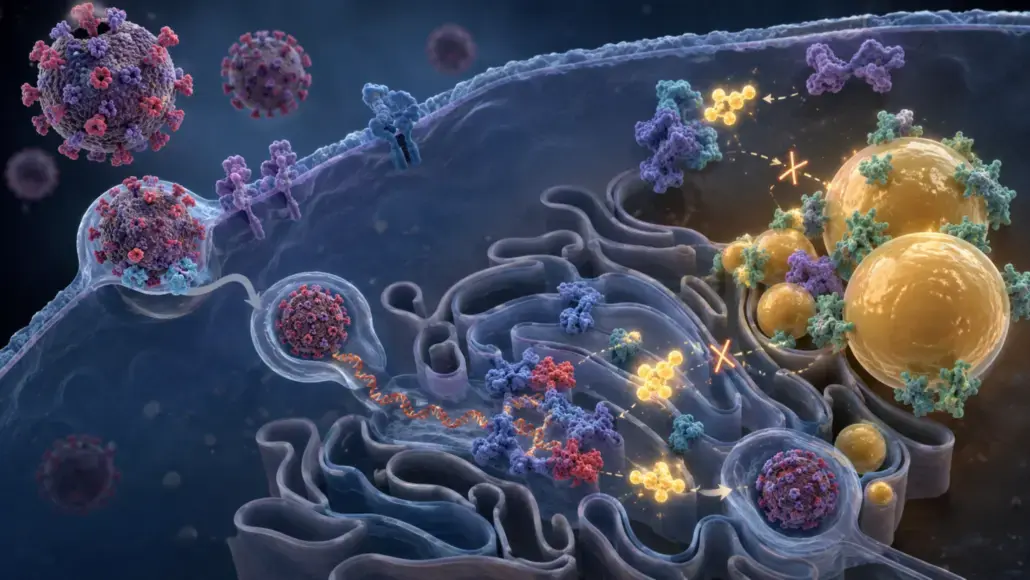
Alt tag: Scientific illustration of Hepatitis C virus interacting with a human liver cell, showing host-targeting molecules disrupting viral entry, replication, and lipid-dependent assembly to overcome antiviral resistance.
While the introduction of Direct-Acting Antivirals has helped cure Hepatitis C, making it a major milestone in global health, mutation in the virus remains a persistent clinical bottleneck. Mutations known as Resistance-Associated Substitutions regularly emerge under drug pressure (adapt or die in the presence of the drug acting as an environmental force). This renders standard DAA therapies ineffective for a subset of patients. Traditional viral targeting is not sufficient to fully overcome this challenge.
Emerging research highlights the potential of host-targeting strategies to prevent viral escape.
HEPC small molecule host-targeting disrupts the human cellular machinery that the virus relies on to survive and replicate. Because host proteins remain genetically stable, this approach reduces the risk of resistance while offering broad, pan-genotypic efficacy. Evaluating these host-directed small molecules represents the next critical phase in achieving durable antiviral eradication.
Advantages of Host Targets
There are distinct pharmacological advantages of targeting host cellular factors rather than viral proteins. This directly addresses the limitations of conventional antivirals.
High Barrier to Resistance
Human host proteins are encoded by host cellular DNA. They do not undergo the rapid, error-prone replication rates characteristic of viral RNA genomes. Consequently, the virus cannot alter human host binding pockets through Resistance-Associated Substitutions. A host-directed HEPC small molecule maintains long-term therapeutic efficacy. Host-targeting agents significantly increase the barrier to resistance, making it much more difficult for drug-resistant quasispecies to emerge compared to traditional direct-acting antivirals.
Pan-Genotypic Efficacy
Hepatitis C requires human cellular factors to enter, replicate, and assemble. These factors are conserved across all eight major viral genotypes and their numerous subtypes. These eight major viral genotypes include:
- Genotype 1 (Subtypes 1a and 1b)
- Genotype 2
- Genotype 3
- Genotype 4
- Genotype 5
- Genotype 6
- Genotype 7
- Genotype 8
Viral proteins feature significant sequence variability between genotypes. Human host pathways remain structurally consistent across different patient populations. Because all strains rely on the same human proteins, host-targeting drugs have naturally broad activity.
All Hepatitis C strains depend on these exact same human cell pathways. This gives host-targeting small molecules broad activity across every variant. While host-targeting strategies inherently offer broad activity across diverse viral strains, combining therapies remains the gold standard to prevent viral escape and ensure durable cure rates.
Synergy with Existing DAAs
Host-directed agents operate through cellular pathways completely distinct from Direct-Acting Antivirals (DAAs).
Traditional DAAs inhibit viral enzymes such as the NS3/4A protease or NS5B polymerase. Host-targeting agents deprive the virus of essential human host machinery.
This approach suppresses viral loads more aggressively. It lowers the required dosing threshold for individual drugs. This also reduces treatment failure in hard-to-treat or previously non-responsive patient populations.
Primary Host Pathways
The Hepatitis C virus must hijack specific human host cell processes to replicate and spread. Instead of targeting viral proteins directly, host-directed therapies block the cellular pathways the virus needs to survive, replicate, and infect new liver cells. The following primary host pathways serve as targets for therapeutic intervention:
Viral Entry
The virus binds to receptor proteins on the surface of human hepatocytes (liver cells) to enter the host cell. Once it enters the host cell, it releases its genetic material. The following are the key host entry factors:
- CD81
- SR-B1
- Claudin-1, Occludin and tight junction proteins
Blocking these cellular receptors prevents new virus particles from entering healthy liver cells. A host-directed HEPC small molecule targeting entry factors seals off uninfected cells.
Lipid Metabolism
Hepatitis C depends on human host lipid pathways. The virus uses host lipid droplets to build its replication machinery. It depends on host lipoproteins to assemble and secrete infectious viral particles. The following are the host enzymes involved in this pathway:
FASN (Fatty Acid Synthase)
This pathway drives the lipid synthesis required for viral membrane formation.
DGAT1 (Diacylglycerol O-Acyltransferase 1)
This pathway facilitates the assembly of viral particles on host lipid droplets.
The virus does not get the raw material it needs to build new particles when these lipid enzymes are blocked.
Replication Complexes
Once it enters the liver cell, the virus forms a protective membranous web where it copies its RNA genome. This process relies on host cellular chaperones, most notably Cyclophilin A (CypA).
Cyclophilin A binds to viral non-structural proteins to facilitate the assembly of functional viral replication complexes. Disrupting CypA or similar host chaperone proteins destabilizes this replication web, collapsing the virus’s ability to copy its genetic material.
Toxicity and Delivery Limitations
While targeting host cellular factors provides a higher barrier to resistance, it presents unique safety and delivery challenges because human host proteins are essential for normal bodily functions.
On-Target Host Toxicity
Healthy, non-infected cells also rely on those same pathways. As a result, inhibiting human proteins can disrupt vital physiological functions in those cells.
Off-Target Side Effects
A host-directed HEPC small molecule may accidentally bind to unintended human enzymes or tissues and trigger systemic toxicity.
Narrow Therapeutic Window
The dose must be high enough to stop the virus but not so high that it threatens normal liver cells.
Targeted Liver Delivery
It is difficult to deliver the drug directly to infected liver cells. Exposure to other organs increases the risk of side effects.
Pharmacokinetic Hurdles
Keeping drug concentrations safe throughout the body requires advanced delivery systems such as lipid nanoparticles or specialized targeting ligands.