







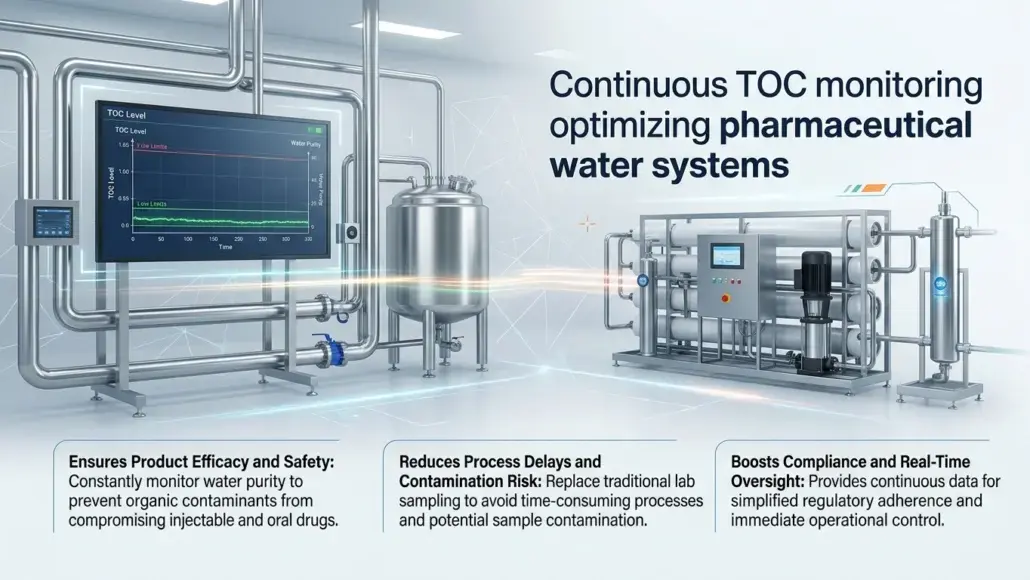
Modern pharmaceutical manufacturing relies heavily on the purity of its water supply, where organic contaminants can significantly compromise the efficacy and safety of injectable drugs and oral medications. The traditional method of analyzing Total Organic Carbon (TOC) involved the collection of discrete samples for laboratory analysis, a process that inherently introduced delays and the potential for sample contamination. However, the adoption of continuous TOC monitoring optimizing pharmaceutical water systems has changed how quality control is managed. By providing real-time data, these systems allow for immediate detection of organic excursions, enabling manufacturers to take corrective action before large batches of product are affected. This shift towards Process Analytical Technology (PAT) aligns with the broader industry goal of real-time release testing, where manufacturing decisions are based on data generated during the production process itself.
The transition to continuous monitoring involves the installation of dedicated sensors at critical points within the water purification and distribution loops. These sensors utilize oxidation and detection technologies to measure the concentration of organic matter in the parts-per-billion range. Unlike grab sampling, which only provides a snapshot of quality at a single moment, continuous monitoring offers a dynamic view of system performance, capturing transient events that might otherwise go unnoticed. This level of oversight is essential for maintaining the high standards required in a GMP environment, where even a minor spike in organic carbon can indicate a failure in the purification process or the presence of a developing microbial colony.
Continuous monitoring also provides a wealth of data that can be used to optimize system performance and reduce operational costs. By analyzing trends in TOC levels, manufacturers can identify the optimal frequency for sanitization cycles and the best time to replace purification components. This data-driven approach minimizes the consumption of energy and chemicals while maximizing the lifespan of expensive equipment. Additionally, the use of online sensors reduces the labor associated with manual sampling and laboratory testing, allowing quality personnel to focus on more complex tasks. The integration of these tools is therefore a key component of a modern, efficient pharmaceutical manufacturing facility.
Technical Mechanisms of Real Time Organic Carbon Detection
The efficacy of continuous TOC monitoring optimizing pharmaceutical water systems depends on the ability of the sensors to accurately oxidize organic compounds and measure the resulting carbon dioxide. Two primary technologies are commonly used: ultraviolet (UV) oxidation with conductivity measurement and UV-persulfate oxidation with infrared detection. In conductivity-based systems, a sample of water is exposed to high-intensity UV light, which breaks down organic molecules into carbon dioxide. The increase in conductivity caused by the dissolved CO2 is then measured and converted into a TOC value. This method is highly sensitive and particularly well-suited for the ultrapure water found in pharmaceutical applications.
For more complex water matrices or higher concentrations of organic matter, infrared-based systems offer an alternative approach. These devices typically use a chemical oxidant in conjunction with UV light to ensure complete oxidation of all carbon species. The resulting carbon dioxide is then stripped from the liquid phase and measured by a non-dispersive infrared (NDIR) detector. Regardless of the specific technology used, the sensors must be designed for durability and ease of maintenance. Regular calibration against known standards is necessary to ensure the accuracy of the readings, and the sensors must be capable of operating continuously in the demanding environment of a pharmaceutical production facility.
The selection of the appropriate detection technology depends on several factors, including the expected TOC levels, the presence of interfering substances, and the specific requirements of the pharmaceutical application. Conductivity-based systems are often preferred for their simplicity and low maintenance requirements, while infrared-based systems offer greater accuracy in water with high levels of inorganic carbon. In some cases, a combination of both technologies may be used to provide a more comprehensive view of organic contamination. Regardless of the technology, the sensors must be validated to demonstrate their accuracy, precision, and reliability in the specific manufacturing environment where they will be used.
Enhancing Process Stability and Risk Mitigation
Integrating continuous TOC monitoring optimizing pharmaceutical water systems provides a tool for risk management. Organic excursions are often the first sign of a problem within the purification train, such as the exhaustion of an activated carbon bed or the degradation of a reverse osmosis membrane. By monitoring TOC levels in real time, maintenance teams can identify these trends early and schedule interventions during planned shutdowns, avoiding the costs associated with emergency repairs and production delays. This predictive approach to maintenance not only improves system reliability but also extends the lifespan of expensive purification components.
Continuous monitoring plays a role in managing the risks associated with microbial growth. Bacteria and other microorganisms require organic carbon as a source of energy, and an increase in TOC levels often precedes a spike in microbial counts. By maintaining organic carbon at the lowest possible levels, manufacturers can create an environment that is less conducive to the formation of biofilms. When the TOC sensor detects a rise in organic matter, it can trigger an automated sanitization cycle or increase the frequency of chemical treatments, providing an additional layer of protection against biological contamination. This proactive stance on water quality is a hallmark of a mature pharmaceutical quality system.
The use of real-time data also allows for more precise control over the sanitization process. Instead of following a fixed schedule, manufacturers can initiate sanitization based on actual system conditions, such as a rising TOC trend or a deviation in conductivity. This targeted approach ensures that sanitization is performed only when necessary, reducing the consumption of energy and the wear on system components. By using continuous monitoring to guide operational decisions, manufacturers can maintain a high level of process stability and ensure the consistent quality of their water supply.
Data Integration and Regulatory Compliance Standards
The data generated by continuous TOC monitoring optimizing pharmaceutical water systems must be managed with care as any other critical manufacturing parameter. Modern TOC analyzers are equipped with data logging and communication capabilities, allowing them to interface directly with facility-wide supervisory control and data acquisition (SCADA) systems. This integration ensures that water quality data is recorded alongside other process variables, creating a comprehensive record of the manufacturing environment. For compliance with 21 CFR Part 11 and other data integrity regulations, these systems must provide secure audit trails and restrict access to authorized personnel only.
Regulatory agencies have recognized the value of continuous monitoring in ensuring product quality. Both the United States Pharmacopeia (USP) and the European Pharmacopoeia (Ph. Eur.) provide guidance on TOC limits and the validation of analytical methods. While grab sampling is permitted, the guidance encourages the use of online instruments for better process control. When a manufacturer can demonstrate a high level of system stability through continuous monitoring, they may be able to reduce the frequency of manual sampling and laboratory testing, leading to operational efficiencies. This shift towards data-driven quality control is essential for staying competitive in the global pharmaceutical market.
The validation of continuous TOC monitoring systems involves several stages, including installation qualification, operational qualification, and performance qualification. During these phases, the accuracy and reliability of the sensors are verified through comparison with laboratory analysis and the use of certified reference materials. The data management systems must also be validated to ensure that they accurately record and report the sensor data and that they comply with the relevant electronic record requirements. By following a rigorous validation process, pharmaceutical manufacturers can ensure that their continuous TOC monitoring systems provide the high-quality data needed for GMP compliance and process optimization.
Strategic Placement and System Optimization Strategies
Determining the optimal location for TOC sensors is a step in continuous TOC monitoring optimizing pharmaceutical water systems. At a minimum, sensors should be placed at the outlet of the final purification stage and on the return line of the distribution loop. Monitoring the water as it returns from the production facility provides a measurement of the total organic load added by the distribution system and the points of use. If the return TOC is significantly higher than the supply TOC, it may indicate a problem with loop hygiene or the improper use of a specific outlet.
Advanced facilities often install additional sensors at intermediate points in the purification process, such as after the reverse osmosis units or before the deionization stage. This level of monitoring allows for more precise troubleshooting and optimization of individual components. For example, if the TOC level after the reverse osmosis stage begins to rise, it may indicate that the membranes are fouling and require cleaning. By using continuous data to fine-tune the operation of each purification step, manufacturers can minimize the consumption of energy and chemicals while maximizing the yield of high-quality water.
The data generated by multiple sensors can be used to create a detailed map of the organic carbon profile within the water system. This allows quality teams to identify specific areas of the system that may be prone to contamination and to develop targeted mitigation strategies. For example, if a specific point of use is consistently associated with higher TOC levels, it may require more frequent sanitization or a change in operating procedures. By using continuous monitoring to identify and address these localized issues, manufacturers can improve the overall hygiene and reliability of their water distribution network.
Advancing Real Time Release Testing with TOC Data
The ultimate goal of continuous monitoring is the implementation of real-time release testing (RRT), where the quality of the water is verified continuously during the manufacturing process. This eliminates the need for quarantine and laboratory testing of the final product, leading to faster production cycles and reduced inventory costs. For water systems, RRT involves using the data from online TOC and conductivity sensors to provide a continuous assurance of water quality. If the sensors indicate that the water remains within the validated limits, it can be used immediately for production without the need for further testing.
Implementing RRT requires a high level of confidence in the accuracy and reliability of the monitoring systems. This is achieved through rigorous validation, regular calibration, and a comprehensive maintenance program. Additionally, the manufacturer must develop a clear set of procedures for responding to any sensor deviations or system alarms. By integrating continuous monitoring into a comprehensive RRT framework, pharmaceutical companies can achieve a level of process control that was previously impossible. This not only improves operational efficiency but also provides a higher level of assurance that the water used in production always meets the required quality standards.
The shift towards RRT is being supported by regulatory agencies, who see it as a way to improve the safety and reliability of pharmaceutical manufacturing. By providing a continuous stream of quality data, RRT allows for more immediate detection of process deviations and a faster response to potential quality issues. This proactive approach to quality management is essential for meeting the demands of modern medicine and for ensuring the continued availability of safe and effective treatments for patients. The role of continuous TOC monitoring in this process is fundamental, providing the real-time insights needed to maintain the integrity of the water supply and the safety of the pharmaceutical product.