







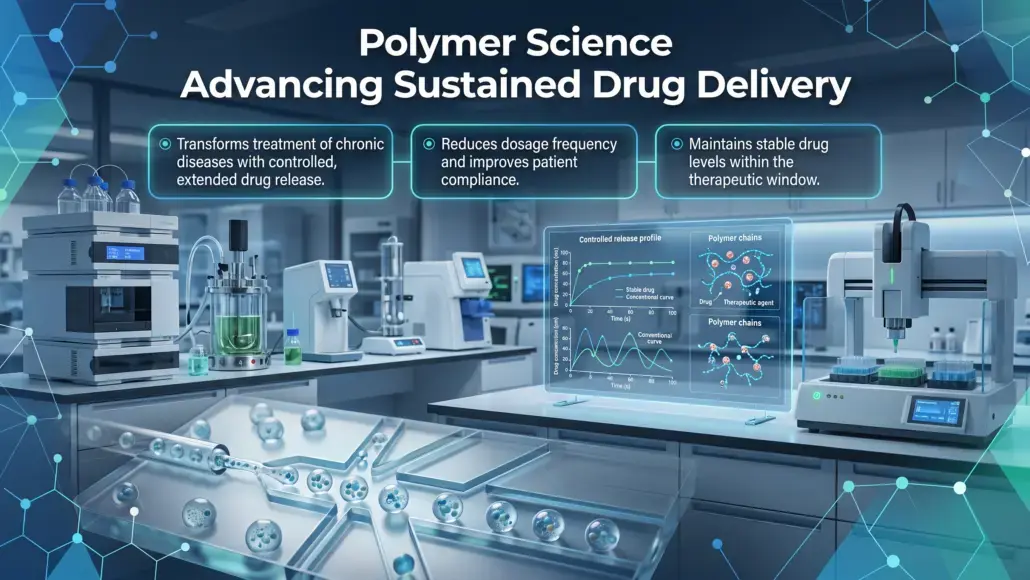
The development of sustained-release drug delivery systems has transformed the treatment of chronic diseases by allowing for the controlled release of therapeutic agents over extended periods. This approach reduces the frequency of administration, improves patient compliance, and maintains drug concentrations within the therapeutic window, minimizing the peaks and troughs associated with conventional dosage forms. Polymer science advancing sustained drug delivery is at the heart of this innovation, providing the materials and engineering principles required to design sophisticated delivery vehicles. From biodegradable microspheres to in situ forming hydrogels, the application of advanced polymers is enabling the delivery of both small molecules and complex biologics in a predictable and reliable manner.
Physicochemical Properties of Biodegradable Polymeric Matrices
The selection of the polymer is the most critical decision in the design of a sustained-release system. Biodegradable polymers are particularly favored because they eliminate the need for surgical removal of the device after the drug has been depleted. Polymer science advancing sustained drug delivery has focused extensively on polyesters, such as poly(lactic-co-glycolic acid) (PLGA), due to their well-characterized safety profile and tunable degradation rates. The degradation of PLGA occurs through the hydrolysis of its ester linkages, producing lactic and glycolic acids, which are naturally metabolized by the body. By adjusting the ratio of lactic to glycolic acid or the molecular weight of the polymer, scientists can control the rate of water uptake and subsequent degradation, allowing for release profiles ranging from weeks to several months.
Beyond PLGA, researchers are exploring other classes of polymers, such as polycaprolactones and polyanhydrides, to achieve specific release kinetics. The physical state of the polymer, whether crystalline or amorphous, also plays a significant role in drug release. Crystalline regions are more resistant to water penetration, leading to slower degradation, while amorphous regions allow for faster diffusion of the drug. Understanding these relationships at the molecular level allows for the engineering of “smart” polymers that can respond to physiological triggers, such as changes in pH or temperature. This precision in material science is essential for developing delivery systems that are tailored to the specific pharmacokinetic requirements of the drug and the clinical needs of the patient.
Mechanisms of Controlled Drug Release and Diffusion
The release of a drug from a polymeric matrix is a complex process that typically involves a combination of diffusion, swelling, and erosion. Polymer science advancing sustained drug delivery seeks to model and control these mechanisms to achieve the desired release profile. In many systems, an initial “burst release” occurs, where the drug near the surface of the matrix is rapidly released upon contact with biological fluids. While a small burst can be beneficial for reaching therapeutic levels quickly, an excessive burst can lead to toxicity. Formulation scientists utilize techniques such as coating the matrix or adjusting the drug-polymer interaction to minimize this effect.
Following the initial burst, the drug release is governed by its diffusion through the polymer network. As the polymer hydrates, it may swell, creating pathways for the drug to move toward the surface. Simultaneously, the polymer matrix begins to erode as the chemical bonds break down. The interplay between these processes determines whether the release follows zero-order kinetics (a constant rate over time) or first-order kinetics (a rate that decreases as the drug concentration drops). Achieving zero-order release is the “gold standard” for sustained delivery, as it provides the most stable drug exposure. Advances in mathematical modeling and imaging techniques, such as micro-CT and confocal microscopy, are providing deeper insights into the internal structure of these matrices, allowing for more accurate predictions of release behavior in vivo.
Innovations in Long-Acting Injectables and Implantable Systems
Long-acting injectables (LAIs) represent one of the most successful applications of polymer science advancing sustained drug delivery. These products are typically administered as a suspension of polymeric microspheres or as an in situ forming depot. In situ forming systems are particularly interesting because they are injected as a liquid but solidify into a solid or semi-solid depot upon contact with the body’s environment. This can be triggered by a change in solvent (solvent exchange) or by a temperature-sensitive phase transition. These systems offer the advantage of being easy to administer through a standard needle while providing the benefits of a long-term implant.
Implantable systems, such as those used for hormonal contraception or the treatment of certain cancers, offer even longer durations of action, sometimes lasting for years. These devices are often made from non-biodegradable polymers like ethylene-vinyl acetate (EVA) or silicone, where the drug release is strictly controlled by diffusion through a rate-limiting membrane. However, the move toward biodegradable implants is gaining momentum to improve patient comfort and reduce healthcare costs. The challenge in this area is to ensure that the mechanical integrity of the implant is maintained throughout the release period and that the degradation products do not cause local irritation. The integration of 3D printing technology into polymer science is also opening new possibilities for creating personalized implants with complex geometries and customized release profiles.
Challenges in Delivering Biologics and Future Regulatory Considerations
While polymer science advancing sustained drug delivery has been highly effective for small molecules, the delivery of biologics presents unique challenges. Proteins and peptides are sensitive to the harsh conditions often used in polymer processing, such as exposure to organic solvents, high shear forces, and the acidic environment created during PLGA degradation. To protect these fragile molecules, researchers are developing new polymers with milder processing requirements and incorporating stabilizing excipients like sugars or buffers into the polymeric matrix. The use of hydrogels, which are highly hydrated polymer networks, is also a promising strategy for biologic delivery, as they provide a more biomimetic environment that helps maintain the protein’s native structure.
From a regulatory perspective, sustained-release products are considered complex generics or new drug applications that require extensive data on both the drug and the polymer. Manufacturers must demonstrate the consistency of the polymer’s molecular weight, composition, and impurity profile. Additionally, the in vitro-in vivo correlation (IVIVC) for these products can be difficult to establish, as the release behavior in the laboratory may not perfectly match the behavior in the complex biological environment. Regulatory agencies are increasingly encouraging the use of modeling and simulation to support the development and approval of these products. As the field continues to evolve, the collaboration between polymer scientists, biologists, and regulatory experts will be essential for bringing the next generation of sustained-release therapies to market, ultimately improving the lives of patients with chronic and debilitating conditions.