








Close
CDMO Safety Testing 2026
Novotech

QIAGEN and NVIDIA Join Forces to Advance AI-Driven Drug Discovery

Note* - All images used are for editorial and illustrative purposes only and may not originate from the original news provider or associated company.

Subscribe

- Never miss a story with notifications

- Gain full access to our premium content

- Browse free from any location or device.

Media Packs

Expand Your Reach With Our Customized Solutions Empowering Your Campaigns To Maximize Your Reach & Drive Real Results!

โ€“ Access the Media Pack Now

โ€“ Book a Conference Call

โ€“ Leave Message for Us to Get Back

Related stories

Decentralized Clinical Trials Market Advances Worldwide

The global Decentralized Clinical Trials Market is expected to...

Bioprocess Analytics Improving Biologics Manufacturing

The immense complexity of modern biopharmaceutical production is being navigated through the strategic and systematic application of bioprocess analytics improving biologics manufacturing. By leveraging real-time data streams and advanced monitoring tools, manufacturers can gain a granular, molecular-level understanding of cellular behavior and the surrounding environmental conditions within the bioreactor. This proactive, data-driven approach allows for immediate, automated adjustments that optimize therapeutic yield, ensure absolute product consistency, and significantly streamline the arduous path toward commercial-scale production in a highly regulated global environment.

Cell Therapy Quality Control Improving Clinical Outcomes

The long-term success of advanced medicinal products is fundamentally dependent on a rigorous and comprehensive approach to cell therapy quality control improving clinical outcomes. By implementing stringent, multi-stage testing for identity, purity, potency, and safety, manufacturers can guarantee that every individual dose delivered to a patient meets the highest possible standards of GMP compliance. This systematic and data-driven oversight minimizes clinical risks and enhances the reproducibility of complex treatments, ultimately leading to more predictable and successful therapeutic results in the rapidly evolving field of regenerative medicine.
- Advertisement -

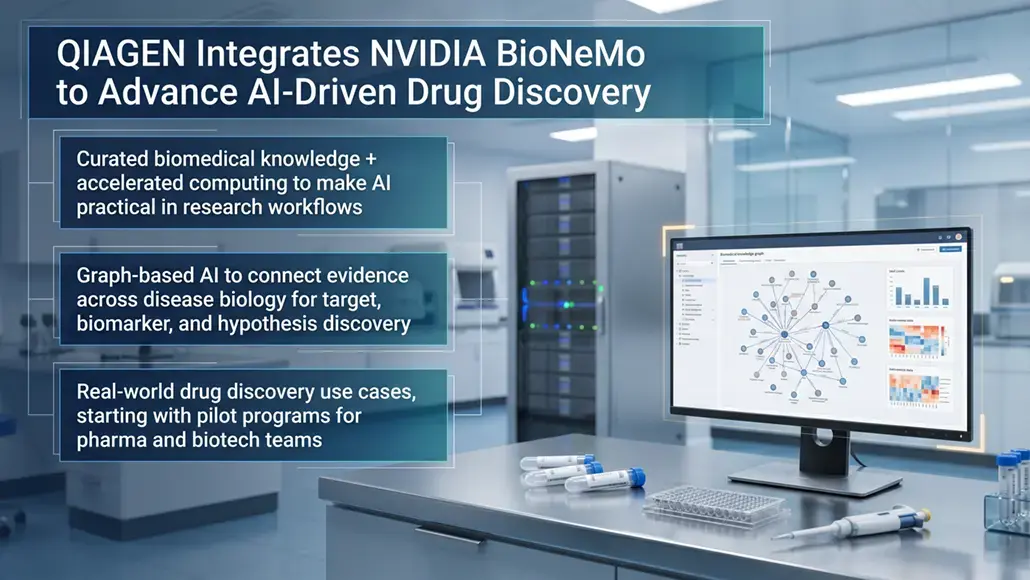
QIAGEN’s Digital Insights bioinformatics division is set to integrate NVIDIA’s accelerated computing infrastructure and the BioNeMo platform to strengthen AI-driven drug discovery capabilities for pharmaceutical and biotechnology researchers. The collaboration aims to make AI more actionable in research settings by combining advanced bioinformatics tools with curated biomedical knowledge bases.

The partnership is designed to help research teams develop a deeper understanding of disease biology, pinpoint promising therapeutic targets, and uncover biomarkers that can support the development of new medicines.

At the core of the collaboration is the application of graph-based AI, which uses retrieval and reasoning methods over biomedical knowledge graphs. This approach enables researchers to explore evidence across complex biological systems and supports the creation of agentic, multi-step workflows throughout the AI-driven drug discovery process.

Nitin Sood, Senior Vice President and Head of Product Portfolio and Innovation at QIAGEN, stated: “QIAGEN Digital Insights has spent more than 25 years building the biomedical knowledge foundation that researchers rely on to interpret complex biology. Through this collaboration with NVIDIA, we can accelerate the impact of that knowledge by combining it with advanced AI to help customers improve critical steps in drug discovery, from target identification to biomarker research and hypothesis generation.”

The collaboration is oriented around concrete, real-world applications across the drug discovery pipeline. These include target identification and validation, drug repurposing, biomarker discovery, pathway analysis, and hypothesis generation using multi-omics data.

By bringing together curated biomedical knowledge, graph-based AI, and NVIDIA’s accelerated computing capabilities, QIAGEN seeks to equip research teams with the means to convert complex biological data into well-informed discovery decisions. The integration of pharmaceutical AI at this scale reflects the growing demand for intelligent, knowledge-driven tools in life sciences research.

Initial pilot programmes will be made available to select partners in the pharmaceutical and biotechnology sectors. A broader rollout is planned following the validation phase, with the initiative positioned to extend the benefits of bioinformatics-powered, AI-driven drug discovery to a wider research community.

The QIAGEN and NVIDIA collaboration underscores how biomedical knowledge graphs and advanced AI frameworks are becoming central to modern drug discovery workflows, offering research-driven organisations new pathways to address some of the most complex challenges in life sciences.


Never miss a pharmaceutical headline

The pharmaceutical industry moves fast โ€“ stay on top of it with our must - read briefings.

  • The top pharma and life sciences stories, straight to your inbox
  • The biggest news, features, interviews, and analysis
  • Dedicated coverage of the key developments driving the global pharmaceutical sector

Latest stories

Related stories

Decentralized Clinical Trials Market Advances Worldwide

The global Decentralized Clinical Trials Market is expected to...

Bioprocess Analytics Improving Biologics Manufacturing

The immense complexity of modern biopharmaceutical production is being navigated through the strategic and systematic application of bioprocess analytics improving biologics manufacturing. By leveraging real-time data streams and advanced monitoring tools, manufacturers can gain a granular, molecular-level understanding of cellular behavior and the surrounding environmental conditions within the bioreactor. This proactive, data-driven approach allows for immediate, automated adjustments that optimize therapeutic yield, ensure absolute product consistency, and significantly streamline the arduous path toward commercial-scale production in a highly regulated global environment.

Cell Therapy Quality Control Improving Clinical Outcomes

The long-term success of advanced medicinal products is fundamentally dependent on a rigorous and comprehensive approach to cell therapy quality control improving clinical outcomes. By implementing stringent, multi-stage testing for identity, purity, potency, and safety, manufacturers can guarantee that every individual dose delivered to a patient meets the highest possible standards of GMP compliance. This systematic and data-driven oversight minimizes clinical risks and enhances the reproducibility of complex treatments, ultimately leading to more predictable and successful therapeutic results in the rapidly evolving field of regenerative medicine.

GMP Cytokines Advancing Cell Therapy Manufacturing

The rapid transition of cell-based treatments from the experimental laboratory stage to the standard of clinical care is being enabled by the availability of GMP cytokines advancing cell therapy manufacturing. These vital signaling molecules are absolutely essential for the successful expansion, specific differentiation, and functional activation of therapeutic cell populations, such as CAR T cells used in oncology. By strictly adhering to Good Manufacturing Practice standards, suppliers ensure that these critical raw materials possess the high purity, consistent potency, and clinical safety required for human applications, thereby reducing product variability and significantly enhancing the success rate of regenerative medicine.

Subscribe

- Never miss a story with notifications

- Gain full access to our premium content

- Browse free from any location or device.

Media Packs

Expand Your Reach With Our Customized Solutions Empowering Your Campaigns To Maximize Your Reach & Drive Real Results!

โ€“ Access theMedia Pack Now

โ€“ Book a Conference Call

โ€“ Leave Message for Us to Get Back

Translate ยป