






Maintaining the absolute purity of water is one of the most significant challenges in pharmaceutical manufacturing. While traditional treatment methods like reverse osmosis, deionization, and distillation are highly effective at removing ions and particulates, they sometimes struggle with low-molecular-weight organic contaminants and refractory compounds. This is where advanced oxidation pharma water treatment becomes essential. Advanced Oxidation Processes (AOP) utilize highly reactive oxygen species primarily the hydroxyl radical (·OH) to physically break down and mineralize organic pollutants that other technologies might miss. By integrating AOP into the water treatment train, pharmaceutical facilities can achieve unprecedented levels of Total Organic Carbon (TOC) reduction, ensuring that their Purified Water (PW) and Water for Injection (WFI) meet the rigorous standards required by global pharmacopeias.
The effectiveness of advanced oxidation pharma water treatment lies in its ability to degrade a wide spectrum of chemical contaminants, including active pharmaceutical ingredients (APIs) that may be present in recycled water streams or environmental source water. These persistent organics can be particularly difficult to remove using conventional biological or physical methods. AOP systems, however, are designed to target the chemical bonds within these molecules, converting them into harmless byproducts like water, carbon dioxide, and mineral salts. This proactive approach to contamination control is a cornerstone of modern pharmaceutical utility management, providing a robust defense against the risks of batch contamination and regulatory non-compliance.
The Chemistry of High-Potency Contaminant Removal
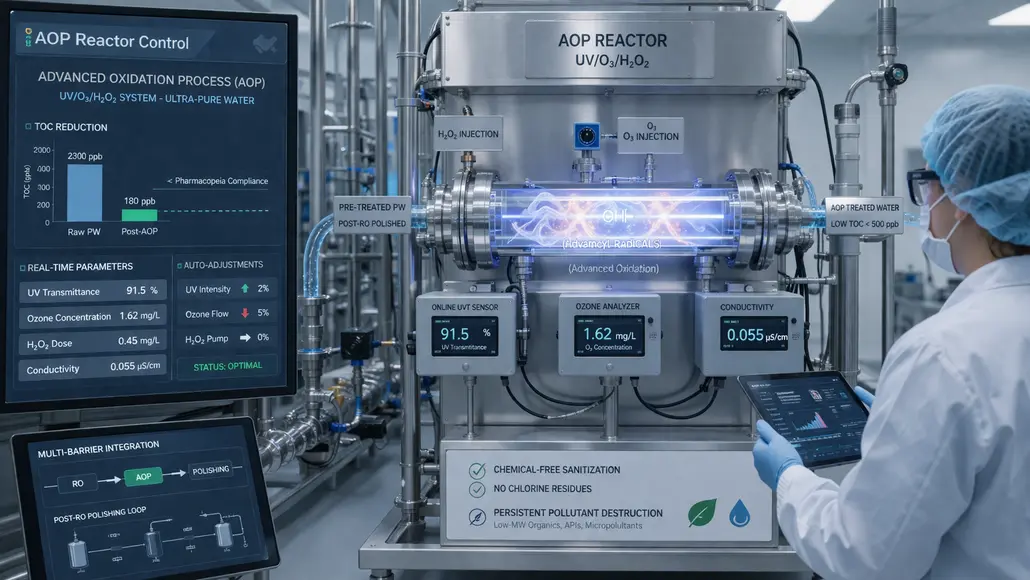
The core principle behind advanced oxidation pharma water treatment is the generation of the hydroxyl radical, which is one of the most powerful oxidants known. Hydroxyl radicals are highly non-selective, meaning they will attack almost any organic molecule they encounter in the water stream. There are several ways to generate these radicals within a treatment system, including combinations of ultraviolet (UV) light, ozone (O3), and hydrogen peroxide (H2O2). For instance, the UV/H2O2 process involves adding a small amount of hydrogen peroxide to the water and then exposing it to high-intensity UV light. This causes the H2O2 molecules to split into two hydroxyl radicals, which then go on to destroy any organic matter present. This chemical-physical synergy is what makes AOP so effective at reaching the ultra-low TOC levels required for high-purity pharmaceutical applications.
TOC Reduction and Compliance with Pharmacopeia Standards
Total Organic Carbon (TOC) is a critical quality attribute for pharmaceutical water, with USP and EP standards requiring levels to be below 500 parts per billion (ppb). In many cases, manufacturers strive for even lower levels to ensure a wide safety margin. Advanced oxidation pharma water treatment is a primary tool for achieving these targets. By continuously monitoring TOC levels and adjusting the AOP parameters—such as UV intensity or ozone dosage operators can maintain consistent water quality even when the feed water composition varies. This level of control is essential for ensuring that the water system remains in a validated state and that the final drug products are free from organic impurities that could affect their stability or efficacy.
Targeting Recalcitrant APIs in Wastewater and Recycle Loops
As the industry moves toward more sustainable water management practices, such as the recycling of process water (as discussed in other contexts), the challenge of removing residual APIs becomes even more acute. Many drug molecules are designed to be stable and are therefore resistant to traditional wastewater treatment. Advanced oxidation pharma water treatment is uniquely suited for this task. By applying AOP to the waste or recycle streams, facilities can ensure that these potent compounds are completely destroyed before the water is reused or discharged into the environment. This not only protects the manufacturing process from cross-contamination but also reduces the facility’s environmental impact, fulfilling corporate social responsibility goals and complying with increasingly strict discharge regulations.
Integration of AOP with Traditional Treatment Technologies
Advanced oxidation pharma water treatment is most effective when used as part of a multi-barrier approach. It is typically placed after initial filtration and softening steps, but before final polishing and distribution. For example, an AOP unit can serve as a “polishing” step after reverse osmosis (RO) to remove any trace organics that might have passed through the RO membrane. Alternatively, it can be used in the storage and distribution loop to provide continuous sanitization and TOC control. The flexibility of AOP technology allows it to be integrated into both existing legacy systems and new, state-of-the-art facilities, providing a scalable solution for water purification challenges of all sizes. Such adaptability is increasingly viewed as essential in modern facility design, reflecting a broader shift toward hybrid utility architectures that has been gaining attention across industry discussions, including those covered by World Pharma Today.
Benefits of Chemical-Free Sanitization in Pure Water Loops
One of the major advantages of certain types of advanced oxidation pharma water treatment specifically those based on UV and ozone is that they can provide sanitization without the need for traditional chemical additives like chlorine. Chlorine is undesirable in pharmaceutical water systems because it can react with organic matter to form harmful disinfection byproducts (DBPs) and must be removed before the water reaches the production line. UV-based AOP, on the other hand, leaves no chemical residue and does not alter the physical properties of the water. Ozone, while a powerful oxidant, can be easily removed using UV light once its work is done. This “clean” approach to sanitization and purification is ideal for maintaining the high-purity environments needed for sterile drug manufacturing.
Real-Time Monitoring and Control of AOP Systems
To maximize the efficiency of advanced oxidation pharma water treatment, modern systems are equipped with sophisticated sensors and control algorithms. These systems can monitor parameters such as UV transmittance, ozone concentration, and inlet TOC levels in real-time. By feeding this data into a centralized control platform, the AOP unit can automatically adjust its operating parameters to ensure optimal treatment performance while minimizing energy consumption. For instance, if the inlet water quality improves, the system can reduce the UV intensity or ozone dose, leading to significant operational savings. This move toward “smart” AOP is a key part of the broader digital transformation of pharmaceutical utility operations.
Overcoming the Challenges of AOP Implementation
While the benefits are significant, implementing advanced oxidation pharma water treatment does come with certain considerations. The design of the AOP reactor must be carefully optimized to ensure adequate mixing and contact time between the hydroxyl radicals and the organic contaminants. Additionally, the presence of certain inorganic ions, such as carbonates or bicarbonates, can “scavenge” the hydroxyl radicals, reducing the overall efficiency of the process. Therefore, a thorough water analysis and pilot study are often necessary before full-scale implementation. However, with modern modeling tools and the expertise of water treatment specialists, these challenges can be effectively managed, resulting in a robust and reliable purification system that provides peace of mind for the manufacturer.
Environmental Stewardship and the Reduction of “Persistent” Pollutants
The pharmaceutical industry is increasingly aware of the impact that “micro-pollutants” can have on aquatic ecosystems. Even trace amounts of certain drugs can have significant effects on wildlife and may contribute to the development of antibiotic-resistant bacteria. Advanced oxidation pharma water treatment is a powerful tool for mitigating these risks. By ensuring the complete mineralization of drug molecules before they leave the site, pharmaceutical companies are taking a proactive stance on environmental protection. This commitment to green chemistry and sustainable manufacturing is becoming a key differentiator in the eyes of investors, regulators, and consumers alike, making AOP a strategic investment for any forward-thinking life sciences company.
In conclusion, advanced oxidation pharma water treatment is a transformative technology that is setting new standards for water purity in the pharmaceutical industry. By harnessing the power of the hydroxyl radical, manufacturers can effectively remove persistent organic contaminants, achieve ultra-low TOC levels, and ensure the absolute safety and efficacy of their drug products. As the industry continues to evolve and face new purification challenges, AOP will remain a critical component of the high-purity water systems that are the foundation of modern medicine. The journey toward absolute purity is an ongoing one, but with the aid of advanced oxidation, the pharmaceutical industry is better equipped than ever to meet its commitment to quality and patient safety. This progression underscores a broader industry commitment to pushing the limits of contamination control and process reliability—an ongoing narrative shaping conversations across platforms like World Pharma Today.