












Smartlab Europe

Medtech companies prepare for an innovation makeover

Note* - All images used are for editorial and illustrative purposes only and may not originate from the original news provider or associated company.

Subscribe

- Never miss a story with notifications

- Gain full access to our premium content

- Browse free from any location or device.

Media Packs

Expand Your Reach With Our Customized Solutions Empowering Your Campaigns To Maximize Your Reach & Drive Real Results!

– Access the Media Pack Now

– Book a Conference Call

Leave Message for Us to Get Back

Related stories

Structural Pricing Pressure is Reshaping Pharma in 2026

In 2026, global pricing pressure in the pharmaceutical sector has shifted from a temporary, cyclical issue to a structural constraint. Explore how U.S. reforms, European reference pricing, and biosimilar competition are forcing companies to embed pricing risk into core strategy.

Merck Targets $70B Revenue in 2026 with Cidara Deal

Merck’s roughly $9.2 billion acquisition of Cidara Therapeutics and its $70 billion revenue ambition mark a strategic pivot toward respiratory vaccines and antivirals. Explore how this deal reshapes Merck’s portfolio and signals a broader industry shift toward targeted M&A to offset patent cliffs.

U.S. Drug Pricing Reset Becomes Real in 2026

In 2026, U.S. drug pricing finally moved from policy debate to P&L impact. The first set of Medicare “maximum fair prices” and Most‑Favoured‑Nation–style reference pricing are reshaping pharma margins and launch strategies.
- Advertisement -

A report by PricewaterhouseCoopers

For decades, the medtech industry was on the forefront of innovation, but now return on innovation investment is declining. Growth through technology innovation has slowed substantially and the benefits from incremental improvements to existing devices pale in comparison to the cost of making them. Profits are contracting and total shareholder returns for medtech companies have been declining over the last few years. The ability to continue serving existing customers and markets in a meaningful way is becoming increasingly difficult because today they are expecting more from medtech.


The mere concept of innovation needs redefining in a health ecosystem that demands and rewards new models for delivering better care across a broader patient population at lower costs.. Medtech companies must get ready to compete in this new environment or risk being displaced by ones that can show evidence their innovations achieve the same high clinical standards but are faster, better, cheaper, and more integrated into the care delivery continuum. In many instances these companies may exist outside the traditional medtech realm.

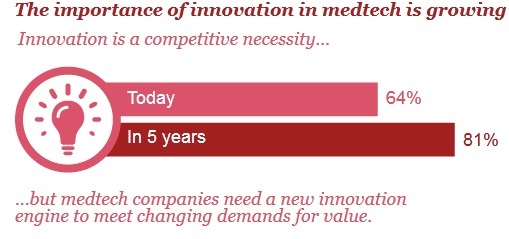
Some of these companies are non-traditional players that are entering healthcare. The medtech industry has always viewed innovation as the critical element of success, and its importance continues to grow. While 64% of executives surveyed by PwC’s Health Research Institute (HRI) view innovation as a competitive necessity today, 81% believe it will be in five years. But the innovation machine is not working like it used to. Download the report from PWC to find out why.


Source: PwC Medtech Innovation Survey 2013

Latest stories

Related stories

Structural Pricing Pressure is Reshaping Pharma in 2026

In 2026, global pricing pressure in the pharmaceutical sector has shifted from a temporary, cyclical issue to a structural constraint. Explore how U.S. reforms, European reference pricing, and biosimilar competition are forcing companies to embed pricing risk into core strategy.

Merck Targets $70B Revenue in 2026 with Cidara Deal

Merck’s roughly $9.2 billion acquisition of Cidara Therapeutics and its $70 billion revenue ambition mark a strategic pivot toward respiratory vaccines and antivirals. Explore how this deal reshapes Merck’s portfolio and signals a broader industry shift toward targeted M&A to offset patent cliffs.

U.S. Drug Pricing Reset Becomes Real in 2026

In 2026, U.S. drug pricing finally moved from policy debate to P&L impact. The first set of Medicare “maximum fair prices” and Most‑Favoured‑Nation–style reference pricing are reshaping pharma margins and launch strategies.

White House-Big Pharma Tariff and Pricing Deals in 2026

In early 2026, the White House struck a series of tariff and pricing deals with major pharma firms, linking lower prices for GLP‑1 and other drugs to tariff relief and new distribution channels. Explore how these arrangements are reshaping U.S. pharma pricing, access and global spillovers.

Subscribe

- Never miss a story with notifications

- Gain full access to our premium content

- Browse free from any location or device.

Media Packs

Expand Your Reach With Our Customized Solutions Empowering Your Campaigns To Maximize Your Reach & Drive Real Results!

– Access theMedia Pack Now

– Book a Conference Call

Leave Message for Us to Get Back

Translate »