










The foundation of effective medical treatment is the ability to see what is happening inside the human body with absolute clarity. For decades, our diagnostic tools from blood tests to MRI scans have relied on classical physics to detect the presence of disease or the concentration of a drug in the bloodstream. While these tools have saved countless lives, they have reached a plateau in terms of sensitivity and resolution. There are many diseases, such as the early stages of neurodegeneration or the presence of microscopic cancer clusters, that remain invisible to even our best classical equipment. The arrival of quantum sensors diagnostics is changing this paradigm, offering a new generation of tools that use the properties of quantum mechanics to sense the world at the atomic and molecular level. These sensors are not just an improvement on existing technology; they are a fundamental leap forward that is redefining the boundaries of medical device innovation.
The shift from classical to quantum sensing
To appreciate the impact of quantum sensors healthcare, it is helpful to understand the limitations of classical sensing. A classical sensor works by measuring a physical change in a material, such as the expansion of mercury in a thermometer or the electrical signal in a traditional glucose monitor. These sensors are limited by “noise” environmental interference that masks the very small signals researchers are looking for. As you try to measure smaller and smaller concentrations of a drug or a biomarker, the signal eventually gets lost in the background noise.
Quantum sensors, by contrast, utilize the inherent sensitivity of quantum states to their environment. A quantum sensor might use a single atom, an electron spin, or a photon to measure magnetic fields, temperature, or chemical concentrations. Because these quantum states are extremely delicate, even the slightest change in the surrounding environment will cause a measurable shift in their behavior. This allows for a level of precision that is several orders of magnitude higher than classical systems. In the context of drug testing technology, this means we can now detect the presence of a therapeutic compound at the level of individual molecules, providing an unprecedented view of how a drug is distributed and metabolized in the body.
Diagnostic innovation pharma and early disease detection
The most immediate benefit of quantum sensors diagnostics is the ability to detect disease much earlier than was previously possible. Many of the most difficult diseases to treat, such as Alzheimer’s or certain types of aggressive cancer, do not show physical symptoms until they have progressed to an advanced stage. By the time a patient feels a lump or experiences memory loss, the disease may have already caused significant damage.
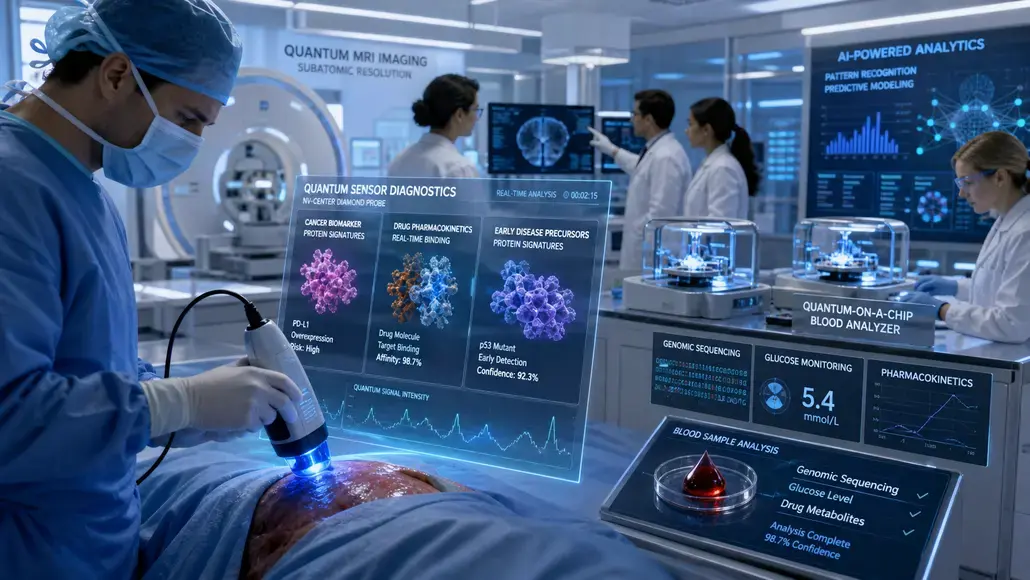
Quantum sensors can detect the “biochemical precursors” of these diseases. For example, nitrogen-vacancy (NV) centers in diamonds are being used to create highly sensitive magnetometers that can detect the tiny magnetic signatures of specific proteins or antibodies in a blood sample. This allows for the detection of cancer-associated biomarkers when they are present in concentrations that are too low for traditional lab tests to pick up. This “diagnostic innovation pharma” is a game-changer, moving medicine away from reactive treatment toward a model of early intervention and even prevention. If we can catch a disease before it has a chance to take root, the success rate of our therapies increases dramatically.
Real-time diagnostics and intra-operative monitoring
Beyond the lab, quantum sensors diagnostics are moving into the clinical setting, providing real-time data during medical procedures. One of the most promising applications is in the field of surgical oncology. During a surgery to remove a tumor, the primary challenge for a surgeon is ensuring that they have removed all the cancerous cells while sparing as much healthy tissue as possible. Current methods for checking “surgical margins” often take too long to be useful during the operation.
Quantum-enhanced imaging tools can provide a real-time, molecular-level view of the tissue as the surgeon is working. By detecting the specific fluorescent or magnetic signatures of cancer cells, these sensors can guide the surgeon’s hand with sub-millimeter precision. This level of medical device innovation reduces the need for follow-up surgeries and improves the long-term prognosis for the patient. Similarly, in the context of personalized medicine, quantum sensors can be used to monitor a patient’s response to a drug in real-time, allowing doctors to adjust the dosage on the fly to ensure maximum efficacy and minimum toxicity.
Enhancing drug testing technology and pharmacokinetic modeling
In the pharmaceutical lab, quantum sensors are providing a more detailed picture of how new drugs interact with biological systems. Understanding the “pharmacokinetics” of a drug how it moves through the body, where it accumulates, and how it is broken down is a critical part of the development process. Traditional methods often rely on radioactive labeling or mass spectrometry, which can be invasive or require the destruction of the sample.
Quantum sensors diagnostics offer a non-invasive way to track drug molecules in real-time. For example, quantum dots and other nano-sensors can be engineered to “light up” only when they bind to a specific drug target. This allows researchers to watch the drug work in a living cell, providing insights into its mechanism of action that were previously impossible to obtain. This enhanced drug testing technology is helping to identify potential side effects much earlier in the R&D cycle, saving time and resources and ensuring that only the safest and most effective candidates move forward to clinical trials.
The miniaturization of diagnostic tools
One of the most exciting trends in medical device innovation is the miniaturization of quantum sensors. While the first generation of quantum sensors required large, laboratory-grade equipment, researchers are now developing “quantum-on-a-chip” technologies. These are small, portable devices that can perform high-precision diagnostics at the point of care, such as in a doctor’s office or even a patient’s home.
Imagine a handheld device that can perform a full genomic sequence or a comprehensive drug panel from a single drop of blood in a matter of minutes. This is the future enabled by quantum sensors diagnostics. By bringing the power of the lab to the patient, these tools can reduce the time to diagnosis and allow for more frequent monitoring of chronic conditions. This decentralization of healthcare is a key part of the global effort to improve health equity and make advanced medical care more accessible to people in remote or underserved regions.
Overcoming the technical and economic barriers
The widespread adoption of quantum sensors healthcare is not without its challenges. Quantum states are notoriously fragile and can be easily disrupted by heat or vibration. Many current sensors require cryogenic cooling to operate, which limits their use outside of specialized research centers. However, we are seeing rapid progress in the development of “room-temperature” quantum sensors, particularly those based on diamond defects or atomic vapors.
Furthermore, there is the issue of cost. Like all cutting-edge technologies, the first generation of quantum diagnostic tools is expensive to produce. However, as the manufacturing processes for these sensors mature leveraging the same lithography and fabrication techniques used in the semiconductor industry the costs are expected to drop significantly. The long-term economic benefits of earlier diagnosis and more precise treatment will far outweigh the initial investment in this medical device innovation.
The synergy of sensors and data analytics
The data generated by quantum sensors diagnostics is incredibly rich and complex. To make sense of it, the industry is increasingly relying on the quantum data analysis and machine learning techniques discussed in other contexts. The combination of high-fidelity data from quantum sensors and advanced processing from quantum algorithms creates a powerful feedback loop.
The sensors provide the “eyes” to see the subatomic world, while the algorithms provide the “brain” to interpret what is being seen. This synergy is driving the next wave of pharma innovation, leading to the discovery of new biological pathways and the design of more targeted therapies. As these two fields continue to converge, the line between diagnostics and treatment will become increasingly blurred, leading to a more integrated and holistic approach to human health.
Conclusion: A new window into biology
We are standing at the threshold of a revolution in medical sensing. Quantum sensors enabling advanced drug diagnostics are providing us with a window into biology that is clearer and more detailed than anything we have had before. By allowing us to detect the earliest whispers of disease and the most subtle interactions of a drug molecule, these tools are giving us the power to intervene with a degree of precision that was once the stuff of science fiction.
The impact of this technology will be felt across the entire healthcare spectrum, from the research lab to the operating room to the patient’s home. As we continue to refine these sensors and integrate them into our medical devices, we are building a world where no disease can hide and every treatment is optimized for success. The era of quantum-enhanced diagnostics has arrived, and it is the key to a longer, healthier, and more vibrant future for all.