











When DeciBio asked nine senior pharma executives what was holding back AI adoption in R&D, the answer wasn’t algorithms or compute. Three of the top four barriers they named were data problems, and low-quality data was cited by every single one of them.
Every AI drug discovery pitch deck has a slide about proprietary data. Fewer have a slide about what it actually takes to make that data usable by a model. That gap is where most “big data” claims quietly come undone.
A dataset can be enormous and still be worthless to an AI pipeline if it’s inconsistent, undocumented, or impossible to trace back to its source. Conversely, a moderately sized dataset that is fully FAIR, meaning Findable, Accessible, Interoperable, and Reusable, can outperform a much larger one simply because a model can trust what it’s being fed. This is the part of the AI drug discovery conversation that rarely gets airtime: the infrastructure layer between raw lab data and a training-ready dataset.
To be clear, volume isn’t worthless. It just isn’t self-validating. The real question is whether scale arrives with structural diversity and traceable provenance, or whether it is the same chemistry counted twice.
Why “more data” is the wrong frame
Most legacy pharma data lives in a mix of ELN exports, LIMS extracts, PDFs of internal reports, and assay spreadsheets that were never designed to be machine-read. The structures might be drawn slightly differently across sources. The same target might appear under three different names. Units, assay conditions, and endpoints are recorded inconsistently between labs and even between scientists on the same team.
None of this is visible in a summary statistic like “10 million data points.” It only becomes visible when a model trained on that data starts learning structure-activity relationships that don’t survive contact with new compounds, or when a QSAR model can’t reproduce results across two batches of ostensibly identical assay data. What looks like an activity cliff is sometimes just a curation artifact. A data advantage built on volume alone tends to unravel the moment it is stress-tested by a model that actually depends on internal consistency.
The gap between volume and coverage is measurable. In an overlap analysis we ran across eight ADME endpoints, comparing two widely used structure-activity databases, the headline compound counts were often similar while the underlying chemical space was not. For LogD, one database held 25,550 compounds and the other 25,836, yet only 12,263 were common to both. Nearly half the structural diversity in each set was invisible to the other. For Caco-2 permeability, the smaller database held 7,277 compounds against 13,616 in the larger, with just 3,475 overlapping. Two datasets can look comparable on a slide and still be training your model on substantially different chemistry.
What the FAIR layer has to enforce
The FAIR principles turn ten this year. In that decade they have stopped being a data-governance nicety and become a modeling prerequisite.
Findable means every compound, target, and assay record carries a persistent, unique identifier, such as InChI keys for structures, UniProt accessions for proteins, and DOIs or internal record IDs for source documents, so a pipeline can retrieve exactly the record it needs, not a fuzzy match.
Accessible means retrieval happens through governed, API-based access rather than manual export. This matters especially in partnership and licensing structures, where proprietary and shared data need to sit side by side without either contaminating the other or becoming a bottleneck for the modeling team.
Interoperable means structures, targets, and phenotypes resolve to the same entity regardless of which internal system or external database they came from. This is usually done through shared ontologies and controlled vocabularies, including ChEBI for chemical entities, Gene Ontology for function, and MeSH or MedDRA for clinical terms, so a knowledge graph linking targets, compounds, and outcomes doesn’t fracture into duplicate nodes for the same real-world thing.
Reusable means every record carries its provenance and version history: which assay protocol generated it, which curation pass touched it, which model version was trained on which data snapshot. Without this, retraining a model or auditing a prediction after a data correction becomes guesswork. This is also where the stakes stop being purely technical. When an AI-derived result informs candidate selection or supports a regulatory submission, the ability to demonstrate which data version produced which prediction is what makes that result defensible to a reviewer.
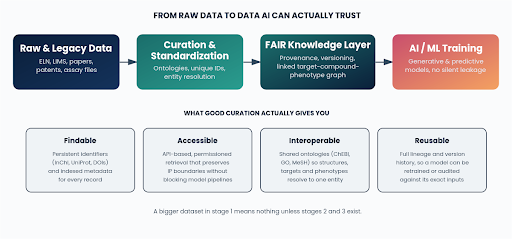
Figure 1: How raw pharma data becomes AI-trustworthy data
Where this actually breaks in practice
Three failure modes show up repeatedly when legacy datasets are pushed toward AI-readiness:
- Entity collisions. The same protein target catalogued under a gene symbol in one system and a UniProt ID in another, with no cross-reference, silently splits training data that should have been pooled.
- Structure ambiguity. Stereochemistry, tautomer state, and salt form recorded inconsistently across sources mean a model can see what looks like two different molecules when it’s really one, or vice versa.
- Untracked provenance. When a dataset has been curated, merged, and re-curated across multiple projects with no lineage, nobody can say with confidence which records were manually corrected, which were auto-mapped, and which are still suspect. That uncertainty propagates directly into model confidence, whether or not anyone accounts for it.
Fixing these isn’t a one-time cleanup. It requires the same discipline as software engineering: version control for datasets, automated ontology mapping with human review at the edge cases, and a standing curation function rather than a project-based one.
The takeaway for teams evaluating AI platforms or building internal capability
When assessing a claimed data advantage, whether from a vendor’s proprietary database or an internal pharma dataset, volume is the least useful signal. Ask instead: Is every record traceable to a unique entity? Can the data be queried programmatically? Do structures and targets resolve consistently? Is there version history to explain a model’s prediction later? And critically, how much of that volume is genuinely distinct chemistry rather than the same series recorded twice?
A strong data position gets discussed as a strategic asset. In practice, it’s a curation and infrastructure problem, and the teams that treat it that way are the ones whose models hold up outside the training set.
Read the full commercial analysis in The State of AI/ML in Drug Discovery 2026, Excelra’s executive report on business models, partnership economics, and market consolidation in AI drug discovery.
Authored By Vikash Peesapati, Head of Strategy & Corporate Development, Excelra