








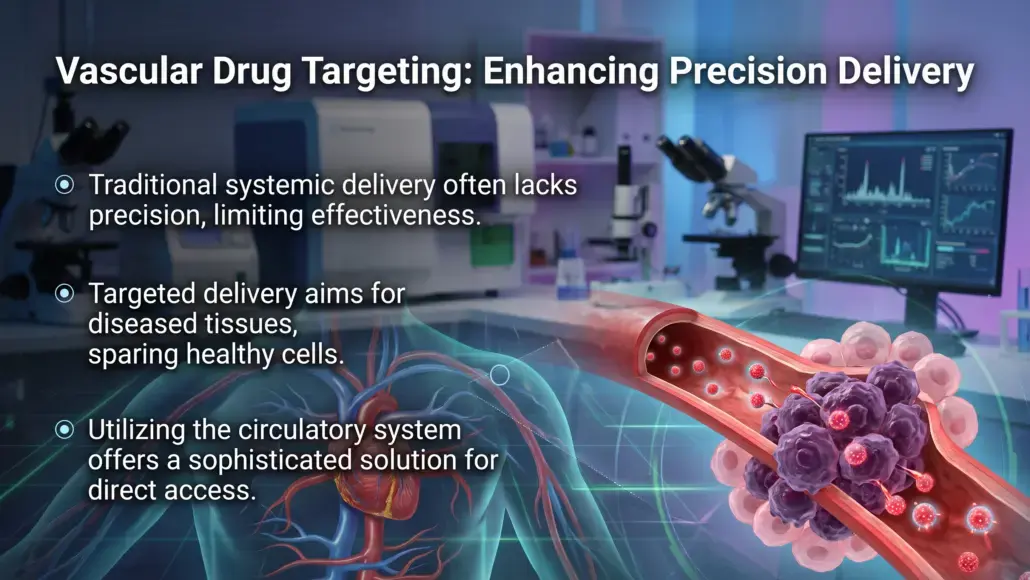
The ability to deliver therapeutic agents specifically to diseased tissues while sparing healthy cells remains a central objective in pharmaceutical research. Traditional systemic drug delivery often results in suboptimal concentrations at the target site and significant off-target toxicity, which can limit the dose and duration of treatment. Vascular drug targeting enhancing precision delivery offers a sophisticated solution to this problem by utilizing the circulatory system as a pathway to reach specific tissues. By engineering drug delivery systems that recognize and bind to unique molecular markers on the vascular endothelium, scientists can achieve localized concentrations of drugs, particularly in the context of oncology, inflammation, and cardiovascular disease. This approach relies on a deep understanding of vascular biology and the development of advanced nanocarriers that can bypass biological barriers.
Molecular Mechanisms of Endothelial Recognition
The vascular endothelium is not a uniform layer of cells but a highly specialized tissue that exhibits significant heterogeneity depending on the organ and the disease state. This heterogeneity provides the basis for vascular drug targeting enhancing precision delivery. In diseased tissues, the endothelium often expresses specific receptors, adhesion molecules, or enzymes that are absent or present at much lower levels in healthy vasculature. For example, tumor-associated blood vessels frequently overexpress vascular endothelial growth factor receptors (VEGFR) or integrins like alphavbeta3. By attaching ligands such as antibodies, peptides, or aptamers to the surface of a drug carrier, researchers can ensure that the carrier binds preferentially to these markers.
Once the drug carrier binds to the endothelial surface, several outcomes are possible depending on the design of the system. In some cases, the drug is released into the local environment, where it can then diffuse into the surrounding tissue. In other instances, the binding event triggers endocytosis, allowing the drug carrier to be internalized by the endothelial cells or transported across the vascular barrier through transcytosis. This is particularly important for delivering drugs to the brain, where the blood-brain barrier (BBB) prevents most molecules from entering the central nervous system. By targeting receptors involved in receptor-mediated transcytosis, such as the transferrin receptor, scientists can facilitate the movement of therapeutic agents into the brain parenchyma, opening new possibilities for treating neurological disorders.
Engineering Nanocarriers for Enhanced Circulation and Binding
The success of vascular drug targeting enhancing precision delivery depends heavily on the physical and chemical properties of the nanocarriers used to transport the drug. These carriers, which can include liposomes, polymeric nanoparticles, or dendrimers, must be designed to remain in circulation long enough to reach their target. The immune system, particularly the mononuclear phagocyte system (MPS), is highly efficient at identifying and removing foreign particles from the blood. To avoid this, nanocarriers are often coated with hydrophilic polymers like polyethylene glycol (PEG), a process known as PEGylation. This creates a hydration shell around the particle, reducing protein adsorption and preventing recognition by macrophages.
In addition to circulation time, the size, shape, and surface charge of the nanocarrier play a vital role in its ability to bind to the vascular target. For instance, non-spherical particles, such as rod-shaped or disk-shaped carriers, often exhibit better margination properties, meaning they are more likely to move toward the vessel walls rather than staying in the center of the bloodstream. This increases the frequency of interactions between the ligands on the particle and the receptors on the endothelium. Furthermore, the density and orientation of the targeting ligands must be optimized to ensure high-affinity binding without causing steric hindrance. The interplay between these physical parameters and the biological environment determines the efficiency of the targeting strategy and the overall therapeutic index of the drug.
Applications in Oncology and Inflammatory Diseases
Oncology remains the most prominent area for the application of vascular drug targeting enhancing precision delivery. Tumors require a constant supply of nutrients and oxygen, which they obtain by stimulating the growth of new blood vessels through angiogenesis. These new vessels are often leaky and poorly organized, a phenomenon known as the enhanced permeability and retention (EPR) effect. While the EPR effect allows for some passive accumulation of nanoparticles in tumors, active targeting of the tumor vasculature provides a more reliable and efficient means of drug delivery. By targeting markers associated with angiogenesis, such as aminopeptidase N or endoglin, researchers can deliver cytotoxic agents directly to the vessels that support tumor growth, effectively starving the tumor or inducing vascular collapse.
Beyond oncology, vascular targeting is showing promise in the treatment of inflammatory diseases like rheumatoid arthritis or atherosclerosis. Inflammation is characterized by the upregulation of adhesion molecules such as E-selectin, ICAM-1, and VCAM-1 on the endothelial surface. These molecules facilitate the recruitment of white blood cells to the site of inflammation. By using these same molecules as targets for drug delivery, it is possible to deliver anti-inflammatory drugs or antioxidants directly to the affected vessels. This localized approach reduces the risk of systemic immunosuppression and enhances the efficacy of the treatment. In the case of atherosclerosis, targeting the inflamed endothelium of the arterial wall can help stabilize plaques and prevent the formation of blood clots, potentially reducing the incidence of heart attacks and strokes.
Overcoming Biological Barriers and Regulatory Hurdles
Despite the significant potential of vascular drug targeting enhancing precision delivery, several challenges remain in translating these technologies from the laboratory to the clinic. One major obstacle is the complexity of the human circulatory system, which can vary significantly between patients. Factors such as blood flow velocity, shear stress, and the presence of competing ligands in the plasma can all affect the efficiency of the targeting process. Additionally, the heterogeneity of marker expression within a single tumor or between different metastatic sites can lead to uneven drug distribution. To address these issues, researchers are developing multi-targeted systems that can recognize several different markers simultaneously, increasing the likelihood of successful binding.
From a regulatory perspective, targeted nanomedicines are considered complex products that require extensive characterization. Manufacturers must demonstrate the consistency of the nanoparticle size, ligand density, and drug loading across different batches. The safety profile of the targeting ligands and the nanocarrier materials must also be thoroughly evaluated. Clinical trials for targeted therapies often require the use of biomarkers or molecular imaging to identify patients who are most likely to benefit from the treatment. This move toward companion diagnostics is a key part of the precision medicine paradigm, ensuring that the right drug is delivered to the right patient at the right time. As our understanding of vascular biology and nanotechnology continues to grow, the integration of these fields will undoubtedly lead to more effective and less toxic therapies for a wide range of debilitating diseases.