









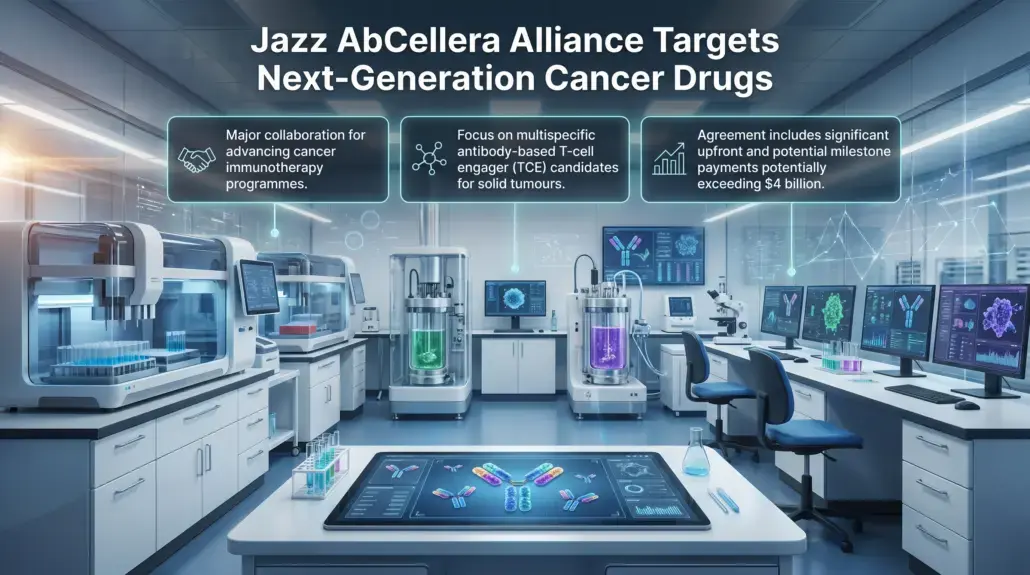

Jazz Pharma has entered into a major collaboration with AbCellera focused on advancing cancer immunotherapy programmes, signing an agreement that could ultimately exceed $4 billion in value. Under the arrangement, the companies will work on up to five multispecific antibody-based T-cell engager (TCE) candidates targeting gastrointestinal cancers and other solid tumours. The deal includes an upfront payment of $56 million, while each programme could generate milestone payments of as much as $792 million if development goals are achieved. The Jazz AbCellera Alliance represents the largest licensing agreement completed by Jazz to date.
According to Jazz chief scientific officer Josh Allen, the partnership will concentrate on the discovery and development of multispecific antibody-based TCEs for gastrointestinal cancers alongside additional solid tumour indications. The agreement comes as Jazz continues to expand its oncology business following the launch of HER2-directed bispecific antibody Ziihera (zanidatamab) for biliary tract cancer (BTC). The company is also awaiting an FDA decision, expected by 25th August, regarding a potential label expansion into gastric and oesophageal adenocarcinoma. Jazz’s oncology portfolio additionally includes Zepzelca (lurbinectedin) for small cell lung cancer (SCLC).
For AbCellera, the transaction adds to a growing list of collaborations with pharmaceutical companies including Eli Lilly, Novartis, AbbVie, and Pfizer. The Vancouver, Canada-based biotechnology company specialises in applying AI to drug discovery, using immune system data to identify multispecific antibodies that can be developed into therapeutic candidates. Among its disclosed partnerships, the Jazz AbCellera Alliance is the largest in terms of announced financial value.
Under the terms of the agreement, AbCellera will conduct discovery and early-stage research activities for two initial programmes, while a third programme is expected to begin within 12 months, triggering an additional $28 million payment. The companies also retain the option to add two further programmes. AbCellera will support candidate preparation for investigational new drug (IND) applications and manufacture clinical supplies for any programmes that advance into clinical testing. T-cell engagers have become a significant area of biopharmaceutical research due to their established role in cancer immunotherapy, helping activate immune responses against tumours, while researchers are also exploring their potential applications in autoimmune diseases.