









The Asia-Pacific (APAC) biopharmaceutical space is being revolutionized by the tremendous progress made in artificial intelligence (AI). The use of AI technologies to drive drug discovery is not just a fad but a paradigm shift transforming the way new therapies are imagined, developed, and commercialized.The robust IT infrastructure in APAC, together with the rapid digitisation of healthcare records, enables large-scale integration of AI technologies. This digital readiness speeds up the deployment of AI-powered drug discovery workflows, successfully bridging the gap between research, development, and regulatory approval.
The APAC Biopharma Landscape: A Growing Global Player
Over the last ten years, the Asia-Pacific biopharmaceutical industry has grown dramatically, establishing itself as a vital place for clinical research, manufacturing, and, increasingly, innovation. According to EvaluatePharma, the APAC area accounted for almost 30% of worldwide pharmaceutical sales in 2023, and this proportion is expected to rise consistently as nations such as China, Japan, South Korea, and India increase their biopharmaceutical investments.
Nonetheless, conventional drug discovery is still time- and resource-intensive, with merely 12% of compounds undergoing clinical trials receiving approval. APAC biopharma companies have been driven to adopt new technologies that can quicken the drug discovery pipeline due to this inefficiency. AI drug discovery has become a prime facilitator, using computational power, machine learning algorithms, and big data analytics to transform each step of the process.
How AI-Driven Drug Discovery Works
In essence, AI drug discovery brings together massive datasets—ranging from genomic sequences and chemical libraries to clinical trial outcomes—and runs them through highly complex machine learning algorithms. These can pick out prospective drug candidates, forecast molecular behavior, and refine compound design much more quickly than can human-based methods.
For example, deep learning algorithms inspect protein structures and make predictions on how small molecules will bind, which can help design more efficient and selective drugs. In the same way, AI systems can model ADMET properties, substantially decreasing the use of expensive and time-consuming laboratory experiments.By reducing attrition rates downstream and speeding up the AI drug discovery process, this computational paradigm enables breakthrough treatments to reach patients sooner.
APAC’s Advantages in AI-Driven Drug Discovery
The APAC region is best positioned to leverage AI-based drug discovery for a variety of reasons. To start with, the presence of immense and diverse biological datasets in huge populations offers a fertile ground for training AI models. China and Japan have heavily invested in national genomic databases, and this offers unprecedented access to genetic information that is crucial for precision medicine.
Second, APAC governments are aware of the strategic value of AI to healthcare innovation. China, for instance, has established AI as a pillar of its 14th Five-Year Plan, with direct investments backing AI-biopharma projects. Singapore and South Korea have also established innovation centers to encourage the convergence between AI startups, research institutions, and pharmaceutical firms.
Furthermore, the strong IT infrastructure in the APAC region, along with the increasing digitization of healthcare records, facilitates the widespread adoption of AI solutions. This digital readiness speeds up the integration of AI drug discovery processes, helping to connect research, development, and regulatory approval more effectively.
Industry Case Studies: Leading the AI Revolution
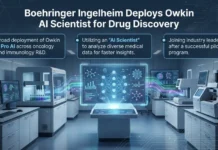
A number of APAC biopharma startups and firms illustrate how AI drug discovery is being revolutionized. Insilico Medicine in China has gained prominence by employing AI to discover novel kinase inhibitors for cancer therapies, progressing from virtual screening to clinical candidate nomination in months—a feat that usually takes years.
Likewise, Japan’s Astellas Pharma has incorporated AI platforms into its drug discovery pipeline, specifically in immuno-oncology. Its partnership with AI companies has returned encouraging leads and improved target validation, highlighting how AI augments human capabilities.
Indian startups such as Biocon and Strand Life Sciences use AI for drug repositioning and biomarker discovery and utilize regional disease trends and population genetics to customize treatments to local requirements.
Challenges and the Path Forward
While its potential is immense, AI-based drug discovery in APAC is beset by challenges. Regulatory compliance and data privacy are major issues since AI is based on lots of sensitive patient information. Ensuring uniform data standards across countries and having strong cybersecurity practices in place are essential for long-term growth.
In addition, there is a recurring demand for professional talent that can bridge AI technology and pharmaceutical sciences. Education and training investments and intersectoral collaboration will be needed to create this interdisciplinary workforce.
Finally, incorporation of AI outputs into regulatory submissions must have clear validation frameworks. APAC regulatory authorities are adopting new policies to correspond with AI advancements, but international harmonisation and clarity will increase developer trust.
The Transformative Impact on Patient Outcomes
Finally, the potential of AI-assisted drug development is in the ability to enhance patient outcomes. Through more precise therapies, accelerated development timelines, and lower costs, AI can make more advanced treatments for diseases prevalent in the APAC region, like infectious disease, cancer subtypes, and metabolic disorders, more accessible.
In addition, the flexibility of AI models enables ongoing learning from real-world data, facilitating iterative refinement of drug design and treatment strategies. This closed-loop process promotes individualized medicine strategies adapted to varying genetic and environmental environments that are common in APAC.
Conclusion
AI-led drug discovery: revolutionizing APAC’s biopharma industry represents the healthcare innovation’s future directions. With the integration of sophisticated computational methods and extensive biological information, APAC is not just speeding up the rate of pharmaceutical research and development, but also improving its quality and patient relevance.
As governments, business, and academia move further into collaborations and investments in AI, the region is set to emerge as a world leader in biopharma innovation. Overcoming issues concerning data governance, talent, and regulation will be key, but the path is set: AI-enabled drug discovery will transform how new medicine is found and delivered across the Asia-Pacific and ultimately lead to better global health outcomes.