









The pharmaceutical industry sits atop one of the world’s most valuable and sensitive treasure troves of information. From proprietary molecular structures and multi-billion dollar drug formulations to the deeply personal genomic profiles of clinical trial participants, the data managed by pharma companies is a prime target for state-sponsored espionage, ransomware attacks, and industrial theft. As the industry moves toward more collaborative and data-intensive research models, the vulnerabilities of traditional digital infrastructure have become glaringly apparent. In this high-stakes environment, quantum security pharma strategies are emerging as the ultimate defense, providing a cryptographic shield that is not just faster than current systems, but fundamentally different in its approach to protection.
The looming threat of the “Harvest Now, Decrypt Later” strategy
To understand the urgency behind quantum encryption pharma, one must acknowledge a disturbing trend in global cyber warfare: the “harvest now, decrypt later” strategy. Hostile actors are currently stealing vast amounts of encrypted pharmaceutical data, knowing they cannot break it with today’s classical computers. However, they are banking on the fact that within the next decade, fault-tolerant quantum computers will be capable of breaking the RSA and ECC encryption standards that currently protect 99% of the world’s digital traffic. For a drug company with patents that last twenty years or clinical data that must remain private for a lifetime, the prospect of this data becoming readable in ten years is an existential threat.
Quantum security pharma addresses this by introducing Post-Quantum Cryptography (PQC) mathematical algorithms that are resistant to the processing power of both classical and quantum systems. By transitioning to these new standards today, companies can ensure that their data remains secure even when the “quantum apocalypse” for traditional encryption arrives. This proactive approach to digital health security is no longer optional; it is a foundational requirement for any organization involved in long-term medical research and development.
Quantum Key Distribution and the laws of physics
While PQC focuses on mathematics, another pillar of quantum security pharma relies on the laws of physics itself: Quantum Key Distribution (QKD). In a traditional secure data system, the “key” used to encrypt and decrypt information is sent as a series of bits that can be intercepted and copied without the sender or receiver knowing. QKD changes this by sending the key via individual photons. According to the principles of quantum mechanics, the act of observing a quantum state changes that state. Therefore, if an eavesdropper attempts to intercept a quantum key, the interference will be immediately detectable, and the key will be rendered useless.
This creates a level of pharma data protection that is “provably secure.” For the first time, researchers can share highly sensitive information such as preliminary clinical trial results or secret chemical formulas across global networks with absolute certainty that the communication channel has not been compromised. This capability is particularly vital for secure data sharing between pharmaceutical giants and their academic partners, where trust and transparency are the bedrock of innovation. By utilizing QKD, the industry can foster a more open and collaborative research environment without fear of intellectual property theft.
Fortifying the clinical trial ecosystem and patient privacy
Clinical trials are the lifeblood of the pharmaceutical industry, but they are also a significant source of cybersecurity risk. Trials involve a complex web of stakeholders, including hospitals, contract research organizations (CROs), and thousands of individual patients. Each point of data entry and transfer is a potential vulnerability. If patient data is leaked, it not only violates privacy laws like GDPR and HIPAA but also risks the integrity of the trial itself.
Integrating quantum security pharma into the trial ecosystem ensures that patient identities remain anonymous and their medical records remain immutable. Advanced encryption can be used to create “zero-knowledge proofs,” where a researcher can verify that a patient meets the criteria for a trial without actually seeing the patient’s raw genetic data. This level of cybersecurity healthcare is essential for recruiting participants for trials involving sensitive conditions or rare diseases, where privacy concerns are often a barrier to enrollment. When patients know their data is protected by the most advanced technology available, they are more likely to participate in the research that leads to future cures.
Protecting the automated manufacturing and supply chain
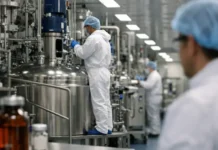
As pharmaceutical manufacturing becomes increasingly automated through the “Industry 4.0” revolution, the risk of cyberattacks moves from the server room to the factory floor. Modern manufacturing plants rely on interconnected sensors and controllers that manage everything from temperature and pressure to the precise mixing of chemical ingredients. A cyberattack on these systems could not only stop production but could also subtly alter the formulation of a drug, leading to dangerous consequences for patients.
Quantum security pharma extends its protection to these operational technologies. By securing the communication between IoT devices and centralized control systems with quantum-resistant protocols, companies can prevent “man-in-the-middle” attacks that seek to sabotage production lines. This is a critical component of digital health security, as the safety and efficacy of the final product are directly tied to the integrity of the manufacturing process. A secure data system is, therefore, not just a matter of information technology, but a matter of public safety.
Strategic implementation and the global regulatory landscape
The transition to a quantum-secured infrastructure is a massive undertaking that requires strategic planning and significant investment. It involves auditing existing systems, identifying the most vulnerable data points, and gradually phasing in new encryption standards. Leading pharmaceutical companies are already appointing “Chief Quantum Officers” and forming dedicated cybersecurity teams to manage this migration. This is part of a broader trend where cybersecurity healthcare is being elevated from a back-office function to a core strategic priority.
Furthermore, the global regulatory landscape is evolving to keep pace with these technological shifts. Organizations like the National Institute of Standards and Technology (NIST) are in the final stages of standardizing post-quantum algorithms, and regulatory bodies are beginning to issue guidelines on the use of quantum-safe technology in clinical submissions. For pharma companies, staying ahead of these regulations is essential for maintaining market access and avoiding the massive fines associated with data breaches. By being early adopters of quantum security pharma, these organizations can set the standard for the entire industry.
The human element: Building a culture of security
No matter how advanced the encryption, the human element remains the most common point of failure in any security system. Phishing attacks and social engineering continue to bypass even the most sophisticated firewalls. Therefore, the implementation of quantum security pharma must be accompanied by a cultural shift within the organization. Employees at all levels—from bench scientists to C-suite executives—must be trained to recognize the threats of the quantum age.
This involves fostering a “security-first” mindset where data protection is integrated into every workflow. It means moving away from the idea that security is a “barrier” to research and instead viewing it as an “enabler” of innovation. When researchers can share data freely and securely, they can collaborate more effectively, leading to faster discoveries. In this sense, digital health security is a catalyst for scientific progress, providing the safe environment needed for the world’s brightest minds to tackle our most difficult medical challenges.
Conclusion: A resilient future for pharmaceutical research
We are entering an era where the digital and biological worlds are inextricably linked. The medicines of the future will be discovered in data-driven labs and manufactured in automated factories, making them more vulnerable to cyber threats than ever before. To protect the integrity of our healthcare system, we must match the sophistication of our enemies with the power of our technology.
Quantum security pharma represents the new frontier of data protection. By leveraging the principles of quantum mechanics, we can build a digital infrastructure that is resilient, transparent, and fundamentally secure. This investment in cybersecurity is an investment in the future of medicine itself, ensuring that the life-saving breakthroughs of tomorrow are protected from the threats of today. As we continue to push the boundaries of what is possible in drug discovery, the peace of mind provided by quantum-level security will be the foundation upon which the next century of medical progress is built.