








The pharmaceutical industry is currently at the leading edge of a profound technological revolution, where artificial intelligence (AI) is being deployed at scale to solve some of the most persistent and high-stakes challenges in global logistics. One of the most impactful and rapidly evolving applications of this technology is found in AI-driven cold chains, which are fundamentally transforming how temperature-sensitive pharmaceutical products are managed, monitored, and transported. As the global portfolio of drugs requiring precise thermal oversight continues to expand driven by the rise of complex biologics, mRNA vaccines, and advanced cell and gene therapies the need for a smarter, more adaptive, and more resilient supply system has become paramount. AI provides the essential cognitive layer necessary to turn vast amounts of disparate logistics data into precise, proactive, and often autonomous actions that safeguard product integrity and optimize operational efficiency on a global scale.
The transition to AI-driven cold chains represents a seismic shift from human-monitored, reactive systems to intelligent, self-correcting networks. Traditional cold chain management has historically relied on manual intervention, retrospective data analysis, and experience-based problem-solving, all of which are increasingly prone to error and delays in a complex global market. AI, by contrast, can ingest and analyze thousands of variables in real-time—including hyper-local weather patterns, real-time traffic conditions, flight delays, and multi-modal sensor data to make high-stakes decisions that are far beyond the capacity of human operators. This shift is not just about basic automation; it is about creating a level of systemic intelligence that can anticipate the inherent complexities of a global supply chain and respond with a degree of precision and speed that was previously unimaginable.
Predictive Visibility as a Fundamental Strategic Advantage in Pharma Supply
Predictive visibility is arguably the most significant and transformative benefit of integrating AI into the pharmaceutical supply chain. While standard tracking and tracing systems can tell you where a shipment is at any given moment, AI-driven systems can tell you where it will be and, more importantly, what its thermal and physical condition will be when it arrives at its destination. By using advanced machine learning algorithms to analyze massive sets of historical transit data alongside real-time inputs, AI can identify potential risks and anomalies long before they manifest as actual problems. For example, an AI model can predict that a specific flight path is likely to experience an unusual delay due to a developing weather front, prompting the system to automatically reroute the shipment or suggest a more robust thermal packaging solution before the product ever leaves the facility.
This predictive capability is absolutely essential for managing the high-value, high-risk nature of modern pharma supply. When a single shipment can represent millions of dollars in research and manufacturing investment and, more crucially, the only hope for thousands of patients, there is no acceptable margin for uncertainty. AI-driven cold chains provide a layer of data-driven assurance that allows logistics managers to move from constant crisis management to strategic, forward-looking oversight. The deep insights generated through these predictive models also help in refining the overall long-term strategy for pharma logistics, allowing companies to design and build supply chains that are inherently more resilient to the fluctuations and disruptions of the global market.
Furthermore, predictive visibility enables a more efficient and effective response to the unavoidable disruptions that do occur. In the event of a major airport closure or a sudden cold storage failure, an AI-driven system can instantly model all available alternatives and present the logistics team with the best possible course of action based on thermal stability, cost, and delivery time. This level of rapid-response decision-making minimizes the impact of disruptions and ensures that the flow of essential medicines remains as steady and reliable as possible. In an AI-driven cold chain, visibility is not just a passive view of the status quo; it is an active tool for shaping the future of the shipment.
Intelligent Thermal Control and the Rise of Autonomous Logistics Assets
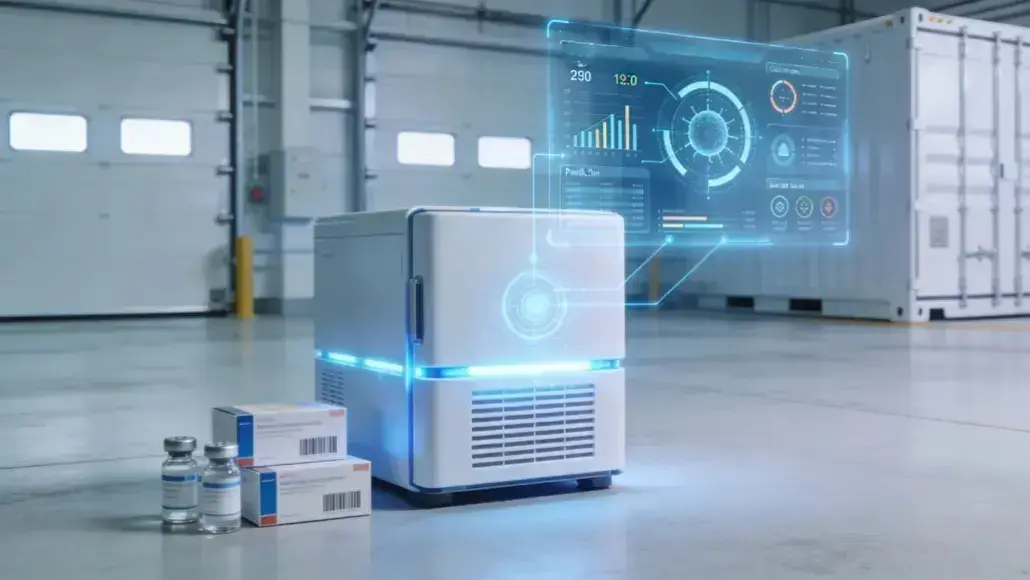
Beyond visibility and prediction, AI is playing a central and growing role in the development of more sophisticated and intelligent thermal control systems. Modern “smart” containers and transport units are increasingly being equipped with edge-computing AI algorithms that manage their internal environments autonomously. These systems can dynamically adjust cooling outputs or heating elements based on real-time external ambient temperatures, the remaining battery life, and the projected transit time. This level of intelligent thermal control is vital for long-haul international shipments where external conditions can vary wildly and unpredictably, from the extreme heat of a desert tarmac to the sub-zero temperatures and low pressure of an aircraft’s cargo hold.
The shift toward automation and autonomy is the logical and necessary extension of this embedded intelligence. In a fully realized AI-driven cold chain, many of the routine and complex decisions involved in pharma supply are handled by automated systems with minimal human intervention. This includes the automated scheduling of maintenance for refrigeration units based on actual wear and tear data, the optimization of warehouse storage locations based on the specific stability profile of each product, and the instantaneous generation of regulatory compliance documentation. By reducing the heavy reliance on manual processes and human decision-making, AI-driven cold chains significantly minimize the risk of human error, which remains one of the primary causes of temperature excursions and product loss in the pharmaceutical industry.
This automation also has profound implications for the human workforce within the logistics sector. Rather than spending their time on repetitive data entry and manual monitoring tasks, skilled logistics professionals can focus on more strategic and high-value activities. This includes managing complex supplier relationships, driving innovation in packaging and transport technology, and overseeing the ethical and regulatory aspects of global pharmaceutical distribution. In this sense, AI does not replace humans; it augments their capabilities, allowing them to manage a much more complex and sensitive supply chain with greater effectiveness and less stress.
Optimizing Global Pharma Logistics Operations Through Collective Intelligence
The global and interconnected nature of the modern pharmaceutical industry means that supply systems must be able to operate seamlessly across incredibly diverse geographies, infrastructures, and regulatory environments. AI-driven cold chains are uniquely and powerfully suited to this challenge, as they can ingest, normalize, and synthesize data from a vast and variety of sources to provide a unified, global view of the entire operation. This connectivity allows for the optimization of logistics on a scale and at a depth that was previously impossible. For instance, AI can analyze the performance of a global network to identify the most efficient and reliable routes and carriers for specific types of products, taking into account not just financial cost, but also thermal stability, security, and historical delivery performance.
Furthermore, AI-driven cold chains enable a significantly more dynamic and responsive approach to inventory management and demand planning. By predicting when and where specific products will be needed based on factors such as disease outbreaks, seasonal trends, and clinical trial progress AI can help pharma companies to position their stock more effectively and closer to the point of care. This reduces the need for expensive and risky emergency shipments and minimizes the risk of stockouts, which can have devastating consequences for patients. A smarter, more responsive logistics operation ensures that the pharma supply system can fulfill its primary and most important mission: getting the right medicine to the right patient at the right time, regardless of the logistical challenges involved.
The optimization provided by AI also extends to the environmental impact of pharma logistics. By identifying the most efficient routes and transport modes, and by reducing the amount of waste due to product excursions, AI-driven cold chains help to lower the carbon footprint of the entire industry. This is becoming an increasingly important consideration for pharmaceutical companies as they strive to meet their sustainability goals and respond to the growing demand for green healthcare solutions. In an AI-driven world, operational efficiency and environmental responsibility are two sides of the same coin, both driven by the power of data and intelligence.
Enhancing Compliance, Transparency and Trust in the Cold Chain
Regulatory compliance is a non-negotiable and highly scrutinized aspect of pharmaceutical logistics, and AI is proving to be an exceptionally powerful tool for maintaining and exceeding the high standards required by global health authorities. AI-driven cold chains provide a comprehensive, detailed, and immutable digital record of every single shipment’s journey, from the moment it is packaged to the moment it is delivered. This makes the complex process of auditing and verification much more straightforward, accurate, and transparent. Intelligent systems can automatically flag any deviations from the prescribed thermal or handling protocols, allowing for immediate investigation, root-cause analysis, and corrective action.
This level of transparency not only satisfies the rigorous demands of regulators but also builds and maintains trust with patients, healthcare providers, and the public. In an age where the integrity and authenticity of medications are of paramount concern, the ability to provide a verifiable and data-backed history of a product’s journey is a significant clinical and strategic asset. It ensures that everyone involved in the care of a patient from the manufacturer to the pharmacist to the physician can be certain that the medication being administered has been handled with the highest level of care and has retained its full therapeutic efficacy.
The data-rich and transparent environment of an AI-driven cold chain also facilitates more effective and collaborative partnerships between pharmaceutical companies and their third-party logistics (3PL) providers. By sharing AI-generated insights and performance data, all parties can work together toward the common goal of improving the overall safety and performance of the supply chain. This collaborative approach leads to a more integrated, transparent, and high-performing ecosystem where the focus is firmly on the collective objective of delivering high-quality healthcare products. As the industry continues to move toward more patient-centric and personalized models of care, this level of transparency and trust will be a critical factor in the success and reputation of any pharmaceutical organization.
The Road Ahead: The Future of AI in Pharmaceutical Logistics and Global Health
As we look toward the future, the role and impact of AI in the pharmaceutical cold chain will only continue to grow in scope and importance. We can expect to see even more advanced and innovative applications, such as the use of AI for real-time risk assessment and management in decentralized clinical trials, where medications must be delivered directly to patients’ homes. We will also see the deeper integration of AI with other emerging technologies like autonomous drones for “last mile” delivery in hard-to-reach areas and the use of blockchain for secure and tamper-proof data sharing across the entire global network.
The continued advancement and refinement of these technologies will drive further significant improvements in the safety, efficiency, and resilience of the pharma supply system. While the challenges of global logistics are significant and ever-changing, the intelligence, foresight, and adaptability provided by AI-driven cold chains offer a powerful and necessary way to navigate the complexities of modern healthcare. These systems are not just a technological upgrade; they are a fundamental part of the global effort to ensure that the promise of modern medicine to heal, to protect, and to save lives is fulfilled for every patient, everywhere in the world, with absolute certainty and care.
In conclusion, AI-driven cold chains are much more than a technological trend; they are a fundamental and necessary evolution in how we protect and manage the pharmaceutical supply chain. By providing predictive visibility, intelligent thermal control, and optimized global operations, these systems are setting a new and much higher standard for the safe and efficient delivery of life-saving medications. As the pharmaceutical industry continues to embrace and integrate the power of AI, the ability to protect the molecular integrity of every product, every step of the way, will become the cornerstone of a truly modern, responsive, and patient-centered global healthcare system.