











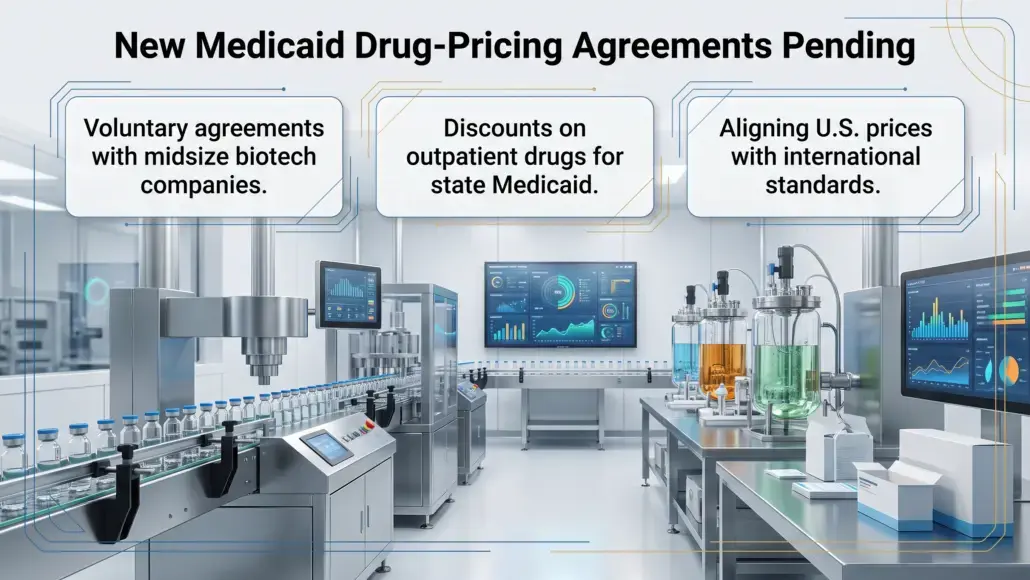
The Trump administration is preparing to announce a new round of voluntary drug-pricing agreements with midsize biotech companies as early as August 31, 2026, according to sources familiar with the matter.
The companies involved are expected to offer discounts on outpatient drugs to state Medicaid programs, with the goal of aligning what states pay with the prices those same manufacturers charge in foreign countries. The specific drugmakers set to participate have not yet been publicly named, and the plan had not been independently verified at the time of reporting.
Extending the MFN Pricing Framework
The expected announcement would build on a broader pricing framework the White House has been developing for several months — the voluntary “Most Favored Nation” (MFN) pricing model. Under this framework, manufacturers are expected to offer all new drugs launched in the United States at prices comparable to those charged in other high-income countries.
To date, the administration has secured voluntary MFN pricing agreements with 17 pharmaceutical companies, including Pfizer, Eli Lilly, and Johnson & Johnson. These agreements are designed to reduce the cost of medicines for both the federal Medicaid program and cash-paying patients. The administration has stated it expects to eventually reach similar agreements with most manufacturers of sole-source brand name drugs and biologics across the country.
How the MFN Price Works in Practice
Lindsay Bealor Greenleaf, Head of Market Access Policy Strategy at ADVI, explained to Pharmaceutical Executive how the MFN price is operationally achieved within the Medicaid context:
“With regard to Medicaid, the way that that MFN price would be achieved would be through a rebate construct. The Medicaid program would receive an MFN price on net, with the manufacturer basically cutting a check for the government. Patient out of pocket costs in Medicaid are not much of an issue. There’s not an impact on patient out-of-pocket costs or patient access, necessarily. In the Medicaid program with these voluntary deals, the impact is felt squarely on the manufacturers specifically.”
Projected Savings Under the Framework
In May 2026, the White House announced that the MFN framework was projected to generate $64.3 billion in combined federal and state savings over the next decade. That figure specifically covers the Medicaid and cash-payer channels targeted by the voluntary Medicaid drug-pricing deals.
However, when applied across all U.S. markets — including the private insurance market — the framework is projected to generate $529 billion in domestic savings over the same ten-year period, according to the White House.
The administration has framed this initiative as a direct response to the persistent disparity between what American patients pay for prescription drugs compared to patients in other developed nations. As cited in the reporting, U.S. patients currently pay far more for prescription medicines — often nearly three times what patients in other high-income countries pay.
What Remains Unclear
Several key details surrounding the anticipated August 31 announcement remain unresolved. It is not yet known whether the announcement will name specific companies, or how closely the terms of the new agreements will align with the MFN framework laid out in May. The original report did not identify which drugmakers were expected to participate in this next round.
With 17 companies already operating under voluntary agreements, the administration appears to be working toward broader participation, particularly among manufacturers of sole-source brand name drugs and biologics.