












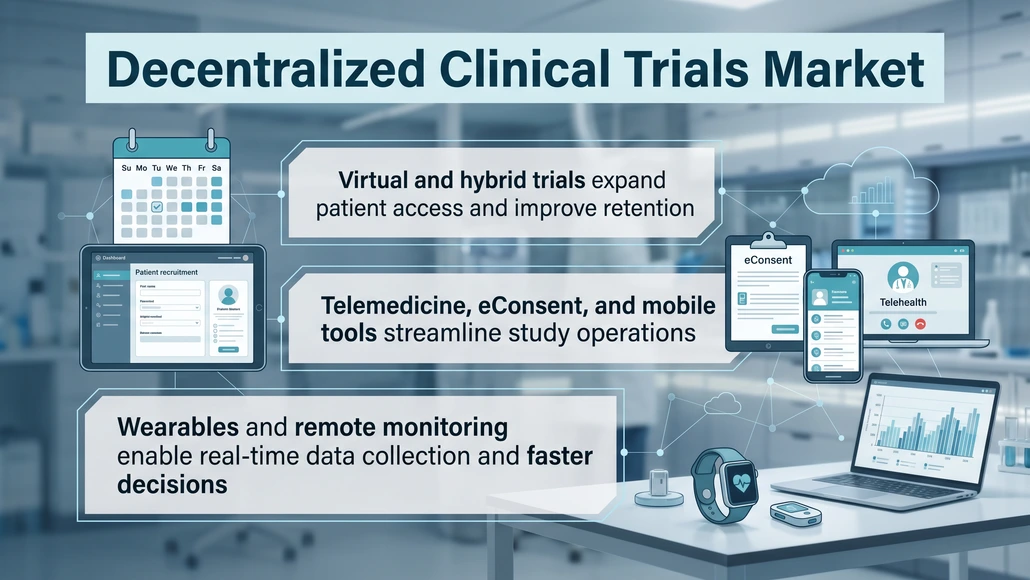
The global Decentralized Clinical Trials Market is expected to grow from USD 9.74 billion in 2025 to USD 34.13 billion by 2035, registering a compound annual growth rate (CAGR) of 13.36% during the forecast period from 2026 to 2035. The market is expanding as pharmaceutical companies, biotechnology firms, contract research organizations, and healthcare technology providers accelerate adoption of virtual and hybrid clinical trial models to improve patient participation, streamline study operations, and support faster drug development.
The increasing integration of digital health technologies, remote patient monitoring systems, wearable devices, telemedicine platforms, and cloud-based clinical data infrastructure is reshaping global clinical research operations. Pharmaceutical companies are gradually transitioning from traditional site-centric trial structures toward more patient-focused decentralized approaches capable of improving accessibility, retention, and operational flexibility.
Decentralized clinical trials are emerging as a strategic solution to address long-standing challenges associated with conventional clinical research, including patient recruitment difficulties, geographic limitations, high operational costs, and extended study timelines. The broader digital transformation taking place across healthcare and life sciences is expected to continue driving investment across decentralized clinical trial infrastructure over the coming decade.
Digital Technologies Reshaping Clinical Research
Clinical research organizations and trial sponsors are increasingly adopting digital tools to improve trial management and patient engagement. Traditional studies often require participants to travel frequently to centralized research facilities, creating logistical barriers that can limit enrollment and reduce retention rates.
Decentralized clinical trials help address these limitations by enabling remote participation through telemedicine consultations, home healthcare services, electronic consent systems, mobile applications, and wearable monitoring technologies. These capabilities improve convenience for patients while expanding access to clinical studies across broader geographic regions.
The growing use of artificial intelligence, connected devices, cloud computing, and advanced analytics platforms is also improving the scalability and efficiency of decentralized trial models. Real-time monitoring systems and continuous data collection technologies are helping researchers strengthen protocol adherence and improve clinical decision-making processes.
Patient-Centric Research Models Driving Adoption
The increasing focus on patient-centric healthcare is becoming one of the primary drivers supporting decentralized clinical trial adoption. Recruitment and retention challenges remain among the most significant issues affecting traditional clinical research programs, often contributing to study delays and rising operational costs.
Remote participation models allow patients to engage in clinical studies from home or through nearby healthcare facilities, helping improve accessibility for elderly populations, individuals with mobility limitations, patients in rural areas, and those managing chronic conditions.
Flexible decentralized models are also helping improve patient engagement and study participation throughout the trial lifecycle. Healthcare organizations are increasingly prioritizing convenience, accessibility, and inclusivity in research strategies, further accelerating adoption across pharmaceutical and biotechnology industries.
Wearables and Remote Monitoring Supporting Market Expansion
Wearable devices and remote patient monitoring technologies are playing an increasingly important role in decentralized clinical research. Smartwatches, biosensors, digital biomarkers, and connected medical devices are enabling continuous collection of real-world patient data outside conventional clinical environments.
These technologies support monitoring of vital signs, medication adherence, physical activity, cardiovascular performance, sleep patterns, and other health indicators in real time. Continuous data collection capabilities are helping improve trial accuracy while reducing dependency on frequent in-person visits.
Artificial intelligence and machine learning technologies are also being integrated into decentralized trial systems to support data analysis, patient matching, adverse event detection, and study optimization.
Pharmaceutical Industry Accelerating DCT Adoption
Pharmaceutical and biotechnology companies are increasing investments in decentralized trial infrastructure to improve operational efficiency and support more flexible clinical development programs. Adoption of virtual trial capabilities accelerated significantly during the COVID-19 pandemic, when organizations implemented remote study models to maintain research continuity amid travel restrictions and site access limitations.
Many companies are now expanding hybrid trial models that combine traditional site-based activities with decentralized digital technologies. Strategic collaborations involving pharmaceutical companies, telehealth providers, technology companies, and contract research organizations are also becoming more common as organizations seek to strengthen decentralized research capabilities.
Regional Outlook
North America currently leads the decentralized clinical trials market, supported by advanced digital healthcare infrastructure, high telemedicine adoption, significant pharmaceutical research activity, and favorable regulatory developments. The United States remains a major contributor due to continued investment in healthcare technology and digital clinical research capabilities.
Europe is also experiencing increasing adoption of decentralized trial technologies, supported by healthcare digitization initiatives and regulatory modernization efforts across countries including Germany, the United Kingdom, and France.
Asia-Pacific is expected to witness substantial growth over the forecast period due to expanding pharmaceutical manufacturing activity, increasing clinical research investments, rising internet penetration, and broader healthcare digitization efforts across countries such as China, India, Japan, and South Korea.
Competitive Landscape
The decentralized clinical trials market remains highly competitive, with healthcare technology providers, pharmaceutical companies, contract research organizations, and digital platform developers investing in artificial intelligence, cloud infrastructure, cybersecurity, wearable integration, and advanced analytics capabilities.
Industry participants are focusing on improving platform scalability, strengthening patient engagement tools, enhancing data security frameworks, and expanding global decentralized trial operations. Strategic partnerships, acquisitions, and technology collaborations are expected to continue shaping the competitive environment as organizations seek to strengthen technological capabilities and geographic reach.
Future Outlook
The decentralized clinical trials market is expected to continue expanding as pharmaceutical companies increasingly prioritize operational efficiency, accessibility, and patient-centric innovation in clinical development programs. Advancements in telemedicine, artificial intelligence, remote monitoring, wearable technologies, and digital health infrastructure are expected to support long-term market growth.
As healthcare systems continue modernizing and regulatory frameworks evolve to support virtual clinical research models, decentralized clinical trials are expected to become an increasingly important component of future clinical research strategies.