










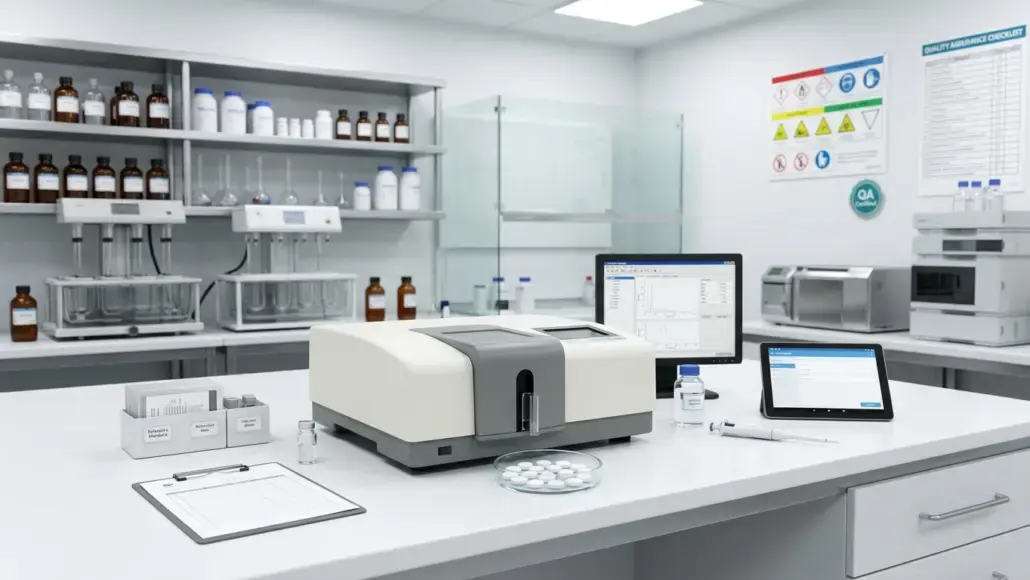
Color consistency is critical in pharmaceutical quality control (QC). Variations in tablet coatings, powders, liquids and packaging materials can indicate formulation inconsistencies, contamination risks or manufacturing deviations. To improve accuracy and reduce subjective visual inspection, pharmaceutical manufacturers increasingly rely on colorimeters and color spectrophotometers for standardized color analysis.
For organizations searching for top-rated color spectrophotometers or colorimeters for sale near them, here’s how to select the right instrument, balancing conformance, precision, usability and long-term reliability.
Know the Difference Between Colorimeters and Spectrophotometers
Colorimeters are designed for simpler color measurement tasks. They typically provide fast pass/fail evaluations and are useful for routine production checks, packaging verification and basic QC applications.
Color spectrophotometers provide more advanced analysis by measuring light across multiple wavelengths. These systems generate detailed spectral data and are widely used in pharmaceutical R&D, formulation development, stability studies and regulated manufacturing environments where higher precision is required.
For most pharmaceutical QC laboratories, spectrophotometers offer stronger long-term value because they support tighter tolerances, improved repeatability and better cross-site standardization.
Prioritize Conformance and Data Integrity
Pharmaceutical manufacturers must evaluate more than just technical specifications. Instruments should support regulatory expectations for documentation, traceability and validation. Key capabilities include:
- Audit trails
- Secure electronic records
- User access controls
- Standardization traceability
- IQ/OQ/PQ validation support
- 21 CFR Part 11 readiness
Many organizations also assess how vendors address data governance and how to ensure data integrity for ALCOA+ compliance. Reliable reporting and secure data storage are increasingly important for multinational pharmaceutical operations.
Evaluate Accuracy and Operational Fit
The best color measurement systems combine precision with practical usability. Pharmaceutical buyers should consider:
- Measurement repeatability
- Ease of standardization
- Software integration
- Multi-operator consistency
- Sample compatibility
- Global technical support
- Conformance and validation support
Facilities handling coated tablets, capsules, powders or liquid formulations may require different instrument geometries or illumination options. Portable systems may also benefit production-floor inspections, while benchtop models are often preferred for laboratory environments.
Leading Companies Offering Colorimeters and Color Spectrophotometers
Several established manufacturers provide color measurement solutions for pharmaceutical QC.
1. HunterLab
Founded in 1952, HunterLab develops advanced color spectrophotometers and colorimeter solutions for industries where precise color control directly affects quality, consistency and regulatory alignment. Its systems support pharmaceutical, food, beverage, chemical, plastics and healthcare applications, helping manufacturers replace subjective visual evaluations with repeatable, data-driven color measurement results.
Its ColorFlex L2 color spectrophotometer/colorimeter combines a 45°a:0° annular-illuminated optical geometry with an intuitive touch-screen interface and independent color workstation functionality, requiring no additional PC for operation. HunterLab also supports pharmaceutical quality workflows with solutions for validated color analysis, efficient QC processes, and compliance with FDA color standards, ASTM methods and global industry requirements.
2. Lovibond
Lovibond is a globally recognized manufacturer of color measurement and water analysis solutions used across laboratories, industrial facilities and QC environments. Operating under the Tintometer Group, the company develops visual and automated color measurement instruments, reagents, standards and accessories for applications in water quality, petroleum products, beverages, chemicals and other industrial materials.
Lovibond offers a broad portfolio of colorimeters, reflectance and transmission measurement systems, comparator instruments, and standardization solutions that support accurate and repeatable color evaluation. With research, manufacturing and distribution operations across Europe, North America and Asia, it continues to provide reliable color analysis technologies trusted by industries that require precise quality and conformance.
3. TECHKON
TECHKON produces advanced color measurement instruments and QC software primarily for the printing and packaging industries. As part of the Datacolor family, it provides spectro-densitometers, scanning devices and color management platforms designed to improve print accuracy, process consistency and production efficiency across pressrooms and packaging operations.
Focused on measurement precision and workflow optimization, the brand combines high-resolution color analysis with user-friendly software and mobile color capture technologies such as ColorCatcher. Its solutions support color communication, print verification and quality assurance from prepress to final production, making it a trusted provider of color measurement technologies for modern printing environments.
Comparison of Leading Color Spectrophotometer and Colorimeter Providers
The comparison below summarizes key capabilities across three established companies used in regulated manufacturing environments.
| Company | Primary Focus | Key Products | Common Applications | Industry Strengths |
| HunterLab | Color and appearance analysis | Spectrophotometers, colorimeters and haze meters | Pharmaceutical powders, liquids, tablets, food and plastics | High-precision color analysis and compliance-focused testing |
| Lovibond | Water analysis and visual color measurement | Colorimeters, comparators, and transmission and reflectance systems | Water testing, chemicals, oils, beverages and pharmaceuticals | Trusted visual grading systems and laboratory testing solutions |
| TECHKON | Print and packaging color control | Spectro-densitometers, scanning devices and QA software | Pharmaceutical packaging, labels and print verification | Advanced print quality management and color workflow automation |
Choosing the Right Color Spectrophotometer or Colorimeter
Here are key factors to consider when selecting a color spectrophotometer or colorimeter for pharmaceutical QC. These factors were also used to select the top color spectrophotometer and colorimeter providers.
- Matching to sample type: Select a system based on material form. Powders, tablets, capsules, liquids or translucent products may require specific reflectance or transmittance capabilities, aperture sizes and optical setups for accurate measurement.
- Regulatory and data integrity needs: Prioritize instruments that support audit trails, secure electronic records, validation documentation and LIMS integration to strengthen data integrity and ensure ALCOA+ compliance in regulated pharmaceutical environments.
- Ease of use and training efficiency: Look for intuitive interfaces, guided workflows, and streamlined standardization processes to reduce operator training time and maintain consistency across QC teams.
- Scalability across sites: Choose systems with strong inter-instrument agreement and centralized data handling to ensure consistent color measurement results across multiple manufacturing facilities globally.
- Vendor support and life cycle service: Evaluate the availability of technical support, standardization services, software updates and application assistance to ensure long-term operational stability and reduced downtime.
Strengthening Pharmaceutical QC With Reliable Color Measurement Systems
Selecting the right colorimeters or color spectrophotometers for pharmaceutical QC requires careful evaluation of accuracy, conformance support, validation capabilities and long-term operational performance.
As pharmaceutical manufacturers continue to strengthen global quality standards, advanced color measurement systems are playing an increasingly important role in improving consistency, reducing risk and supporting regulatory readiness throughout the production life cycle.