










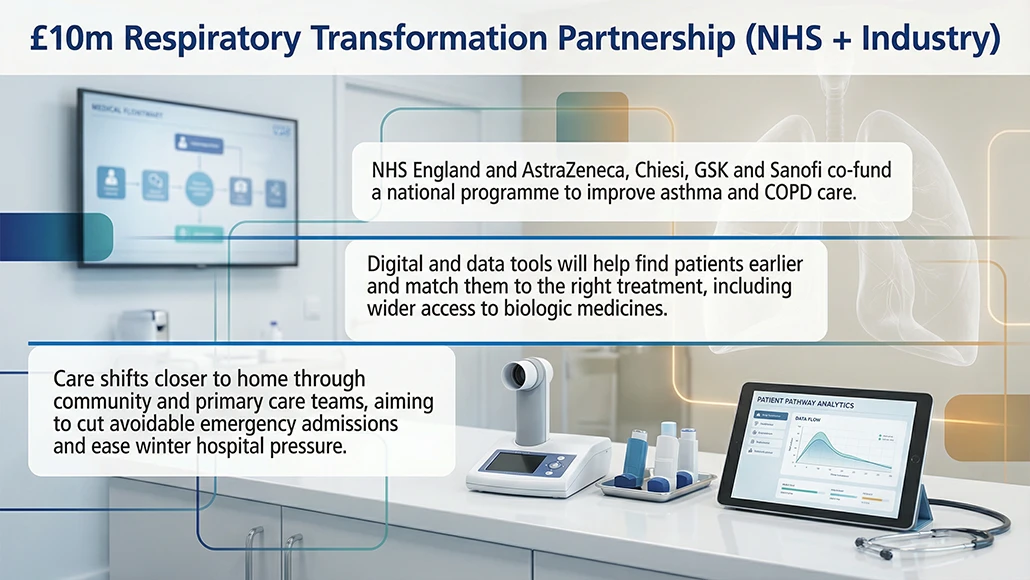
The NHS has partnered with leading pharmaceutical companies to establish a £10 million Respiratory Transformation Partnership, a coordinated programme designed to improve care delivery for asthma and chronic obstructive pulmonary disease (COPD) patients across England while easing systemic pressure on healthcare infrastructure.
The co-funded initiative brings together NHS England, the Office for Life Sciences, 15 health innovation networks, and pharmaceutical companies AstraZeneca, Chiesi, GSK and Sanofi. Structured as a multi-stakeholder collaboration, the Respiratory Transformation Partnership is positioned as a central component of the government’s broader healthcare reform agenda, with a focus on integrating data-led tools and decentralised care delivery models.
Programme scope and operational framework
The programme will deploy data and digital tools to identify patients who would benefit from more targeted treatments, expand access to biologic medicines, and enable community and primary care teams to manage patients closer to home. The initiative is designed to shift care pathways away from hospital-centric models, aligning with policy efforts to strengthen local and community-based healthcare services.
Respiratory disease remains the third leading cause of death in the UK, contributing to more than 700,000 hospital admissions and approximately six million inpatient bed days annually, the majority of which are unplanned. Around one in five people in England are expected to experience a respiratory condition during their lifetime, highlighting the scale of demand placed on healthcare systems.
Policy alignment and government position
Dr Zubir Ahmed, Health Innovation and Safety Minister, said: Too many people with asthma and lung disease end up rushed to hospital when, with the right care and support, that admission could have been avoided entirely. For far too long these patients have been let down because of a broken system.
This government is bringing together the NHS, industry and local health innovation networks to make sure patients get the treatment they need, closer to home, before their condition reaches crisis point.
This £10 million partnership is a concrete example of what our reform agenda looks like in practice – shifting care out of hospitals and into communities, using data to reach patients who have been missed, and working hand in hand with industry to get the best treatments to the people who need them most.
The programme aligns with the UK’s 10 Year Health Plan and Life Sciences Sector Plan, reinforcing collaboration between public health systems and private sector innovation providers.
Industry participation and strategic positioning
The partnership is chaired by Dr Jonathan Fuld, National Clinical Director for Respiratory Disease at NHS England, and coordinated by Health Innovation Oxford and Thames Valley on behalf of the Health Innovation Network.
Tom Keith-Roach, UK Country President, AstraZeneca, said: AstraZeneca is delighted to be joining the RTP to scale guideline-directed care across the NHS – bringing our scientific innovation and expertise in transforming care, to improve outcomes for people with asthma and COPD.
By uniting the NHS, clinicians, patients, industry and system partners, the RTP will cut avoidable exacerbations and reduce the burden of respiratory disease on patients, the NHS and the economy, advancing the ambitions of the 10 Year Health Plan and the Life Sciences Sector Plan.
System-wide impact and expected outcomes
The initiative is expected to reduce emergency admissions and alleviate pressure on hospitals, particularly during winter periods when respiratory conditions typically surge. By improving early diagnosis, enabling long-term condition management, and expanding access to innovative treatments, the programme aims to optimise resource utilisation across the NHS.
The partnership has secured backing from a wide range of clinical, academic and patient organisations, including Asthma and Lung UK, the British Thoracic Society, the Primary Care Respiratory Society, the National Respiratory Audit Programme, the Association of Respiratory Nurses, and the National Institute for Health and Care Excellence (NICE).
Jonathan Fuld stated: Around one in five people in England will be affected by respiratory illness in their lifetime and far too many are living with symptoms that are undiagnosed or poorly managed, often in communities that already face the greatest health challenges.
The RTP can be a blueprint for how partnerships between the NHS, charities, professional bodies, and pharmaceutical companies can deliver better outcomes for people in every part of the country by improving rates of diagnosis, providing ongoing care and advice in local, neighbourhood services, and offering innovative treatments that can keep people out of hospital.
Separately, NICE in January published draft guidance recommending eight digital platforms to support asthma management, reinforcing the broader policy shift toward digitally enabled care models.