








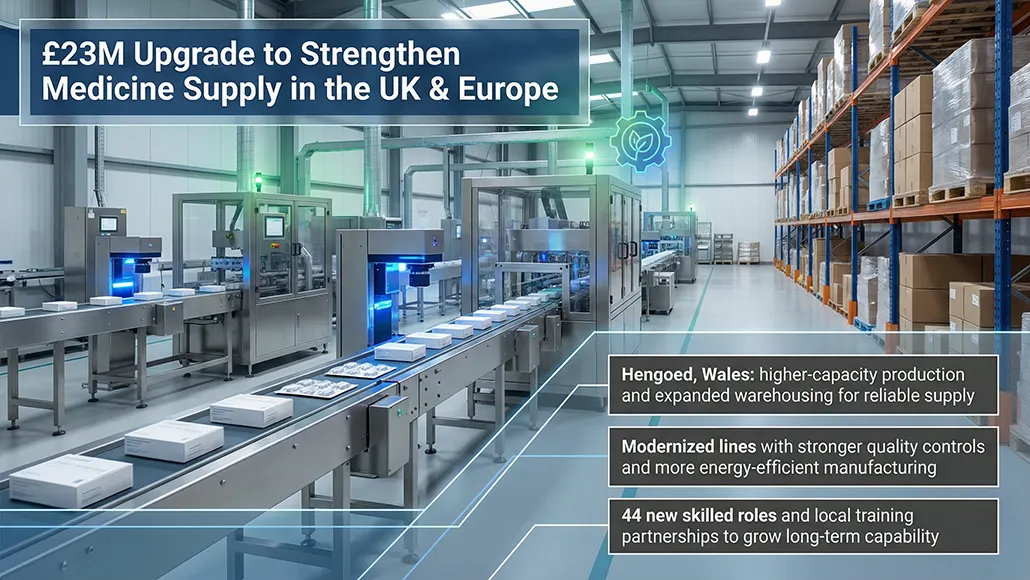
Norgine has confirmed a £23 million ($31 million) investment in its manufacturing facility in Hengoed, Wales, increasing the total capital directed toward the site to more than £50 million ($67 million) since 2022. The move is intended to strengthen the reliable supply of medicines across the United Kingdom (UK) and Europe while incorporating high-speed, energy-efficient production systems and enhanced quality control capabilities.
The Hengoed pharma facility, which currently manufactures approximately 50 million packs of medicines and medical devices each year, is undergoing modernization to ensure it can adapt to changing market requirements. Backed by the UK Government’s Life Sciences Innovative Manufacturing Fund, the expansion will increase both production capacity and warehousing space while supporting sustainable manufacturing operations powered by 100% low-carbon electricity. The site supports a portfolio spanning gastrointestinal, rare, and specialty conditions, including treatments used in areas from childhood cancer to common gastrointestinal disorders, and produces medicines for both Norgine’s own portfolio and its international in-licensing partners.
“At Norgine, we believe every scientific breakthrough should be able to reach the patients who need it, and innovative approaches to manufacturing and supply are a vital part of making that possible possible,” said Saulo Martiniano, chief operating officer, Norgine, in a company press release.¹ “By expanding and further enhancing our Hengoed facilities, we are increasing capacity, strengthening quality capabilities and investing in more energy-efficient production. We are proud of this investment, which will help bolster the resilience of UK and European health systems. With the enhanced capabilities at Hengoed, Wales, alongside our site in Dreux, France, and our broad network of manufacturing partners across Europe, we are well placed to navigate uncertainty and deliver medicines efficiently and consistently for years to come.”
Norgine also highlighted the importance of regional infrastructure and workforce development for long-term pharmaceutical manufacturing capacity. In Wales, current initiatives include the creation of 44 new skilled positions, contributing to a projected total of more than 75 permanent roles across manufacturing, quality, and warehouse functions. Partnerships with local colleges are supporting apprenticeship pathways, while student placements with Cardiff University are intended to help develop the next generation of technical talent capable of operating advanced manufacturing systems.
Secretary of state, Wales, Jo Stevens, stated in the press release,¹ “We have a thriving life sciences sector in Wales, and this investment from Norgine is a vote of confidence in our Welsh workforce. I am delighted that UK Government funding is supporting the business to continue to grow and create new well-paid jobs. Norgine is a brilliant example of an international business that is flourishing in Wales.”
Across the industry, broader investments in regional manufacturing infrastructure are also emerging as companies seek to reinforce supply chain resilience. Novo Nordisk has committed €432 million to expand a facility in Athlone, Ireland, illustrating a wider strategy to establish dedicated manufacturing hubs that can supply markets beyond the United States. By retrofitting existing infrastructure, the company aims to create additional capacity capable of meeting growing demand for GLP-1 products while strengthening a more redundant supply network.
The project in Athlone, expected to be completed between 2027 and 2028, is focused on expanding capabilities for oral product manufacturing through extensive retrofitting of existing facilities. The initiative is designed to enable skilled workforces to deliver high-quality treatments using environmentally sustainable processes. Kasper Bødker Mejlvang, executive vice president of Product Supply, Novo Nordisk, noted, in a press release, “With the investment in the Athlone facility, Novo Nordisk is expanding its production capacities for oral products, which will strengthen our ability to meet both current and future demand, outside the US.”
Such regional hub development reflects a broader strategy aimed at strengthening pharmaceutical supply resilience. By expanding production capabilities for oral products and upgrading existing infrastructure, companies can better manage global supply disruptions. Although the source material centers on the expansion in Ireland, the Hengoed pharma facility is positioned as a key hub supporting international markets and reinforcing the resilience of pharmaceutical supply chains serving the UK and Europe. Through these investments, the industry is working to maintain reliable manufacturing capacity and support the continued delivery of treatments for serious chronic diseases.