












Smartlab Europe

Real-World Effectiveness And Safety of Teduglutide in Adult Short Bowel Syndrome: A Meta-analysis

Note* - All images used are for editorial and illustrative purposes only and may not originate from the original news provider or associated company.

Subscribe

- Never miss a story with notifications

- Gain full access to our premium content

- Browse free from any location or device.

Media Packs

Expand Your Reach With Our Customized Solutions Empowering Your Campaigns To Maximize Your Reach & Drive Real Results!

– Access the Media Pack Now

– Book a Conference Call

Leave Message for Us to Get Back

Related stories

Structural Pricing Pressure is Reshaping Pharma in 2026

In 2026, global pricing pressure in the pharmaceutical sector has shifted from a temporary, cyclical issue to a structural constraint. Explore how U.S. reforms, European reference pricing, and biosimilar competition are forcing companies to embed pricing risk into core strategy.

Merck Targets $70B Revenue in 2026 with Cidara Deal

Merck’s roughly $9.2 billion acquisition of Cidara Therapeutics and its $70 billion revenue ambition mark a strategic pivot toward respiratory vaccines and antivirals. Explore how this deal reshapes Merck’s portfolio and signals a broader industry shift toward targeted M&A to offset patent cliffs.

U.S. Drug Pricing Reset Becomes Real in 2026

In 2026, U.S. drug pricing finally moved from policy debate to P&L impact. The first set of Medicare “maximum fair prices” and Most‑Favoured‑Nation–style reference pricing are reshaping pharma margins and launch strategies.
- Advertisement -

Randomized clinical trials have demonstrated that teduglutide, a glucagon-like peptide-2 (GLP-2) analog, improves intestinal absorption in patients with short bowel syndrome (SBS) with parenteral support (PS) dependence.1 Our objective was to assess real-world evidence of teduglutide effectiveness and safety in adult SBS patients with PS dependence in a real-world setting.

Methods
We searched PubMed databases for English language papers published through January 22, 2020. We completed a systematic literature review (SLR) to identify manuscripts (n=162) describing real-world evidence studies of teduglutide in adult SBS patients with PS dependence. Random effects meta-analysis of data identified in the SLR generated summary estimates, using the DerSimonian-Laird approach,2 for mean change in PS volume, mean change in PS infusion frequency, and percent of responders (≥20% PS volume reduction from baseline) by weeks 24 and 48 or end of follow-up (EOF). We also analyzed reported adverse event (AE) data. We present efficacy results as combined point estimates.

Results
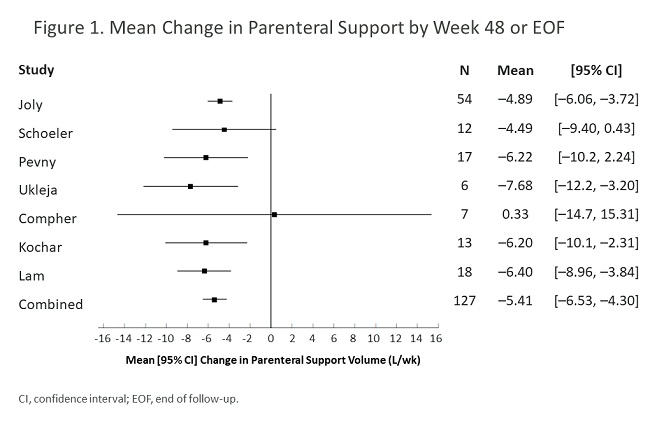
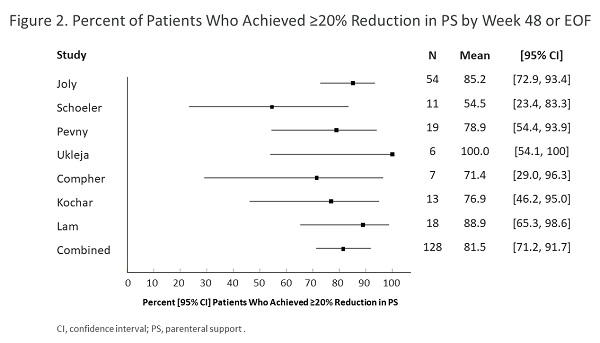
Seven studies involving 127 participants were included that investigated teduglutide. By week 24, PS volume changed by a combined point estimate (CPE) [95% CI] of –4.71 [–6.63, –2.79] L/wk and PS frequency changed by a CPE [95% CI] of –1.87 [–3.22, –0.52] days/wk. By week 48 or EOF, PS volume changed by a CPE [95% CI] of –5.41 [–6.53, –4.30] L/wk (Figure 1) and PS frequency changed by a CPE [95% CI] of –2.32 [–3.55, –1.09] days/wk. A CPE of approximately 70%-80% of patients responded (achieved ≥20% reduction in PS) to teduglutide by 24 or 48 weeks or EOF (week 48/EOF in Figure 2). AEs reported in 5 of 7 studies included abdominal pain (14.3%-50.0%), nausea/vomiting (7.7%-33.3%), catheter sepsis (16.7%-30.8%), and stoma enlargement in 50%-100% of patients with stomas. Four deaths were reported in 3 of 7 studies (none were associated with teduglutide per authors).

Conclusions
Although it is difficult to compare data from different settings, this meta-analysis of real-world data shows teduglutide efficacy was equal to or greater than that in randomized clinical trials for adults with SBS with PS dependence. Safety data appear comparable. Further research is needed on modifiable factors associated with best patient outcomes with teduglutide.

References
1. Jeppesen PB, Pertkiewicz M, Messing B, et al. Gastroenterology. 2012;143(6):1473-1481.e3.
2. DerSimonian R, Laird N. Control Clin Trials. 1986;7(3):177-188.
 

Latest stories

Related stories

Structural Pricing Pressure is Reshaping Pharma in 2026

In 2026, global pricing pressure in the pharmaceutical sector has shifted from a temporary, cyclical issue to a structural constraint. Explore how U.S. reforms, European reference pricing, and biosimilar competition are forcing companies to embed pricing risk into core strategy.

Merck Targets $70B Revenue in 2026 with Cidara Deal

Merck’s roughly $9.2 billion acquisition of Cidara Therapeutics and its $70 billion revenue ambition mark a strategic pivot toward respiratory vaccines and antivirals. Explore how this deal reshapes Merck’s portfolio and signals a broader industry shift toward targeted M&A to offset patent cliffs.

U.S. Drug Pricing Reset Becomes Real in 2026

In 2026, U.S. drug pricing finally moved from policy debate to P&L impact. The first set of Medicare “maximum fair prices” and Most‑Favoured‑Nation–style reference pricing are reshaping pharma margins and launch strategies.

White House-Big Pharma Tariff and Pricing Deals in 2026

In early 2026, the White House struck a series of tariff and pricing deals with major pharma firms, linking lower prices for GLP‑1 and other drugs to tariff relief and new distribution channels. Explore how these arrangements are reshaping U.S. pharma pricing, access and global spillovers.

Subscribe

- Never miss a story with notifications

- Gain full access to our premium content

- Browse free from any location or device.

Media Packs

Expand Your Reach With Our Customized Solutions Empowering Your Campaigns To Maximize Your Reach & Drive Real Results!

– Access theMedia Pack Now

– Book a Conference Call

Leave Message for Us to Get Back

Translate »